
Specs are compiled from manufacturer listings and verified buyer reviews and can change over time — please confirm the key details on the product page before buying.
Your 3S pack only lasts if its three cells stay even while they charge. A 3S pack is three cells wired in series (one after another), and when those cells drift apart, the pack loses punch and ages fast. Every pick below charges 3S packs with a real balance circuit (it evens out each cell as it fills), so you can plug in, trust the readout, and get back to driving or flying.
This guide is built by comparing the manufacturers’ published specifications and the patterns across verified customer reviews, so you get each pick’s real strengths and trade-offs instead of marketing spin.
Some of these units run off a wall outlet only, while others can also pull power from a car battery or a USB-C power bank at the track. Below you’ll find the honest differences between them, so you know which charger matches your bench and your battery bag. Use this breakdown of the 3s lipo charger field to choose with confidence today.
Top Picks


How To Choose The Best 3S LiPo Charger
A 3S pack holds three lithium cells in a row, nominally 11.1 volts combined, and every charge has to top those cells up together without letting one run ahead. That single job is what separates a charger worth owning from a pretty box that slowly wrecks your batteries. Here is what actually decides that outcome.
Balance current is the number to check first
Balance charging means the charger nudges each cell to the same voltage as it fills the pack. The speed of that nudging is the balance current, and a charger that balances quickly finishes a drifted pack instead of sitting on it for ages. If a 3S pack has been sitting a while, weak balancing shows up as a charge that never quite ends.
Wall power or car battery
An AC input lets you plug straight into a household socket on your bench. A DC input lets you run off a car battery or a field power source when you are out at the track. Plenty of these chargers do both, which is the flexible setup for anyone who races or flies away from home.
Match the charge current to your pack’s capacity
Charge current is measured in amps, and it needs to suit the battery, not just the charger. A charger that can push a lot of amps is only useful if your pack is rated to take it. Most 3S packs are happy at a comfortable rate, so a unit with an adjustable current range covers you as your battery collection grows.
Connectors and cables in the box
Your charger is only as useful as the plugs it can reach. XT60 is common on modern packs, Tamiya shows up on older RC cars, and Deans still lives on plenty of airsoft and car batteries. Check that the charger’s box includes the adapter leads you need, because a missing balance extension cable means a trip back to the store.
Side-by-Side Comparison
| Model | Best For | Max Charge Current | Input Power | Channels | Amazon |
|---|---|---|---|---|---|
| Traxxas 2971 EZ-Peak Live★ Best Overall | Traxxas owners who want app control | 12 A | AC 240 V | 1 | Amazon |
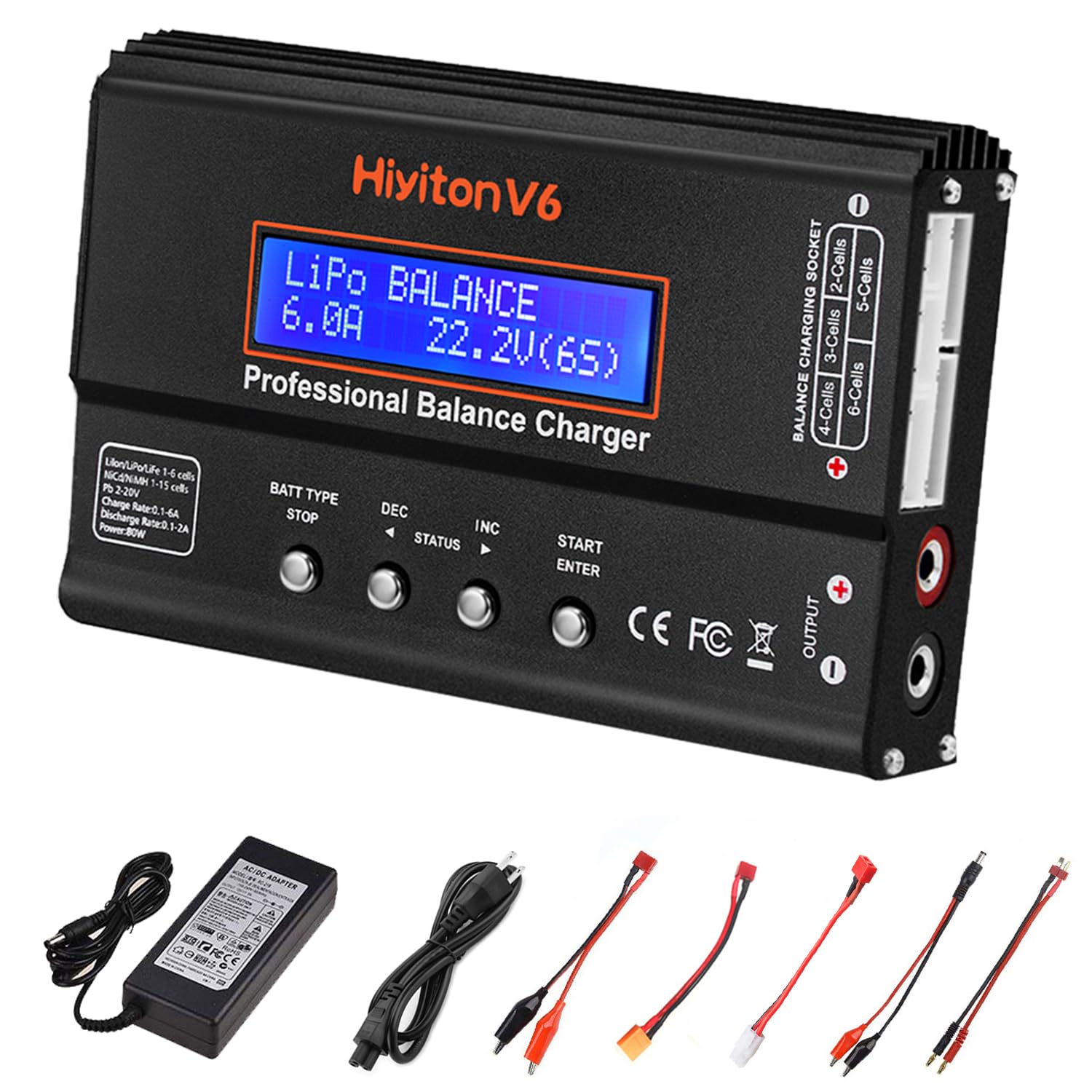
| Hiyiton 6A V6Balanced Value | Beginners with mixed connector packs | 6 A | DC 18 V | 2 | Amazon |
| SKYRC B6NeoField Favorite | Field charging from a power bank | 10 A | DC 28 V / PD 80 W | 2 | Amazon |
| Aorika Dual 10A | Charging two packs at once on a bench | 10 A × 2 | AC 100-240 V / DC 11-18 V | 2 | Amazon |
| HTRC Dual 16A | High-amp dual charging on a budget | 16 A × 2 | AC 300 W / DC 400 W | 2 | Amazon |
| Gens Ace IMARS D300 | Smart-battery simplicity with dual channels | 16 A × 2 | AC 300 W / DC 700 W | 2 | Amazon |
| OVONIC X1 Pro | Tinkerers who want firmware and precision tools | 16 A | AC 300 W / DC 700 W | 2 | Amazon |
| HOTA D6 Pro | Big screen and wide chemistry support | 15 A | AC 200 W / DC 325 W | 2 | Amazon |
Detailed Reviews
1. Traxxas 2971 EZ-Peak Live Charger
Our pick — 4.5+★ from 550+ verified ratings; the strongest balance of quality and price.
The app-friendly workhorse that reads your battery and sets itself up.
If your 3S packs carry Traxxas iD chips, this charger talks to them directly, so it already knows the cell count and chemistry the moment you plug one in. You skip the menu-navigation ritual entirely. That auto-programming is the whole charm here, and it makes this the strongest pick for a Traxxas-heavy battery bag at 4.5+ stars.
The output ceiling is real power for a 3S pack — a 12-amp charge current off a 100-watt supply. It charges 2s, 3s, and 4s LiPo packs, plus 5-8-cell NiMH, covering more than one machine in your stable. Owners praise the 12 A charge speed, and the balance-charging performance is the recurring reason this charger stays in their kit for years.
The Bluetooth app earns equal enthusiasm from owners who use it, showing live charge progress on your phone while the pack sits on the bench. The catch worth knowing: the auto-programming only open up with Traxxas iD batteries. If you run generic 3S packs, you set the charge manually and lose the headline feature. Several buyers on generics also feel the charger is expensive for what it delivers.
Why owners keep it
- Auto-programs any Traxxas iD battery for you
- 12 A output at 100 W charges a 3S pack quickly
- Bluetooth app shows live charge progress on your phone
- Handles 2s, 3s, and 4s LiPo plus 5-8-cell NiMH
Where it pinches
- Smart features require Traxxas iD batteries to shine
- Some find the price steep for a single-channel unit
Made for: Traxxas owners with iD-labeled packs who want to plug in and walk away.
Rather not: If your 3S batteries come from other brands, you pay for smart features you cannot use.
2. Hiyiton 6A Lipo Battery Charger
A connector-stuffed first charger that covers old rigs and new packs in one box.
Starters usually own a drawer of mismatched plugs, and this V6 arrives with Tamiya, XT60, Deans, and Futaba leads included. You are not buying extra cables before your first charge. For a beginner building a mixed RC stable, that single purchase saves a week of shopping.
The 6-amp ceiling is modest — about half the Traxxas unit’s 12 A — but it is enough for a standard 3S pack at home. It spans LiPo, Li-ion, and LiFePO4 all the way from 1S to 6S, so a 3S is well inside its comfort zone. An LCD screen shows the mode and the cells as they fill, and the smart chip guards against over-current, over-voltage, and short-circuit.
Here is the honest part. This charger has a habit of running warm under load, with heat being the one point the crowd raises as a genuine downside. Several also note the box lacks charging leads beyond the included plugs. The 4.0+ star showing across 700+ ratings says most people are satisfied, but you should plan on a small fan and check your battery’s connector before charging day.
Heat is the tax: A 6-amp charge on this unit runs noticeably warm, so give it air and do not stack it in a bag mid-charge.
Value where it counts: The included adapter set is the real draw — Tamiya, XT60, Deans, and Futaba in one package.
Good match for: A first-time owner with several connector types and a standard 3S pack to feed.
Give it a miss: If your packs are large and you want faster fills, the 6 A ceiling will feel slow.
3. SKYRC B6Neo Balance Lipo Battery Charger
At 82 grams, this charger slips into a pocket and runs from a USB-C power bank at the field.
The size is the story here. This unit measures 1.26 by 2.76 by 1.97 inches and weighs 82 grams, making it the most pocketable pick in this list by a wide margin. Compare it to the Aorika dual charger at 5.9 by 8.6 by 3.1 inches and the difference in bag space is obvious. You can toss it in a flight case without reorganizing anything.
Power is split two ways: 200 W through the DC input running at 10 A, or 80 W through a Type-C PD input at 5 A. The PD path is what makes it a true field charger — a power bank or USB-C wall brick gets you charging without a car battery. It handles 1S-6S LiPo, so a 3S is squarely in range, and an active balancer keeps your cells in line while the discharge mode tops out at 24 W.
The noise rating is 48 dB, which is a quiet bench companion rather than a screaming fan box. One thing to know before ordering: no AC adapter is included. The mixed feeling about power options in reviews centers on that — you supply the wall power or the USB-C PD source yourself. Once you supply the right USB-C PD brick, the 82-gram footprint keeps owners happy.
The field case: A power bank plus this 82-gram box gets your 3S pack charged at the track with no car battery in sight.
Bring your own brick: No AC adapter in the box, so budget for a USB-C PD supply on day one.
The right call for: Flyers and racers who want one tiny charger that works off USB-C PD power banks.
Look elsewhere if: You expect a wall adapter in the box — this one makes you supply it.
4. Aorika LiPo Battery Charger Dual 10A
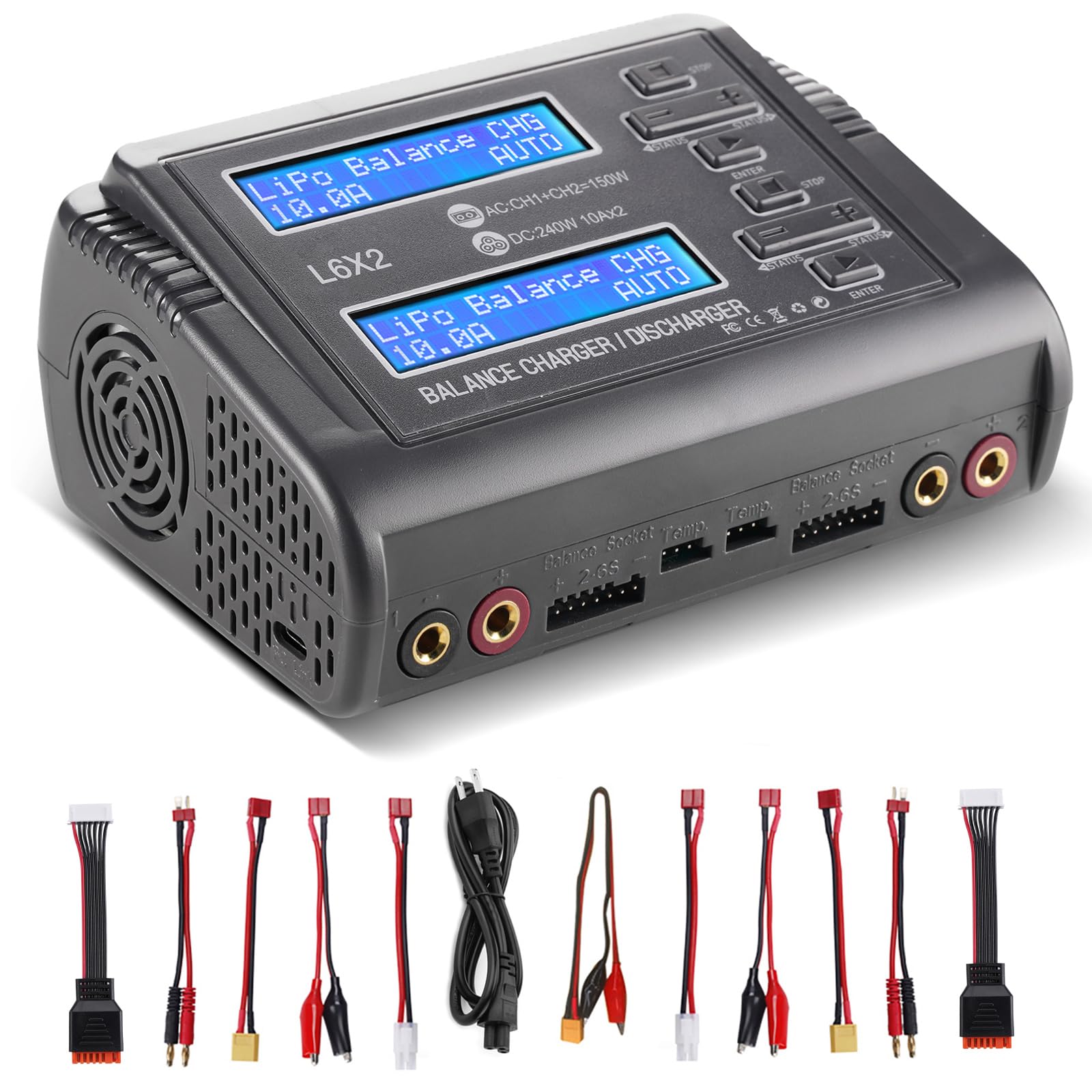
Two packs charging at once, so your next run is ready before the last one cools.
Two-channel charging is the headline. This Aorika can fill two separate batteries at the same time, each on its own channel at up to 10 A, and that keeps your track day turning. Owners cite the two 10 A channels as the specific reason this charger earns its spot on the bench.
Power comes in two ways: up to 150 W combined on AC (100-240 V) or 240 W combined on DC (11-18 V). It reads 1S-6S lithium packs including LiPo, LiHV, Li-ion, and LiFe, plus 1S-15S NiMH and NiCd. Twenty memory slots mean you can save a profile for each 3S pack and recall it without re-entering settings.
A large screen handles the mode and voltage adjustments, and it is light enough to carry between modeling competitions. The connectivity is the mixed spot — the box includes a generous pile of cables and harnesses, but joining them to certain battery plugs is less smooth than owners expect. Otherwise the value is strong, with good marks for how quiet it runs.
Hits the marks
- Charges two packs simultaneously on separate channels
- 20 memory presets for your saved battery profiles
- Large screen makes mode selection simple
- Runs quietly while charging
The snag
- Connecting certain battery plugs feels less than ideal
- Not the smallest unit — it needs bench space
Best when: You own several 3S packs and want two charging at once instead of waiting in line.
Pass on it: If your bench space is tight, this unit’s footprint is on the larger side.
5. HTRC LiPo Charger Dual
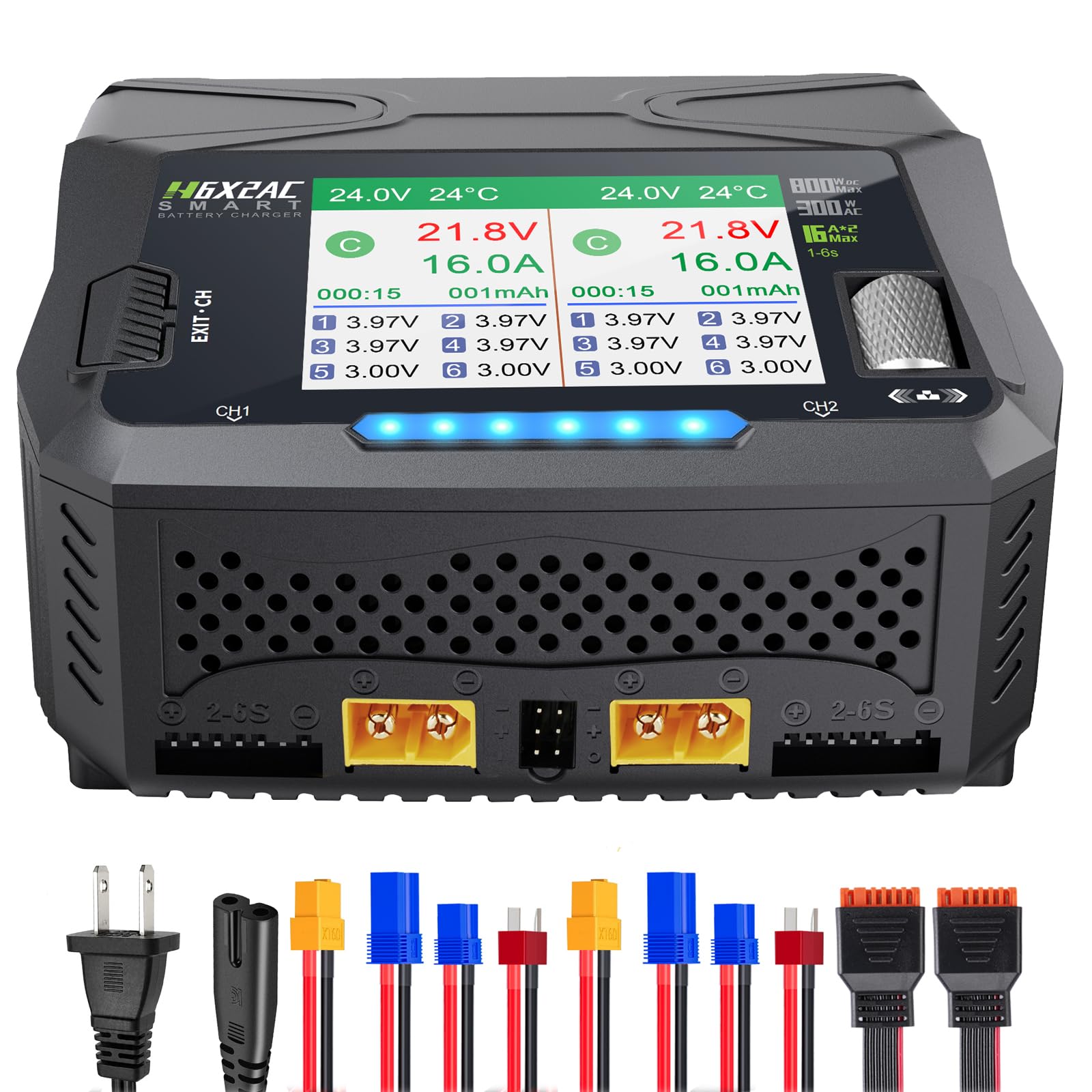
Massive dual-channel amperage that keeps a race weekend’s worth of packs ready.
For a 3S pack that has been sitting, balance current decides how fast those three cells equalize. This HTRC pushes a balance current of up to 1600 mA per channel, which finishes a drifted pack quickly. That figure is the one to notice if you own older batteries that tend to wander out of sync.
The raw output is the other draw. Two channels each hit 16 A off a 300 W AC or 400 W DC input, and the charger reads 1S-6S lithium plus 1S-15S NiMH/NiCd and 2-20V lead-acid. Only two buttons handle everything, and an auto function identifies the cell count once you are charging. Many reviews single out how easy the two-button setup is to operate.
Watch the durability signal, though. This is the one pick where a meaningful streak of reviews mentions the charger quitting after a stretch of use, and that honesty belongs in the decision. It still holds a 4.0+ star rating overall, and the 1600 mA balance current is genuinely strong. Treat it as a budget-paced performer rather than a long-term investment, and pair it with a spare.
Balance power is real: The 1600 mA balance current is the standout spec — it rescues drifted 3S packs that slow chargers leave stuck.
Longevity caveat: A chunk of owner experience points to the unit stopping after heavy use, so buy knowing you may replace it in time.
Designed for: Hobbyists running many packs who want high-amp dual charging without premium spend.
Think twice if: You want one charger to last many seasons — durability is the weaker point here.
6. Gens Ace IMARS D300 Smart Dual Lipo Charger
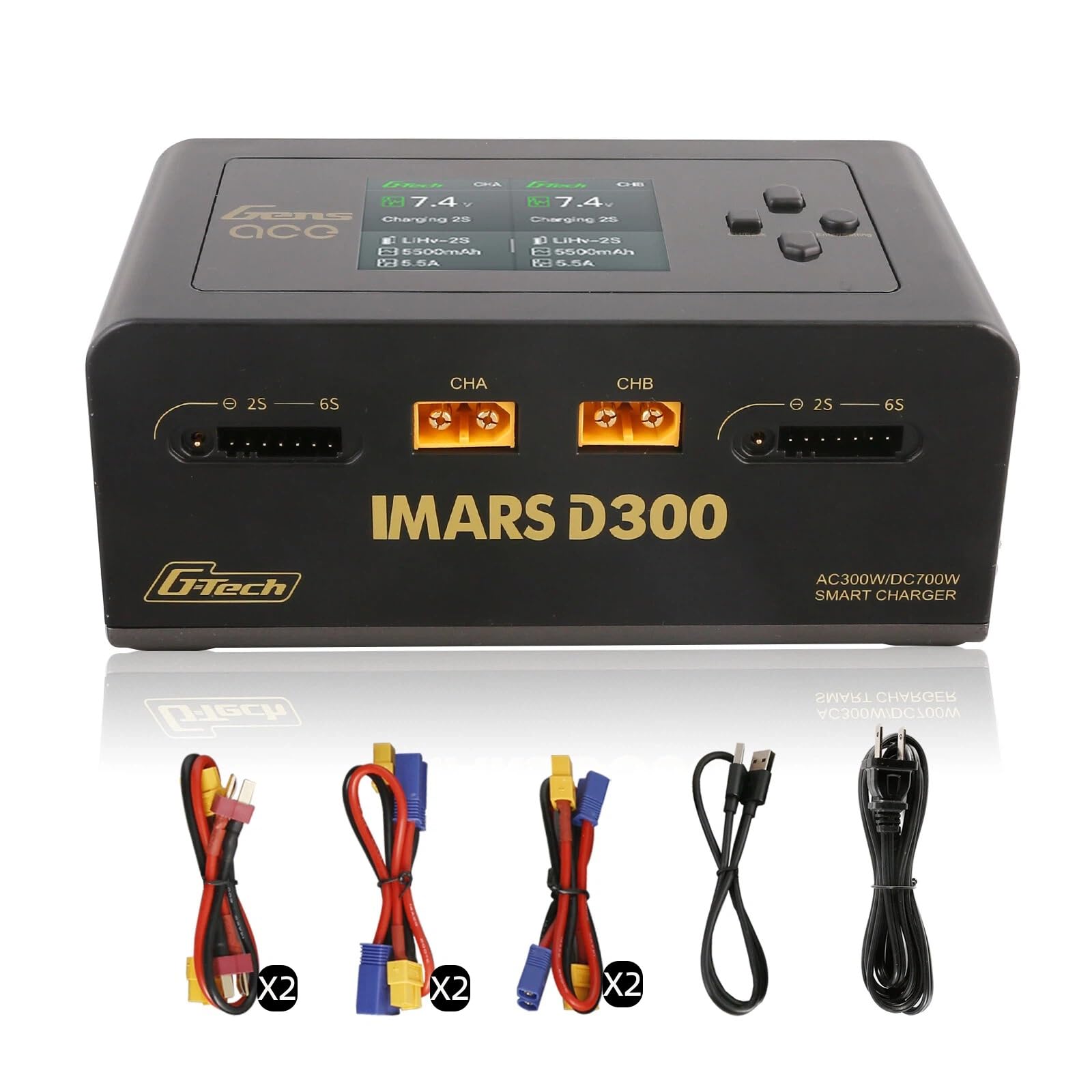
The dual-channel unit that reads a smart battery and sets itself, no menu dive required.
A built-in smart chip reads G-Tech batteries automatically and programs the charge for you, then stops when the pack is full. That is the headline convenience of the IMARS D300. With 16 A per channel across two channels and 7 operating modes, it is built for someone who wants speed without fiddling with settings each time.
The power ceiling is generous — a 300 W combined AC input that climbs to 350 W per channel on DC. It covers 1-6S LiPo, Li-ion, LiHV, and LiFe packs, plus 1-16S NiMH and NiCd, so a 3S charge is the easy end of the range. The 2.4-inch IPS screen shows the current task’s voltage, current, and time in real time. Owners single out the fast charging on 4S-6S LiPo packs as the reason they keep it in rotation.
One honest note: with 4.5+ stars across 300+ ratings, this is a well-loved charger. A sliver of buyers report failures after three months, which is why durability is the one mixed signal. Pair those reports against the overwhelming effectiveness praise and it reads as a rare bad unit rather than a pattern. The stock of included XT60 adapters for Deans, EC5, and EC3 also saves you a lead shopping trip.
Strong points
- Smart chip auto-programs G-Tech batteries
- 16 A × 2 channels on a 300 W AC input
- 2.4-inch IPS screen with live charge readout
- XT60-to-Deans, EC5, EC3 adapters in the box
Caveat corner
- An occasional unit fails within a few months of use
- Auto features work best with Gens Ace smart batteries
Take it home if: You want a smart, dual-channel charger that handles a big battery collection without setup stress.
Better elsewhere: If you only run plain non-smart packs and never need the auto chip, you are paying for convenience you will not use.
7. OVONIC X1 Pro Dual RC Lipo Battery Balance Charger

A data-packed charger for the tinkerer who wants resistance readings and firmware updates.
Some buyers want a charger that shows its work, and this one does exactly that. It reports resistance detection, temperature reading, capacity cutoff, safety timer, and accumulated charge times, with firmware you can update over time. If you like tuning your packing routine, the extra tools live here.
Owners mention the charging speed shines most on 2S and 3S packs, the balance for most RC cars and planes. It pushes 16 A (amps, the current flowing into your pack) from a 300 W AC wall input or a 700 W DC input, so a 3S pack tops up quickly between runs. It reaches 6S on LiPo, Li-ion, LiFe, and LiHV (high-voltage lithium) packs, plus 1-16S NiMH. Sync charging fills two packs at once, and the protection suite covers overvoltage, over-temperature, over-current, short circuit, and reverse polarity (wrong-way plug-in).
The honest trade-off is reliability spread wide in the reviews. While performance draws the most praise, a real slice of customers note units that quit or fail from the start. That lower-ceiling confidence is why this sits below the dual-channel leaders at 4.0+ stars. Buy it for the toolset and the fast 3S charging, and check the return window on arrival.
Tools for the curious: Resistance detection and self-test make this the choice for anyone who wants to inspect cell health, not just top up packs.
Reliability caveat: The failure reports are real enough to matter — test it the day it lands while the return window is open.
Fits the buyer who: Wants fast 3S charging plus deep metrics and firmware upgrades.
Not the best fit: If you want the safest long-term bet, this carries more reliability risk than the top picks.
8. HOTA D6 Pro Dual Channel RC Battery Charger
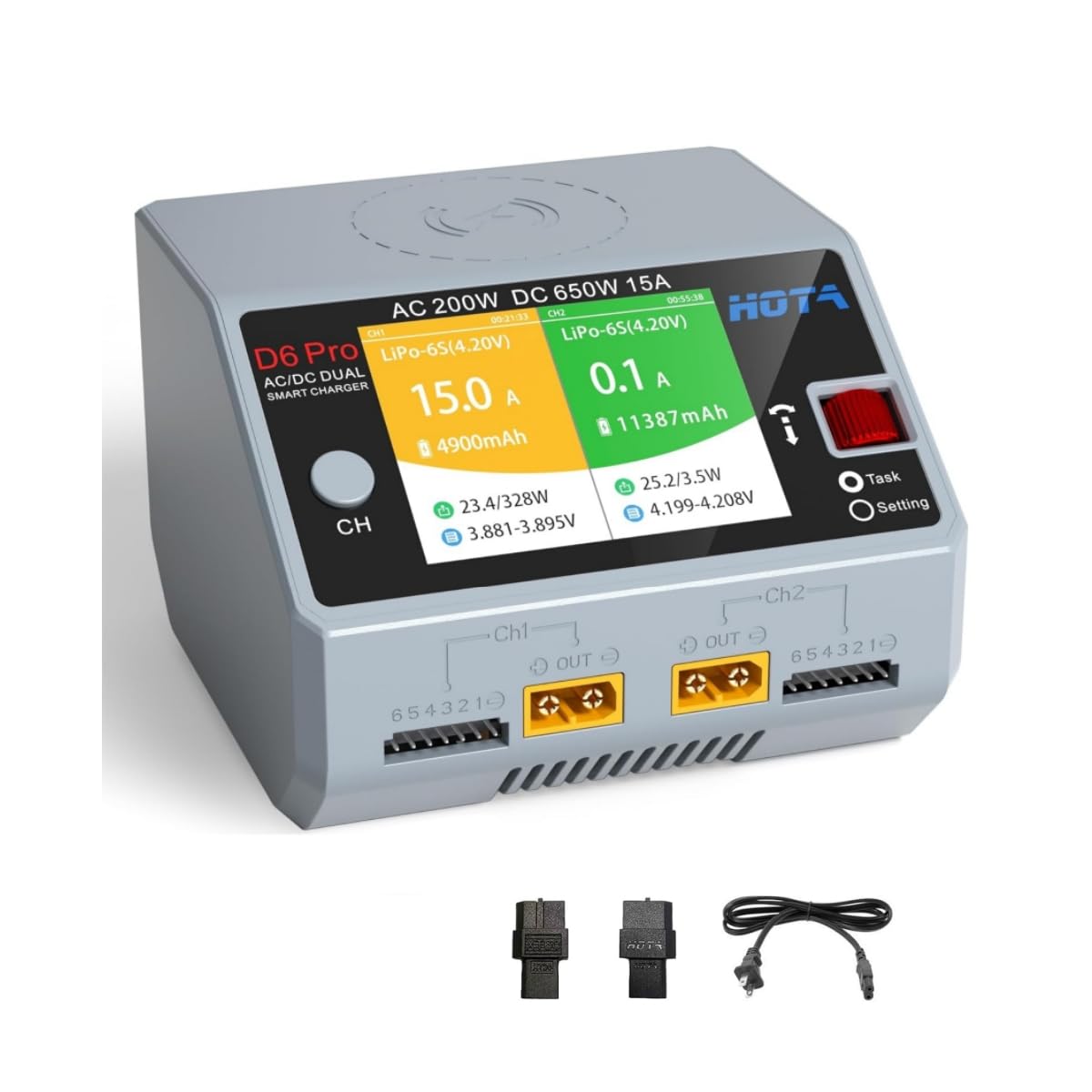
A wide-angle color display that makes reading charge status easy at a glance.
The screen is what you notice first. A large IPS panel with a wide viewing angle and true color keeps the charge data readable from across the workbench. For anyone tired of squinting at a tiny monochrome readout, this is the pick that solves that specific annoyance. It charges 15 A off a 325 W DC or 200 W AC input with power distribution between the two channels.
Chemistries are broad: 1-6S LiPo, LiFe, Li-ion, and LiHV, plus NiZn, NiCd, and NiMH up to 16S, smart batteries, lead-acid at 2-24V, and even Eneloop cells at 1-16S. The menu can be set to English, and the XT60-to-XT60 output lead is in the box. A dual-channel layout means two 3S packs get charged in one sitting. The all-in-one protection suite covers overheating, capacity, input reverse, short circuit, overcharge, and more.
The caveat to weigh: at 4.5+ stars, this is a strongly rated charger, but the AC power supply has a reputation for failing after a couple of months in a small handful of cases. It is not the majority experience, yet it is the specific weakness to know. If you charge mostly off DC, that concern is moot; if you rely on the internal AC supply, keep it in mind.
The display wins: That IPS screen is the reason to pick this one over a cheaper dual charger — the charge data reads clearly from arm’s length.
Power supply note: A small number of AC supplies fail early, so lean on DC input if your routine allows it.
Reach for it if: You want a wide, readable screen and support for an unusually broad spread of battery chemistries.
Consider a rival if: You plan to run mostly on the internal AC supply and want the strongest track record on that path.
Know the Specs
Balance current and cell count
Balance current is how fast the charger can equalize the individual cells in a 3S pack, measured in milliamps. Higher balance current finishes a drifted pack sooner. Cell count is expressed as the “S” rating — a 3S pack is three cells, and every pick here covers 3S. Watch the balance figure if you own older batteries that wander out of sync.
Charge current and watts
Charge current, in amps, is how fast energy goes into the pack. Watts describe the total power the charger can deliver, and the two work together — a 16 A charger with a big watt ceiling moves a large battery fast, while a 6 A unit is gentler. Always match the charge current to what your specific pack is rated to accept.
AC versus DC input
AC input runs off a household wall socket, which suits a home bench. DC input lets you charge from a car battery or field power source at the track. Chargers that accept both give you flexibility — one at home, one on the go. A USB-C PD input is a third path, letting a power bank power small chargers in the field.
Connectors
XT60, Tamiya, Deans, and Futaba are common battery plug standards. XT60 is widespread on modern RC packs; Tamiya shows up on older RC cars; Deans remains on many airsoft and car batteries. Check that the charger’s box includes adapter leads for the plugs you already own, or you will be shopping for cables before your first charge.
Common Questions
Will any of these chargers work with my 3S LiPo pack?
What is the difference between balance charging and normal charging?
Can I charge a 3S pack off my car battery or a power bank?
How much charge current should I use on a 3S pack?
Do I need to buy extra cables with these chargers?
Is a dual-channel charger worth it over a single-channel one?
What balance current actually matters for a 3S pack?
Can these chargers handle NiMH batteries too, not just LiPo?
Why does the AC power supply fail on some chargers?
The Bottom Line
For most home benches, the Traxxas 2971 EZ-Peak Live takes the crown because its auto-programming and Bluetooth app turn a chore into a plug-and-walk-away routine, and its 4.5+ star standing across 500+ ratings backs that up. If you want two packs filling at once with a giant readable screen, the HTRC Dual 16A delivers the most balance muscle of the group. And for a field bag charger that runs off a power bank, the SKYRC B6Neo at 82 grams is the one to toss in your pocket. Whichever you choose, charge in balance mode, watch the cell voltages, and your 3S packs will reward you with consistent punch for a long time.
How we choose
We do not accept paid placement. Every pick is matched to a real buyer and a real use-case; we do not hands-on test units.
Sources
Specifications: manufacturer listings and product documentation. Review insights: verified customer reviews, as of November 2026. Pricing: not shown on this page (it changes often); check the current price via the retailer link.
As an Amazon Associate, Gamepad Test earns from qualifying purchases. This does not affect which products we feature.