
Specs are compiled from manufacturer listings and verified buyer reviews and can change over time — please confirm the key details on the product page before buying.
A four-pack of long-range walkie talkies lives or dies on one thing: whether all four radios still talk to each other when the terrain turns ugly. The pack you buy is a group purchase, so a single dead charging dock leaves three people talking and one person stranded. This guide is built around that reality — how far each set really reaches, how long each battery genuinely lasts, and which four-packs come with matched batteries, matched chargers, and matched channels ready to go.
This guide is built by comparing the manufacturers’ published specifications and the patterns across verified customer reviews, so you get each pick’s real strengths and trade-offs instead of marketing spin.
Range claims on the box assume wide-open country with nothing in the way. In a real suburb, a forest, or a concrete parking garage, the practical distance is often a fraction of the advertised figure. That gap is exactly what this comparison of the best 4 Pack Long Range Walkie Talkie sets is designed to close for you before you spend anything.
Top Picks

How To Choose The Best 4 Pack Long Range Walkie Talkie
Buying four radios at once changes the math. You are not picking one good handset — you are picking a matched fleet that has to survive four people’s pockets, four charging cycles, and four chances for one unit to go quiet. Sort your shortlist on three things: real-world range, battery capacity in mAh (milliamp-hours, the fuel-tank size of the battery), and whether every unit in the box is identical.
Ignore the biggest range number on the box
Every long-range claim assumes open ground with nothing between the radios. Trees, hills, steel-framed buildings and even heavy rain all eat into that figure. A set rated for many miles in open country can drop to a fraction of that inside a warehouse. Judge a pack by whether owners describe it working through walls and woods, not by the headline number on the packaging.
Match your battery capacity to your shift
Battery life lives and dies by transmit time — the more you hold the talk button, the faster the tank empties. A radio with a bigger mAh battery holds more reserve for a long day. A smaller pack still works fine for short bursts. If you charge in a dock overnight, look for a set where each radio has its own charging base rather than a shared one.
Know your band before you buy two different packs
FRS radios (Family Radio Service, the license-free band) and GMRS radios (General Mobile Radio Service, which can use repeater towers for extra reach) use different rules. Some GMRS sets will not talk to FRS handsets at all. If you plan to mix a new pack with radios you already own, check the band first — a mismatch means four new paperweights.
Check the waterproofing and the clip, not just the speaker
An IP rating tells you how well a radio keeps dust and water out; IP67 is the sealed-against-dust, survives-a-dunk level. A good belt clip and an anti-slip body matter more than most shoppers expect, because a radio that pops off your hip into mud is out of the game. Look for drop-test claims and switchable high/low power if you work around other radio users.
Side-by-Side Comparison
| Model | Best For | Battery Capacity | Stated Battery Life | Water/Dust Rating | Amazon |
|---|---|---|---|---|---|
| Arcshell AR-5 4 Pack★ Best Overall | All-round family and job-site use | 1000mAh Li-ion | 18 hours | — | Amazon |
| Retevis RT21 4 PackRugged Pick | Rough outdoor trips | 1200mAh Li-ion | 12 hours | IP54 | Amazon |
| Retevis H777 4 PackPocket Pick | Pocket carry and tool belts | 1000mAh Li-ion | 12 hours | — | Amazon |
| 999S GMRS 4 Pack | Weather-aware road trips | 1500mAh Li-ion | 18 hours | IP54 | Amazon |
| Gaswei G1pro 4 Pack | Wet job sites | 1800mAh Li-ion | — | IP67 | Amazon |
| Midland LXT600VP3 4 Pack | Weather alerts on the trail | Rechargeable pack or 3 AAA | — | — | Amazon |
| Radioddity X1 4 Pack | Heavy-duty field crews | 2500mAh Li-ion | Up to 2 days | IP67 | Amazon |
| Midland T71VP3 4 Pack | Clear audio close in | 700mAh rechargeable pack | — | — | Amazon |
Detailed Reviews
1. Arcshell AR-5 Two-Way Radios 4 Pack
Our pick — 4.5+★ from 6,500+ verified ratings; the strongest balance of quality and price.
The four-pack that made everyone else match its charging dock and its earpiece.
The pick that wins this list does it on breadth: four radios, four 1000mAh Li-ion batteries, four chargers, four belt clips, four hand straps, and four earpieces with a mic and push-to-talk built into each one. Every radio ships with an identical frequency on each of its 16 channels, so any of the four can talk to any other the second you pull it from the start. The first tone that comes out of the built-in speaker is a synthesized voice naming the channel as you click the mechanical rotary switch to it — a small thing that saves a lot of squinting.
Range is the honest part of the spec sheet. Arcshell rates it at up to 5 miles with no obstructions, less in a congested area. What wins people over is that the practical version holds up in the places buyers actually work — the line-of-sight reception that reaches roughly two miles, and the clear audio that still cuts through heavy equipment at about a quarter mile. The sound quality matters as much as the reach: a radio you cannot hear over machinery is a radio you stop carrying. An upgraded USB Type-C port means you can top the battery up from a power bank or a car instead of hunting for the wall charger, and 2.5 hours gets a battery to full.
The catch is the battery and durability side, where owners are genuinely split. Some units run beautifully for a long time, and others report the battery quitting inside the first year. The redesigned battery contacts were clearly built to fix exactly that. Treat the plastic shell as a hand tool rather than a bulldozer — the belt clip and body feel solid, but reports of units breaking within days exist alongside reports of them being rugged and made to last. The overall picture is a 4.5+ star set backed by a deep base of owners, and for a four-pack that has to cover a family, a road convoy, or a small crew, it is the most complete box on this list.
What earns the crown
- Four matched 1000mAh Li-ion batteries plus four charging docks, so no one in the group is stuck without a charger.
- USB Type-C port lets you charge from a power bank or car; about 2.5 hours to full.
- 16 channels with an identical frequency on each from the start — no programming needed to start talking.
- Each radio comes with a single-earbud earpiece with its own mic and push-to-talk button.
Where it asks you to be careful
- Battery longevity is the splitter — the redesigned contacts address it, but treat charging with care.
- Range drops sharply in congested areas; the 5-mile figure is the open-air best case.
- Physical durability is mixed — fine around the house, less forgiving as a dedicated demolition-site tool.
Best for: families, road convoys, warehouse or kitchen crews who need four radios and four chargers ready on day one with zero setup.
Think twice if: you need a radio to survive daily drops on a construction site — the sealed, drop-tested industrial picks further down are built for that.
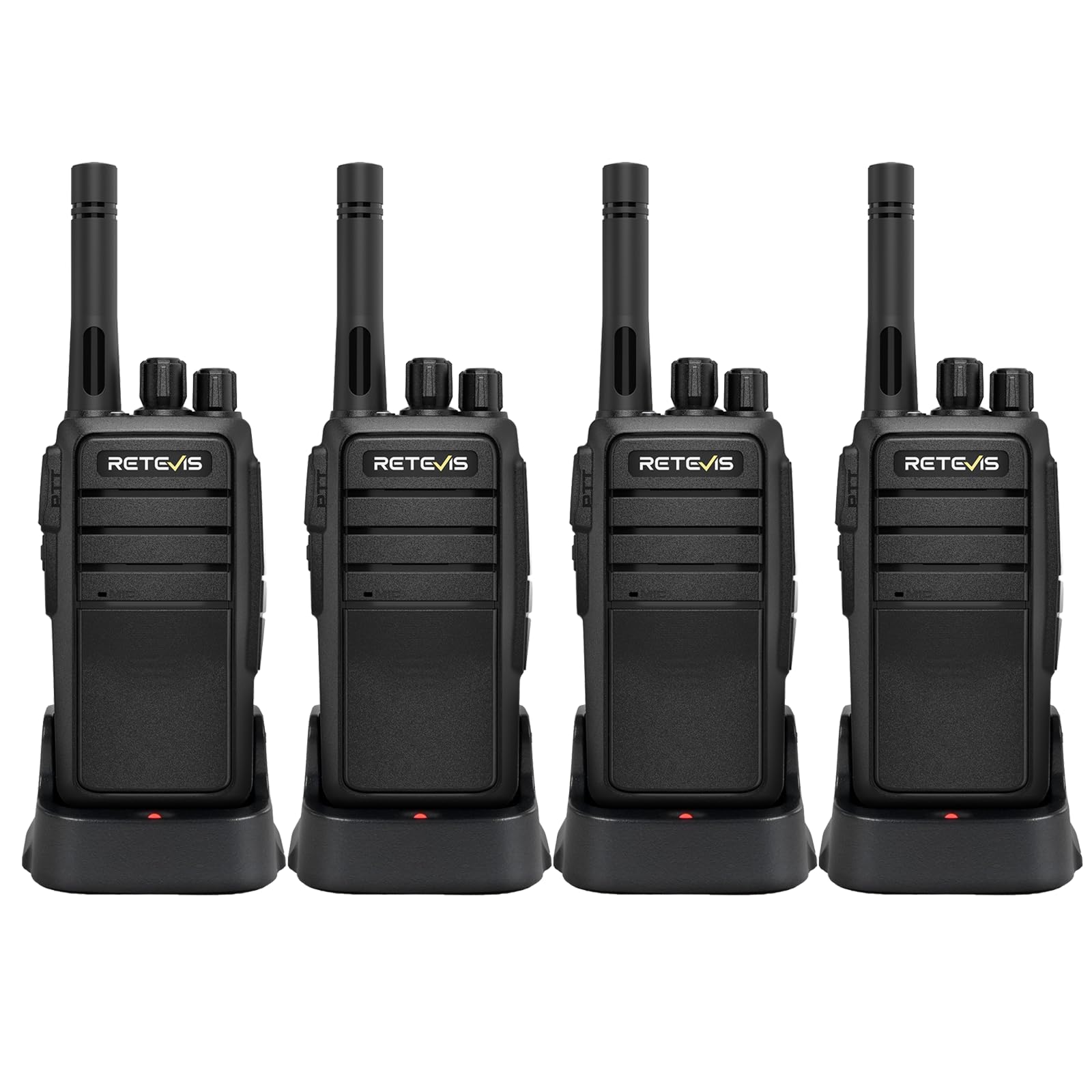
2. Retevis RT21 Walkie Talkies 4 Pack
Rated for 100,000 button presses and 1.2m drops, so a fumbled handoff on the trail does not end the trip.
Retevis built the RT21 for the trail and then made the battery work the way an all-day trip needs it to. The 1200mAh rectangular battery gets through 12 hours of use — that is a 20% larger capacity than the 1000mAh Arcshell cells above, and the reason this one keeps going across a full hike. A one-touch side key tells you out loud how much juice is left, so you are not guessing at dusk. USB-C charging from a power bank or car adapter means you can refill without the dedicated dock, and the walkie is rated IP54 (protected against splashing water and dust) for the weather you meet outdoors.
The listed dimensions run tall — 8.85 inches in height, which is about 2.2x the height of the Retevis H777. In practice that is the antenna and body making room for a bigger battery and a grip that fits a gloved hand. Retevis put it through 100,000 charging-plug cycles, high and low temperature tests, and 360° drops, and every unit ships pre-tuned to matching channels so it can sync with RT68 and older RT21 radios. Rated range is up to 3km (roughly 1.8 miles) in open terrain and about 1–2 km around buildings.
The honest wrinkle is that owners split on functionality and battery. Some radios work very well, especially inside the same building, and others stop altogether or only work intermittently. Durability draws a similar mix, with a rugged reputation on one side and one unit reportedly burning up after first use on the other. Treat this as a great outdoor radio that merits a quick recharge routine and a test in the store before a big trip. What earns the most praise is the build quality itself — that is the trait that sells this pack.
Where it shines: the 1200mAh battery and 12-hour runtime are the headline, and the spoken battery check is a genuinely useful touch you will use ever.
What to plan around: at 8.85 inches and 150 g it is the taller, heavier option here, so plan your carry around a belt clip or pack loop rather than a pocket.
Reach for this if: you want a drop-tested trail radio with a spoken battery check and a bigger battery than the Arcshell.
Look elsewhere if: pocket-size carry is your priority — the H777 is the one that disappears into a shirt pocket.
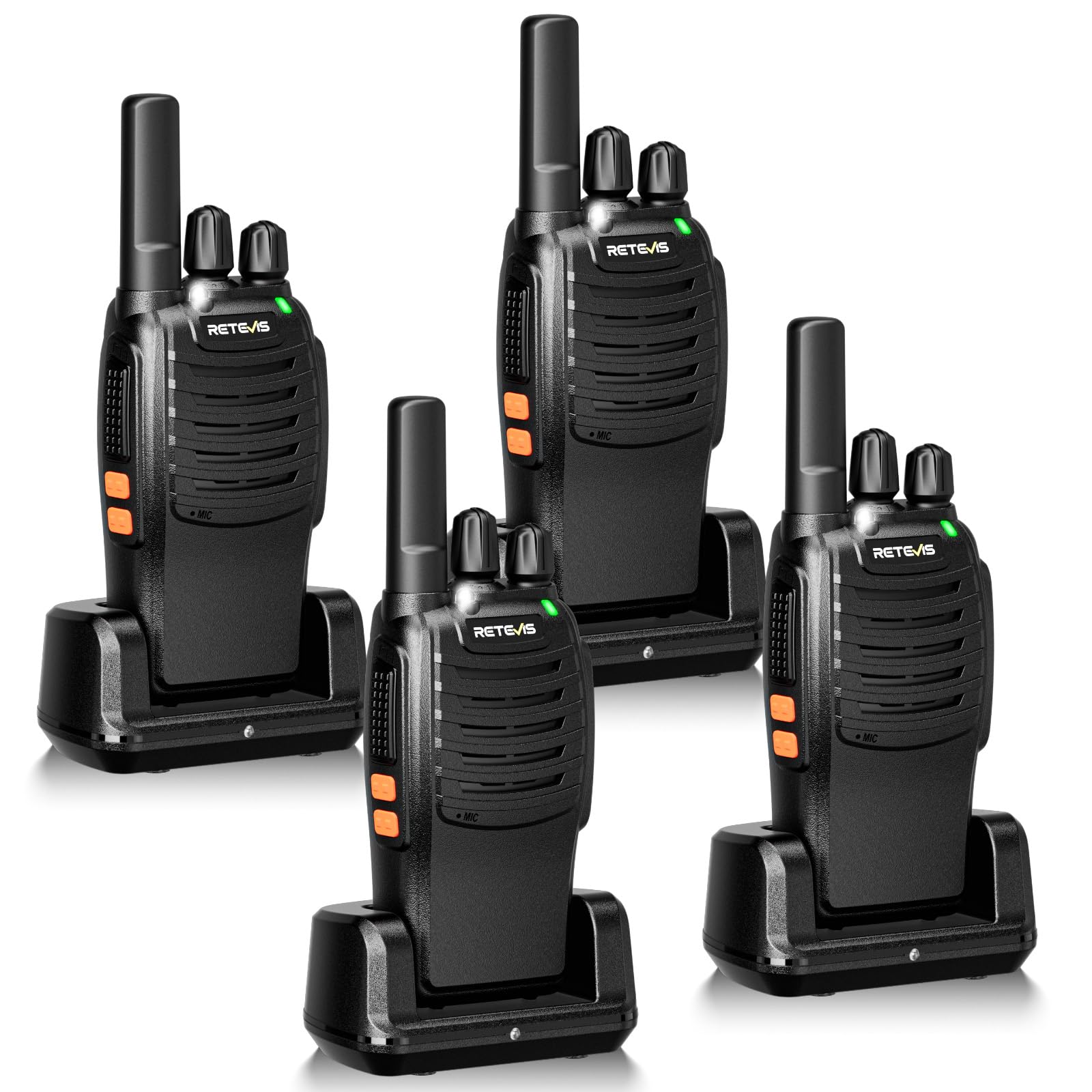
3. Retevis H777 FRS Walkie Talkies 4 Pack
A short antenna and a 115 g body that slides into a tool belt and stays there.
The number that defines the H777 is 4.02 inches in height — about half the RT21’s 8.85-inch frame — because the whole design philosophy here is carry-ability. It measures 1.34 inches deep against the RT21’s 1.18 inches, so the body is a little chunkier front to back despite being far shorter. At 115 g it is 30% lighter than the RT21’s 150 g, and that difference is the one you feel by the end of a shift. A short antenna and a rounded body mean it sits in a pocket or clips to a tool belt without snagging on everything you walk past.
Two charging routes ship in the box: a Type-C cable and a charging base, which is the difference between a dock you keep at home and a cord you keep in the truck. The 1000mAh Li-ion battery is rated for 12 hours of average use and up to 60 hours of standby, meaning the radio holds its charge while sitting in a bag waiting for the drive back. The fill-in features are more complete than the price tier suggests: VOX hands-free, an emergency alarm that sends a quick distress signal, a night flashlight, squelch, power saving, and one-key pairing. A useful extra is that the H-777 is built to be compatible with RT22, RT27, RT68, RT15, RT19 and RT21 radios once channels and sub-audio are matched.
The thing people praise most here is the build and function — the radios just work, including up to 3 miles in heavy woods and roughly half a mile to three-quarters of a mile in dense populated areas, with audio described as clear with no noise interference. The split shows up on durability, where the strong clips get credit but some units reportedly break within two months, and on battery life, where a few batteries die within weeks. Those reports sit inside a set that holds a 4.0+ rating across more than two thousand owners, so treat the trend as a small fraction rather than a rule. The honest read is a solid pocket radio that rewards a little care when you clip it on.
What sells the H777
- 4.02 inches tall and 115 g — pocket or tool-belt friendly in a way a longer radio is not.
- Both Type-C and charging-base options ship in the box, so you are never stranded for a cable.
- VOX hands-free, emergency alarm, night flashlight, and one-key pairing on a small radio.
- Cross-compatible with RT22, RT27, RT68, RT15, RT19 and RT21 radios once matched.
Where the trade-offs sit
- Durability is a mixed picture — a few buyers report breakage within two months.
- Battery life is the other split; not every 1000mAh pack holds up over time.
- Its reach is honest but modest in dense areas, roughly a half mile to three-quarters of a mile.
Pick it when: you want a light, short radio that fits a shirt pocket or a tool belt without being a lump.
Pass it over if: you need the largest battery in the group — the RT21’s 1200mAh and the Radioddity’s 2500mAh both carry more reserve.
4. 999S Walkie Talkies 4 Pack

A 1500mAh tank, a weather scanner, and headsets in the box for all four.
The 999S carries a 1500mAh Li-ion battery rated for up to 18 hours of typical use, with a 5-to-7-day standby under light use. That is 50% more capacity than the Arcshell’s 1000mAh cell up top, and it is why this set suits a full day out rather than a few hours around the house. The bigger draw is the NOAA Weather Radio feature, which automatically scans 10 weather band channels and pulls reports from designated stations. If your camping weekend or cross-state drive could turn on a storm warning, that is the reason to pick this radio over the others here.
Charging flexibility is the other quiet win. You can drop the radios on the included charging bases, or run a USB cable from a laptop, wall brick, power bank, or car — and the battery supports separate charging, so you can refill a spare off the radio. Three hours or less gets each battery topped off. The feature list runs long: an automatic scan, low battery alarm, TOT (a timer that cuts the transmit to protect the radio), squelch, VOX hands-free, and 260 privacy codes to mute other conversations. The body is PC/ABS plastic rated IP54 (splash and dust resistant), so light rain on a trail will not end the trip.
Two things are worth knowing before you order. First, these are GMRS radios, and they are explicitly not compatible with 888s, 777s, and 666s models — if you plan to mix in Radioddity or other packs, check the band. Second, the range and battery feedback is genuinely mixed. Owners are happy with the build and how sharp and clear the sound comes through, while some find the range inadequate and the battery shorter than promised. The working record is a solid set that most owners like — the trick is to buy it for what it is: a well-built weather-aware radio, not the far-tripper on this list.
The genuine draw: NOAA weather scanning plus a 1500mAh battery that holds 18 hours is a strong pairing for anyone who camps or drives far from home.
Don’t buy this to bridge old radios: GMRS-only means these will not talk to 888s, 777s, or 666s handsets — the mismatch is in writing, not a user error.
Best for: road-trippers and campers who want a storm warning on the radio before it arrives and a big battery to run all day.
Not the one for: anyone building a pack around a mix of older GMRS handsets — the 999S talks to its own kind, not to those.
5. G1pro IP67 Walkie Talkies 4 Pack

Sealed to IP67 and rated to shrug off a 2-meter fall when the site turns wet.
If you work outside in weather that does not care about you, the G1pro is built for that exact job. The IP67 rating means the radio is sealed against dust and survives being submerged, and the shock-resistant, slip-resistant body is rated to handle falls from up to 2M. The 0.5W (Lo) and 2W (Hi) output switch is the feature to understand: channels 1–7 and 15–22 carry more power for distance, while channels 8–14 run low power. Flip the switch for your situation and you save battery in the process. A 1800mAh rechargeable battery sits inside, and 22 FRS channels with 99 CTCSS tones give you up to 2,178 combinations to block other conversations.
A 2-port charging base with cable and adapter charges two radios at a time, and the ports run through Type-C, so a power bank or car charger works too. VOX hands-free, a vibration alarm, key lock, and headphone compatibility round out the controls. The same FCC-free FRS rules apply to this pack as to the other FRS picks here, so you do not need a license for family and job-site chatter.
Here is the fitting truth that a buyer deserves: range is this radio’s most-discussed trait, and the experiences divide. Some report strong reach and clear signals, while others find it will not work beyond a quarter of a mile. The 6-mile (or 25 floors) figure is the manufacturer’s open-air best case, not a promise for a busy suburban block. Value draws a similar split, and a few owners mention microphone trouble over time. What most owners agree on is the build quality, which is where this radio’s real money sits — it feels like a tool, not a toy. The 4.0+ rating across more than three hundred owners confirms the core is sound; just measure the range against your real terrain.
Why it earns the wet-site slot
- IP67 sealing plus a 2M drop rating for dust, water, and impact.
- Switchable 0.5W and 2W output — drop to low power on channels 8–14 to save battery.
- 22 FRS channels with 99 CTCSS tones, up to 2,178 combinations.
- 1800mAh Li-ion battery with Type-C charging and a 2-port charging base.
The honest fine print
- Range is the splitter — plan for well under the stated 6 miles in built-up areas.
- Value gets mixed reads, and a few units develop microphone issues over time.
- At 210 g it is the heaviest of the mid-range picks, so clip it rather than pocket it.
The right call if: rain, mud, and drops are part of your workday and a sealed IP67 body matters more than maximum range.
Wrong call if: you need reach over open ground above all — the Arcshell and RB48 Plus both have the range edge.
6. Midland LXT600VP3 FRS Two Way Radios 4 Pack

Two ways to power it on a long trip: the included rechargeable pack or three AAA batteries.
Midland’s LXT600VP3 earns its slot on one power choice the rest of this list does not give you: it runs on the included rechargeable battery pack, or you can drop in three AAA batteries if the rechargeable pack is flat. On a long road trip or a multi-day hike where there is no outlet, that swap is the difference between a radio and a dead weight. It carries 36 FRS channels with a channel scan feature so you can hear what is active before you settle on a channel, and the charger bundle ships with four radios, four belt clips, four rechargeable packs, two desktop chargers, and two AC adapters.
The NOAA Weather Scan plus Alert is the standout feature for the trail and the road. It scans 10 weather channels, locks onto the strongest, and sounds an audible alarm if severe weather is heading your way. On the privacy side, 121 CTCSS tones give you up to 2,662 channel options to block other conversations, and a silent operation mode turns off all tones for discreet work. The stated open-air range runs up to 30 miles, which is a number to hold loosely — as with every set here, it assumes clear terrain.
What to keep in mind is that a great radio needs the battery to back it up, and Midland does not quote a battery hour figure here. The AAA fallback is precisely the safety net for that. If you shop this set, the honest reason to buy it is the weather alert and the power flexibility, not the range figure. It is a calm, practical radio for the rig that returns home on Sunday night having kept its charge.
The feature that earns it: a NOAA weather scan and alert, plus 3-AAA fallback power, is a combination the other picks here do not offer.
The number that does not: no battery hour rating is stated, so plan around the AAA backup rather than a quoted runtime.
Suits you if: you want a weather alert on the trail and the reassurance of AAA batteries when the pack is empty.
Skip the swap if: you already carry a USB power bank — the 999S and Radioddity charge straight from one.
7. Radioddity X1 Waterproof Walkie Talkies 4 Pack
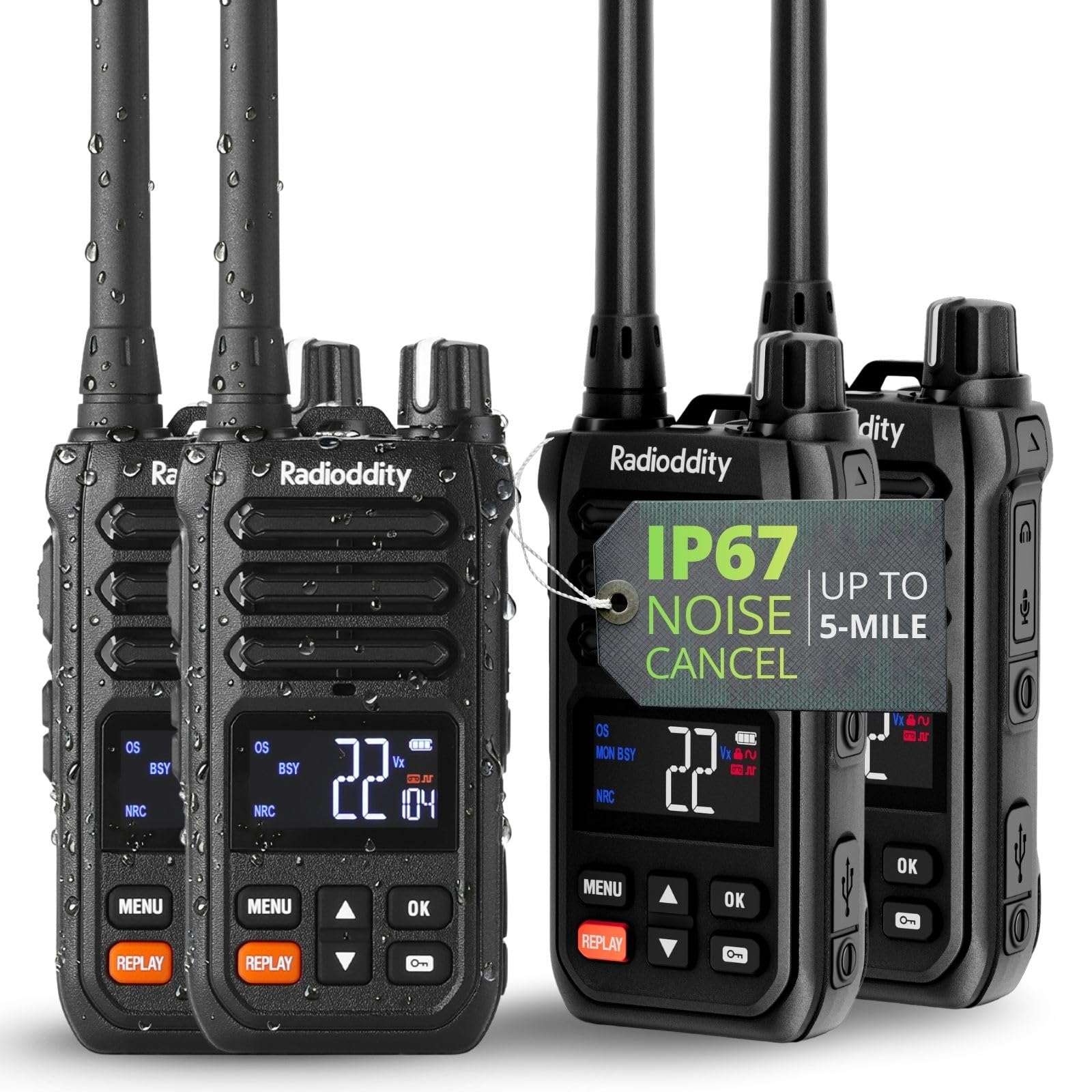
The 2500mAh battery that promises two days between charges on a field site.
Battery capacity is the deciding number here. The X1 packs a 2500mAh Li-ion cell rated for up to 2 days of use — the largest stated capacity on this entire list, ahead of the RT21’s 1200mAh and the 999S’s 1500mAh. USB-C charging from a wall adapter, car charger, or power bank means you can fill it wherever the truck is parked. For a logistics crew or a backcountry trip where a dead radio is a safety concern, that reserve is the feature to buy.
The durability claims are just as specific. The rugged ABS body is tested to handle over 1,000 drops. The IP67 rating seals it against dust and water, with the maker stating it survives 30 minutes of immersion and blocks particles down to 0.1μm. On the air side, Radioddity rates it at up to 5 miles in open areas or 2 miles in urban settings, with noise reduction applied on both transmit and receive — so your voice and the voice you hear both come through cleaner in a noisy environment. It ships pre-programmed with 22 FRS channels and 50 CTCSS / 105 DCS privacy codes, so you can talk on arrival.
Beyond the big two, the X1 carries NOAA weather alerts, an SOS alarm, VOX hands-free, an adjustable backlight, and a record-and-replay function that lets you catch a message you missed. The tradeoff to hold in mind is that this is a newer model with a much thinner review base than the Arcshell or H777 — the data is limited, so the 4.0+ rating reflects fewer owners. If you are buying for a crew that puts radios through real punishment, the sealed body, the huge battery, and the drop testing make it the strongest industrial-grade value here.
Why crews shortlist it
- 2500mAh battery rated for up to 2 days of use — the biggest stated capacity on this list.
- IP67 sealing with a stated 30-minute immersion rating and 1,000+ drop testing.
- Noise reduction on both transmit and receive keeps voices readable over site noise.
- Pre-programmed with 22 FRS channels, 50 CTCSS and 105 DCS codes, plus SOS and NOAA alerts.
Where caution is fair
- Thinner review base than the older picks, so long-term durability is less proven over time.
- The 5-mile range is the open-air figure — expect to lose distance in an urban setting.
Top of mind for: crews and backcountry users who want the largest battery and a sealed, drop-tested body in one radio.
Worth weighing if: you trust a long track record — the H777 and Arcshell offer far more years of owner feedback than this newer model.
8. Midland T71VP3 FRS Two-Way Radio 4 Pack
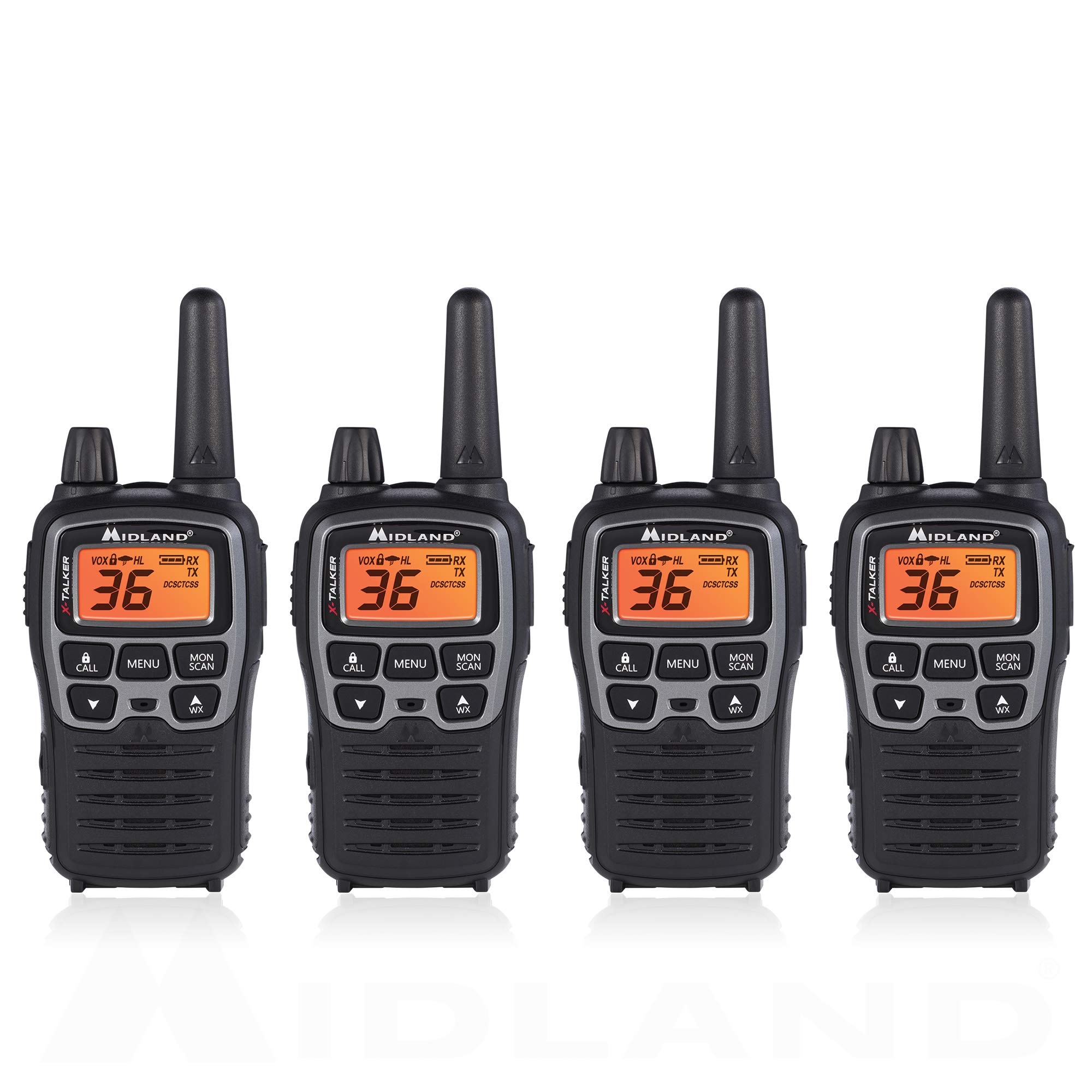
Clear voices carry this pack; the range claim carries the weight of expectation.
The T71VP3 puts its strongest card on the audio side. That is the thing owners agree on — the sound comes through clear. It runs 36 FRS/GMRS channels with channel scan, so you can hear activity before committing to a talk channel. Voice and Sound Activated Transmission, called eVOX, gives you hands-free operation for the moments your hands are full, and 121 CTCSS privacy codes deliver up to 2,662 channel options to mute competing conversations. A silent operation mode kills all tones when you need to move quietly.
The headline spec is a stated range of up to 38 miles in open areas with little or no obstruction. Here the honest part matters most: that figure is a clear-terrain best case, and many customers note the practical reach is limited to under a mile. NOAA Weather Scan plus Alert scans 10 weather channels, locks onto the strongest, and sounds an alarm when severe weather threatens. The box includes four belt clips, four rechargeable battery packs, two desktop chargers, two AC wall adapters, and two micro USB charging cables.
The trade-off is a real one. This is the oldest-school radio in the group, and its 700mAh battery packs are the smallest stated by any pack on this list. Battery life draws the most grumbling, and a few units reportedly stopped working after a couple of months, while plenty of owners find it an excellent, clear-sounding radio. Buy it for pristine audio and the array of privacy codes, not as a distance champ — and keep the chargers handy.
What sound is worth: clear audio and 121 CTCSS codes make this a quiet, professional-feeling radio when the chatter gets crowded.
The honest catch: the 700mAh packs are the smallest stated capacity here, and the range falls well short of the printed 38-mile figure in most real use.
Go for this if: audio clarity and privacy codes matter more than how far the signal travels.
Avoid the mismatch if: you want the honest long-range reach of the RB48 Plus or the X1 — that is not this radio’s strength.
Know the Specs
FRS and GMRS: your band and your license
FRS (Family Radio Service) is the license-free band most family packs use; GMRS (General Mobile Radio Service) is a related band that can add repeater towers for more reach and sometimes requires a license. The practical catch is compatibility: a GMRS-only radio may not hear an FRS handset, and the 999S carries an explicit warning that it will not talk to 888s, 777s, or 666s models. Check the band of your existing radios before you buy a new four-pack, or you may end up with four radios that cannot reach your bridge radio.
mAh and battery life: how big is the tank
mAh (milliamp-hours) measures how much charge a battery holds. A bigger number means a bigger reserve — across this list, the cells run from the 700mAh packs in the T71VP3 up to the 2500mAh cell in the Radioddity X1. Battery life in hours depends heavily on transmit time: a radio left mostly listening can last far longer than one where someone holds the talk button all shift. When a manufacturer quotes 12 or 18 hours, treat it as typical use, not a worst-case promise.
Privacy codes: muting the noise
CTCSS (Continuous Tone-Coded Squelch System) tones and DCS (Digital-Coded Squelch) tones are sub-audible signals that let only your group’s radios open the speaker. The claim on the box is high, and it is a genuine tool — 121 CTCSS tones giving up to 2,662 channel options is how the LXT600VP3 can cut competing chatter. What it does not do is give you a truly private frequency; it only filters what your radio plays, not what other radios hear.
IP ratings and drop testing: what survives
An IP rating has two digits: the first is dust protection, the second is water protection. IP67, the highest rating on this list, means sealed against dust and able to survive a short dunk. IP54 means splashes and light dust are fine, but a drop into a puddle is not. Drop ratings (the G1pro and RB48 Plus are rated to 2M, the RB48 Plus inside a 30-minute immersion) tell you how far the maker believes the body can fall. None of these guarantee your radio survives — they tell you the design intent.
Common Questions
Will an FRS walkie talkie talk to a GMRS walkie talkie?
How far will a four-pack of long range walkie talkies really reach in a suburb?
Do I need a license for a 4 pack of walkie talkies?
How long does the battery last on a four-pack walkie talkie?
Can I charge the radios in a four-pack at the same time?
What does the mAh number on a walkie talkie battery actually mean?
Are these walkie talkies waterproof enough for rain or a worksite?
Can I use the earpiece or headset and still hear incoming calls?
What is the difference between high power and low power channels?
Will a four-pack work inside a warehouse or across multiple floors?
How many walkie talkies can I add to the same group?
The Bottom Line
For most people, the best overall 4 Pack Long Range Walkie Talkie is the Arcshell AR-5 four-pack because four radios, four 1000mAh batteries, four chargers, and four earpieces arrive matched and ready — with a USB Type-C port that keeps them alive off a power bank. The crowd backs it: 4.5+ stars from thousands of owners is the deepest track record on this list, and for a group purchase that matters more than a single spec on the box.
If your workday is measured in warehouse floors rather than open miles, grab the Retevis RB48 Plus — 30-floor coverage, an IP67 triple-proof body, and a 5-year warranty. And if rain, mud, and dropped radios are the daily reality, the Gaswei G1pro seals to IP67 and shrugs off 2-meter falls without giving up FRS simplicity.
One real nudge before you commit: the pick you already trust has the deepest pool of owner experience behind it, and in a category full of inflated range claims, that history is the most reliable specification you can buy.
How we choose
We do not accept paid placement. Every pick is matched to a real buyer and a real use-case; we do not hands-on test units.
Sources
Specifications: manufacturer listings and product documentation. Review insights: verified customer reviews, as of November 2026. Pricing: not shown on this page (it changes often); check the current price via the retailer link.
As an Amazon Associate, Gamepad Test earns from qualifying purchases. This does not affect which products we feature.