
Specs are compiled from manufacturer listings and verified buyer reviews and can change over time — please confirm the key details on the product page before buying.
Here is the short answer: buy a 50 Amp GFCI breaker that physically matches your panel, because a ground-fault breaker for a hot tub, spa, or EV charger is only as good as its fit. The Siemens QF250A is the crowd favorite — 4.5+ stars across 800+ ratings — and it is the safest default for most 2-pole 240-volt circuits in Siemens QPF panels. Everything below sorts out the panel-brand trap, the trip-class difference, and the honest reliability trade-offs so you can pick in a few minutes.
This guide is built by comparing the manufacturers’ published specifications and the patterns across verified customer reviews, so you get each pick’s real strengths and trade-offs instead of marketing spin.
A 50-amp GFCI breaker cuts power the moment it senses a ground fault, which is why it belongs on wet-location circuits like spas, kitchens, and 240-volt EV charging runs. Here is how to choose the right 50 Amp GFCI Breaker without guessing at your panel brand.
Top Picks


How To Choose The Best 50 Amp GFCI Breaker
Your breaker purchase hinges on three plain facts: which panel it clicks into, how much fault current it can safely interrupt, and what grade of ground-fault protection your appliance needs. Get the panel match wrong and the breaker will not seat, no matter how good the internals are.
Your load center decides the brand, not your preference
A breaker from one family will not clip into another family’s panel. Siemens QPF and QE types belong in Siemens panels. Square D Homeline breakers belong in Homeline load centers. Square D QO breakers belong in QO load centers and CSED or NQOD panel boards. Eaton BR and GFTCB types fit their own panel families. Read the label inside your panel door before you shop, and buy only a breaker that lists your panel by name.
Personnel protection versus equipment protection
Most 50-amp GFCI breakers here deliver Class A protection, which is the personnel grade meant to interrupt a ground fault fast enough to protect a person. A rare few are equipment-protection breakers rated at 30 mA of ground-fault sensitivity, built to guard a downline appliance from line-to-ground damage. Match the class to the job: a spa or hot tub generally wants Class A, while a specific piece of equipment may call for the 30 mA version.
The interrupting rating is your safety ceiling
A 10,000 AIC rating is an interrupting rating: it tells you the largest short-circuit current the breaker is built to shut off safely. Most residential panels sit comfortably under that ceiling, which is why nearly every pick here carries a 10 kA rating. When you are choosing between two breakers that both fit, a higher interrupting rating is the one spec that never hurts.
Side-by-Side Comparison
| Model | Best For | Poles | Interrupting Rating | Panel Family | Amazon |
|---|---|---|---|---|---|
| Siemens QF250A★ Best Overall | Most 240-volt circuits | 2 | 10,000 AIC | Siemens QPF | Amazon |
| Square D HOM250GFICBest for Homeline Panels | Homeline panels and EV chargers | 2 | — | Homeline | Amazon |
| Square D QO250GFICPBest for QO Load Centers | QO load centers | 2 | 10,000 AIR | QO | Amazon |
| Siemens QF250AP | Value on a Siemens panel | 2 | — | Siemens QPF | Amazon |
| Square D HOM250GFICP | Upgrades in Homeline centers | 2 | — | Homeline | Amazon |
| Eaton BRN250GF | Eaton BR panels with pigtail neutral | 2 | 10 kAIC | Eaton BR | Amazon |
| ABB THQL2150GFT2P | GE/ABB Q-line panels | 2 | — | ABB Q-Line | Amazon |
| Eaton GFTCB250 | Two 1-inch-space installs | 2 | 10 Kaic | Eaton GFTCB | Amazon |
| Siemens QE250 | Equipment protection | 2 | 10,000 AIC | Siemens QE | Amazon |
Detailed Reviews
1. Siemens QF250A Breaker Ground Fault Circuit Interrupter
Our pick — 4.5+★ from 850+ verified ratings; the strongest balance of quality and price.
The default pick for a spa or EV run that needs Class A protection without fuss.
The number that earns this breaker the top spot is a 10,000 AIC interrupting rating — the largest short-circuit current it is built to shut off safely, which covers the fault levels of ordinary household panels. It is a double-pole 50-amp breaker rated 240 volts, so it feeds the two hot legs a hot tub or EV charger needs instead of a single 120-volt leg. And it carries Class A GFCI protection, the personnel grade, with self-test built in as UL 943 requires, so the breaker checks its own ground-fault sensing on an ongoing basis.
What wins people over is straightforward function: buyers report it handles 40A EV chargers and hot tubs without nuisance tripping. Installation is another bright spot — owners describe it as easy to seat, and fit and compatibility reports come back clean. Quality and value run right behind, so you are not paying a premium for a part that feels flimsy in the hand.
The catch is durability, and that is the one area where opinions split. Some units clearly run for years, while a share of owners mention a damaged unit arriving or a breaker that ages out early. Protect yourself with the basics: inspect the unit the day it lands, and keep your receipt. This is also a Siemens QPF-family breaker, so it belongs in a Siemens panel — measure before you commit.
What earns the top slot
- 10,000 AIC interrupting rating covers residential fault levels
- Class A GFCI protection with self-test per UL 943
- Double-pole 50-amp, 240-volt build for spas, hot tubs, kitchens, and EV chargers
- Installation described as straightforward by most owners
Where it asks for care
- Durability is the split topic — a few units arrive damaged or fail early
- Locked to the Siemens QPF panel family
Go with it if: you have a Siemens QPF panel and want the most proven Class A 50-amp GFCI on the shelf.
Look elsewhere if: your load center is a Homeline, QO, or Eaton panel — a fit mismatch here is a non-starter.
2. Square D HOM250GFIC Two Pole GFCI Circuit Breaker
The 2-pole 50-amp Homeline breaker that EV owners keep coming back to.
If your panel says Homeline on the door, this is the breaker that fits and performs. It is a 2-pole, 50-amp GFI plug-in breaker rated 240 volts, and it seats directly into a Homeline load center. At 1.2 pounds it is a solid, hand-filling part — and it is modestly heavier than the Siemens QF250AP at 1.1 pounds, so you can feel the difference in build heft before it ever goes in.
Reliability is the theme the review pages circle back to, and it holds up across both residential and commercial installs. Versatility runs close behind, with owners putting it to work on EV chargers and everyday heavy loads alike. Installation draws clean marks too — it drops in without drama for anyone who has swapped a breaker before.
Two fair caveats. Value is a split conversation: plenty call it well worth it, while a share feel the price stings for a single breaker. Durability is also mixed, with a few units tripping early. Both are the kind of fit-note you weigh, not a reason to walk. One practical detail the listing makes plain: returns on this one are limited to exchange only.
Why Homeline owners pick it: a guaranteed fit, a flexible 2-pole 50-amp 240-volt build, and reliability that carries the reputation.
The honest friction: value and durability both draw split opinions, and the exchange-only return policy means you want to get the fit right the first time.
Reach for this if: you are working in a Homeline load center and want the breaker most owners trust for EV charging.
Look elsewhere if: you need a refundable, no-questions return — this one is exchange only.
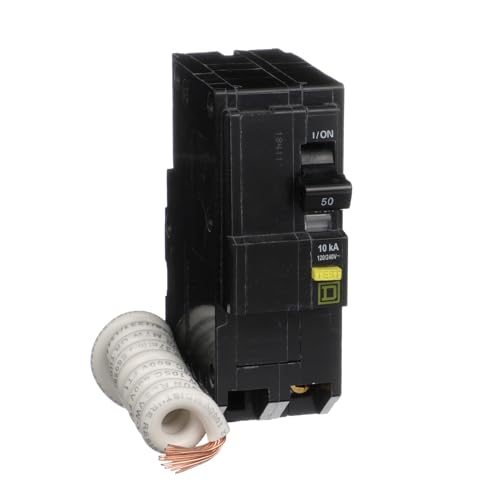
3. Square D QO250GFICP QO 50-Amp Two-Pole GFCI Breaker
The Qwik-Gard plug-on breaker that seats cleanly in QO load centers, CSEDs, and NQOD boards.
If your panel door lists QO load centers, CSED units, or NQOD panel boards, this breaker drops right in. It is a QO Qwik-Gard 50-amp two-pole GFCI breaker rated 120/240 VAC, plug-on by design, and rated for 10,000 AIR (a measure of how much fault current it can safely interrupt). At 14.4 ounces, it is the lightest breaker in this lineup — the Eaton BRN250GF weighs 16 ounces, and you will feel that difference when holding one up to a crowded panel.
Functionality is what carries this one — customers note it does exactly what it should in the panel. Quality feedback lands strong and consistent, with buyers describing it as just as advertised. Fit is another clean mark: it seats properly in QO centers with no shimming or forcing. Installation round out the praise, and a good chunk of owners frame the whole package as solid value.
The trade-off is narrowness. This breaker is loyal to the QO family, and that is the whole point — it will not serve a Homeline or Siemens panel. If you are already inside a QO system, there is no guesswork here.
The QO-fit strength: Qwik-Gard plug-on design, listed for QO load centers, CSEDs, and NQOD boards, with a 10,000 AIR rating behind it.
What it will not do: cross over to another panel family. Match the panel first, then buy with confidence.
Best matched with: a QO load center, CSED, or NQOD board where fit is already confirmed.
Worth a second look if: your panel is a different brand — this one stays in its lane by design.
4. Siemens QF250AP Double Pole Type QPF GFCI Circuit Breaker
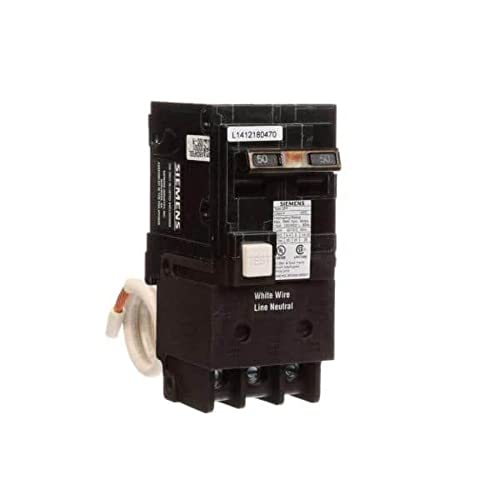
A 50-amp, 2-pole Siemens QPF breaker priced below the QF250A.
This is the same QPF family that makes the top pick so trusted, in a 50-amp, 2-pole, 240-volt plug-in build. Think of it as the quieter sibling: same Siemens panel language, same double-pole format, and a straightforward parts spec. It weighs 1.1 pounds, which puts it just under the Homeline HOM250GFIC at 1.2 pounds — a subtle difference you will notice more in your hand than in the panel.
Where the QF250A carries the spotlight reputation and the deeper review history, this QF250AP is the value play inside the same ecosystem. If your panel is a Siemens QPF, you get the fit without overreaching on the spend. The appeal here is simplicity: a clean install, a known family, and no bells you will not use.
The honest limit is visibility. Match your panel, confirm the QPF type, and this is a sensible buy.
Pick it when: you want Siemens QPF fit and a price that sits below the more heavily reviewed QF250A.
Pause if: you would rather lean on a deeper pool of owner experience — the QF250A is the better-reviewed sibling.
5. Square D HOM250GFICP Two-Pole GFCI Circuit Breaker
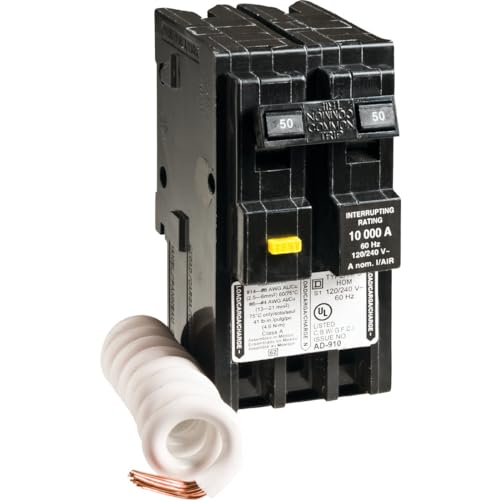
The Homeline upgrade with copper components and a sturdy black housing.
If you already have a Homeline load center, this breaker mounts directly into it for a secure fit. It is a 50-amp two-pole GFCI breaker rated 240 volts. The construction notes call out copper components and a sturdy black housing — internal details that speak to the build quality.
The dual-pole configuration carries 240-volt loads, so it handles the larger appliances and demanding circuits that single-pole breakers simply cannot. Setup is designed for both new installs and upgrades, and the plug-in mounting keeps the swap familiar for anyone who has worked a Homeline panel before.
Where this sits honestly: it carries a strong track record but a thinner one than the more-reviewed HOM250GFIC in position 2. If you value the copper-component build and the compact plug-in handling, it is a clean choice. If you want the most battle-tested Homeline feedback available, the other Homeline pick has the deeper history.
Build notes worth knowing: copper components, a durable black housing, and plug-in mounting into Homeline load centers.
The fair comparison: the HOM250GFIC has the longer review trail and lighter weight, while this one leans on its construction spec.
Best when: you are upgrading a Homeline center and want the copper-component construction spec.
Consider the alternative if: you would rather buy the Homeline breaker with the broadest owner feedback.
6. Eaton BRN250GF GFCI Circuit Breaker with Pigtail Neutral
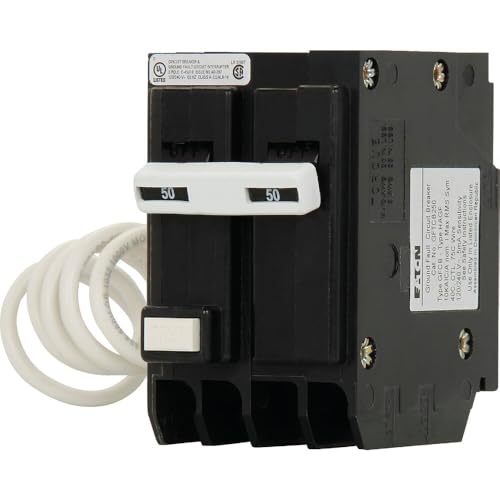
A pigtail-neutral Eaton BR breaker with GFCI status indicators for troubleshooting.
Eaton’s BRN250GF brings a pigtail neutral to the party, which matters for wiring setups that expect a neutral lead rather than a plug-on neutral. It is a two-pole, 50-amp breaker rated 120/240 volts with a 10 kAIC interrupt rating, and it is built with copper components for panel-mount installation. The GFCI status indicators are a genuinely useful touch — they let you see the breaker’s state at a glance while troubleshooting.
On the physical side, this is the bulkiest breaker here. Its 6.3 by 3.5 by 2.3 inch frame sits well apart from the more compact Siemens QF250A at 2 by 3 by 7 inches, so measure your available panel slots before you order. The 16-ounce weight also matches the Siemens QF250A, putting both at the heavier end of this group.
Reliability is where this one asks you to be honest with yourself. Experiences split — some units work cleanly for years, while a share report nuisance tripping after a few months and units that stop working within six months. Quality feedback echoes that split, with a portion of buyers receiving faulty units. That earns it the lower rating in this bunch, and the fair read is: a fine fit for a BR panel, but buy from a source you trust.
Reasons it earns a spot
- Pigtail neutral suits wiring setups that expect a neutral lead
- Built with copper components and panel-mount installation
- GFCI status indicators for quick troubleshooting
- 10 kAIC interrupt rating
Where the risk sits
- Reliability draws split reports, including early tripping and early failures
- Bulkier frame — confirm slot space before ordering
A sensible match for: an Eaton BR panel that calls for a pigtail neutral.
Worth weighing: the split reliability record means you should buy from a seller with a clean return path.
7. ABB THQL2150GFT2P Double Pole Ground Fault Breaker

The GE-lineage 50-amp double-pole GFCI with self-test for Q-line panels.
ABB now owns GE’s residential electrical line, and this THQL2150GFT2P is the 50-amp, 240-volt double-pole GFCI breaker that carries that lineage. It includes self-test as a built-in check, guards against overloads, short circuits, and ground faults, and it complies with the most recent National Electrical Code. The design is plug-in for a straightforward seat in its panel, and it is genuinely light at 45 grams.
For anyone who has an older GE Q-line panel and needs a 50-amp GFCI, this is the direct-family answer. It is engineered for heavy usage with durable materials, and the manufacturer positions it for both professional electricians and DIY installs.
The honest caution is reliability. Reports split, with some units working as promised and a share failing within four months. Value also leans sour, with a notable portion of buyers calling it a poor spend. If you are committed to a Q-line panel, this is the one that fits — just buy from a seller with a clear return window and inspect it on arrival.
The Q-line fit: self-test included, NEC-compliant, and a direct family match for GE/ABB Q-line panels.
The reliability caveat: split reports including early failures make this a buy-with-a-return-path pick.
The right call if: you own a GE/ABB Q-line panel and need a 50-amp double-pole GFCI that fits it.
Think twice if: you are panel-flexible — other families here carry a stronger reliability reputation.
8. Eaton GFTCB250 Cutler Hammer Ground Fault Circuit Breaker
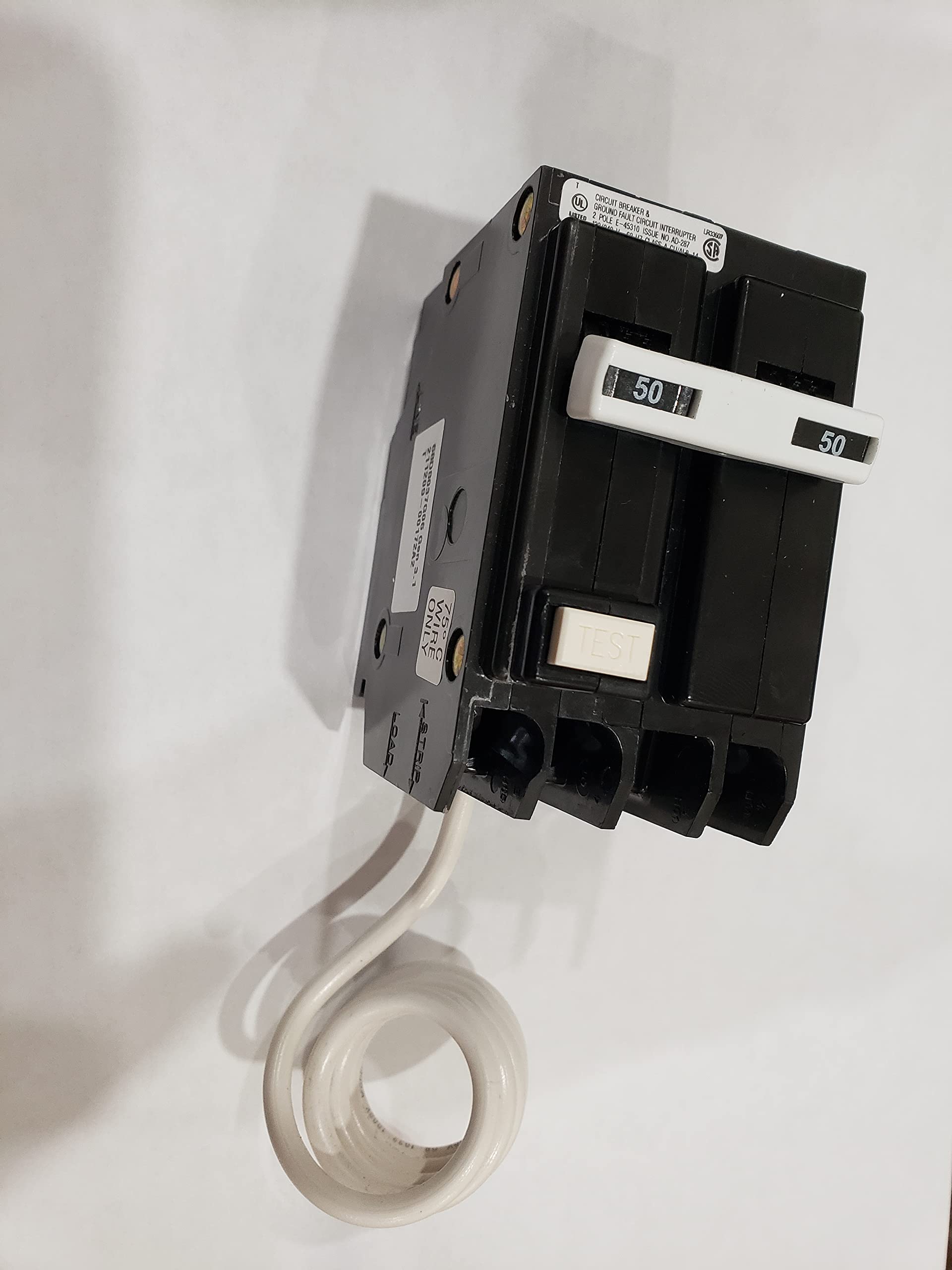
A 50-amp Eaton breaker sized for two one-inch panel spaces.
The GFTCB250 is a two-pole, 50-amp breaker rated 120/240 VAC with a 10 Kaic interrupt rating, accepting 14-4 AWG wire. It requires two 1-inch spaces in the panel, so plan your slot layout around that before you order. It is plate-mount, meets federal spec classification w-c375, and weighs 12.32 ounces — the lightest of the Eaton family here.
For an Eaton panel with room to spare, the install path is clean. The 14-4 AWG acceptance gives you a clear gauge range to match against your wiring run, and the two-pole layout handles a 240-volt load. Its core job is narrow and specific: protect a 50-amp circuit from ground faults without a fuss.
Where it asks for attention: the spec sheet is short on frills, and the two 1-inch space requirement rules out tight panels. If your layout is roomy, this is a clean pick. If you are scraping for slots, check the count before you click.
What it is built to do: guard a 50-amp, 120/240 VAC two-pole circuit with a 10 Kaic interrupting rating and 14-4 AWG wire acceptance.
The practical limit: needs two 1-inch spaces, so a crowded panel may not have room.
Fits best when: you have an Eaton panel with two 1-inch spaces free and 14-4 AWG runs.
skip it if: your panel is already tight on one-inch slots — slot count decides this one.
9. Siemens QE250 Double Pole Ground Fault Equipment Protection Breaker

The specialty breaker built to shield equipment, not people.
This breaker stands apart because its 30 mA GFCI protection is the equipment-protection grade — it guards a downline appliance from damaging line-to-ground faults rather than protecting a person. That distinction is why you would choose a QE-class breaker. It is a 50-amp, double-pole, 240-volt breaker with a 10,000 AIC (interrupting capacity) rating, in a standard 1-inch-per-pole plug-in format.
The 1-inch-per-pole format is a nice fit detail — it slots into standard Siemens panel rails where the pole width matches. It carries the highest rating in this batch, and it is the only breaker here explicitly framed as equipment protection. If the manual for your appliance or equipment specifically calls for 30 mA ground-fault protection, this is the model that meets that spec.
The trade-off is narrowness on both axes. This QE-type is a Siemens-family breaker, so it will not drop into other panel brands. And because it is equipment-class, it is the wrong pick for a spa or hot tub that wants personnel-grade Class A protection. Match the protection class to the job, and this one earns its place.
The specialty spec: 30 mA ground-fault protection built to guard equipment from line-to-ground faults, backed by a 10,000 AIC interrupt rating.
The wrong-job caveat: not a personnel-protection breaker — if your spa or hot tub calls for Class A, look to the top pick instead.
Buy this when: a piece of equipment’s documentation calls for 30 mA ground-fault equipment protection in a Siemens panel.
Steer clear if: you need personnel-grade Class A GFCI for a wet-location appliance.
Know the Specs
10,000 AIC Interrupting Rating
This figure — often written 10 kAIC — tells you the largest short-circuit current the breaker is built to shut off safely. Most residential panels sit well under that ceiling, so a 10,000 AIC breaker covers the fault levels a typical home can produce. When two breakers both fit your panel, a higher interrupting rating is the spec that never hurts.
Class A vs 30 mA Equipment Protection
Class A is the personnel grade of ground-fault protection, meant to interrupt a fault fast enough to protect a person, and it is what most spa, hot tub, and kitchen circuits want. A 30 mA GFCI is the equipment grade, built to guard a downline appliance from damaging line-to-ground faults. The two are not interchangeable — match the class to what your appliance’s documentation calls for.
Pigtail Neutral vs Plug-On Neutral
A pigtail-neutral breaker terminates its neutral through a lead wire you land on the panel’s neutral bar, which suits wiring setups built around a neutral lead. A plug-on neutral seats directly instead. Both are legitimate — the question is what your load center and wiring expect, so check the neutral method before you buy.
Why Panel Family Decides Everything
Breakers clip into panels of their own family, so a Siemens QPF will not seat in a Homeline center, and a QO will not seat in a Siemens panel. The single most useful thing you can do is read the label inside your panel door and buy only a breaker that lists your panel by name — that one step prevents most wasted returns.
Common Questions
Will a Siemens QF250A fit my Homeline panel?
What does 10,000 AIC mean on a breaker?
Is a 30 mA breaker the same as Class A GFCI protection?
Do I need a pigtail neutral or a plug-on neutral breaker?
Can I use a 50 amp GFCI breaker for an EV charger?
How long does a 50 amp GFCI breaker last?
Why does my GFCI breaker keep tripping?
What does the self-test feature on a GFCI breaker do?
Can I install a 50 amp GFCI breaker myself?
Does the breaker brand have to match my panel brand?
The Bottom Line
For most people, the 50 amp gfci breaker winner is the Siemens QF250A — a 10,000 AIC Class A breaker with self-test that fits the widest range of 240-volt jobs, from hot tubs to EV chargers. If you have a Homeline panel, the Square D HOM250GFIC is the proven fit that owners trust for charging. And if a piece of equipment explicitly calls for 30 mA protection, the Siemens QE250 is the specialty pick that meets that spec.
One nudge before you buy: check your panel door’s label against the breaker family, because fit is the one variable no rating can fix.
How we choose
We do not accept paid placement. Every pick is matched to a real buyer and a real use-case; we do not hands-on test units.
Sources
Specifications: manufacturer listings and product documentation. Review insights: verified customer reviews, as of November 2026. Pricing: not shown on this page (it changes often); check the current price via the retailer link.
As an Amazon Associate, Gamepad Test earns from qualifying purchases. This does not affect which products we feature.