
Specs are compiled from manufacturer listings and verified buyer reviews and can change over time — please confirm the key details on the product page before buying.
If your car has no Bluetooth built in, you do not need a new stereo to take calls on the road. You need a small speakerphone that clips to your sun visor, wakes up when you open the door, and lets you talk with both hands on the wheel. The tricky part is that these little devices look almost identical on a listing page, yet some hold a call on a noisy highway and others fade in and out. This guide covers nine real options and explains, in plain words, which one suits which kind of driver.
This guide is built by comparing the manufacturers’ published specifications and the patterns across verified customer reviews, so you get each pick’s real strengths and trade-offs instead of marketing spin.
Below you will find a plain-English breakdown of what each speaker wattage and battery figure actually means for your daily commute, plus three karaoke-style mics for anyone who wants to sing in the car. The short answer: the 1Mii CarEcho MK02 is the most balanced pick here, pairing a 5W speaker with 35 hours of talktime.
Top Picks

How To Choose The Best Auto Bluetooth Microphone
The first thing to settle is what you actually want the device to do. A sun-visor speakerphone is built for one job: letting you talk and hear directions without holding a phone. A karaoke microphone is built for a completely different job: putting a mic in your hand so you and your passengers can sing. Shopping for both at once is the fastest way to end up with a karaoke mic that cannot take a call.
Speaker wattage and call clarity
Wattage is simply how much power the speaker can push, and in a moving car it decides whether you can hear the other person over road noise. A 3W speaker (watts, the power unit here) is enough for calm city streets. A 5W or 6W speaker gives you more headroom on a motorway. None of these are hi-fi systems, and the honest listings say so — they are built for voices and directions, not for filling the cabin with bass.
How the kit turns on by itself
Almost every visor kit here uses a vibration trigger so it powers up when you open the car door and reconnects to your phone in seconds. That matters on the morning you would otherwise drive off with a dead kit because you forgot to press a button. Check that the model you pick has this auto-wake behavior and a real on/off switch you can leave in the right position.
Battery talktime versus standby
Talktime (the hours you can actually be on a call) is the figure that matters day to day, while standby (how long it sits idle before losing charge) tells you how often you will hunt for a cable. A kit rated at 35 hours of talktime will get most commuters through a week without charging. A shorter figure means you should plan on plugging it into the included car charger.
Two phones at once
If you carry a work phone and a personal phone, look for multipoint pairing. That is the feature that holds two Bluetooth connections open at the same time, so a call from either phone lands on the same speaker. Without it, you are manually re-pairing every time you switch devices, which is exactly the fiddling this whole category exists to remove.
Side-by-Side Comparison
| Model | Best For | Speaker Power | Stated Battery Life | Two-Phone Pairing | Amazon |
|---|---|---|---|---|---|
| BONAOK G50★ Best Overall | Car karaoke with impact | 26W | — | — | Amazon |
| 1Mii CarEcho MK02Also Great | Everyday commuting | 5W | 35H talktime | Yes | Amazon |
| Sarevile Trucker HeadsetTop Performer | Long shifts on the road | — | 35H talk / 60H music | Yes | Amazon |
| Avantree CK11 | Hands-free calling | 3W | 18H battery | — | Amazon |
| B-PRO 2B Car Kit | Two phones in one car | Dual 3W | 16H talktime | Yes | Amazon |
| SUNitec BC990P | Loud calls in a truck cab | 6W (dual 3W) | 15H talk | Yes | Amazon |
| Myxtren Car Karaoke System | Duets on road trips | — | 6H mic / 10H receiver | — | Amazon |
| SUNITEC Bluetooth Speaker | Basic hands-free on a budget | — | — | Yes | Amazon |
| Besign BK06 | Budget visor starter kit | Dual 2W | 20H per charge | Yes | Amazon |
Detailed Reviews
1. BONAOK Karaoke Microphone G50
Our pick — 4.5+★ from 900+ verified ratings; the strongest balance of quality and price.
A handheld singing mic that also doubles as a car speaker.
This is the pick for the family that wants the back seat singing, not a phone call. The G50 is a handheld microphone with a built-in 26W speaker — by far the most powerful audio hardware on this list — so it is loud enough to carry a song over engine noise. Inside, an EQ chip and DSP (digital signal processing, which automatically balances the highs and lows) keep the treble and bass in check as you sing.
The car trick is the FM tuner. The mic connects wirelessly to any car through its FM radio, which means you do not need an AUX cable snaking through the cabin. There are dedicated Karaoke and master modes plus a vocal-remove feature so you can sing over a backing track. The handheld body is aluminum, the connector options include 3.5mm jack and USB-C, and the audio sensitivity is rated at 115 dB (decibels, a measure of loudness).
The one thing to get right is version matching. If you want to use two G50 mics for a duet, both must be the same generation — the maker notes the Bluetooth chip changed, so a 2023 mic will not pair for duet with a newer one. Buy two together and you are fine. The other honest note: this is a karaoke tool, so its music playback leans toward party energy rather than balanced listening.
What makes it fun
- 26W speaker is the loudest on this list
- FM tuner links to any car radio without a cable
- Vocal-removal and Karaoke modes built in
- Aluminum body feels solid in the hand
Know before you buy
- Duet pairing needs two mics of the same version
- Tuned for singing, not neutral music playback
Best for: road trips and family parties where the point is noise and laughter, not a boardroom call.
Skip when: you need a quiet visor kit for conference calls — this is a stage, not a speakerphone.
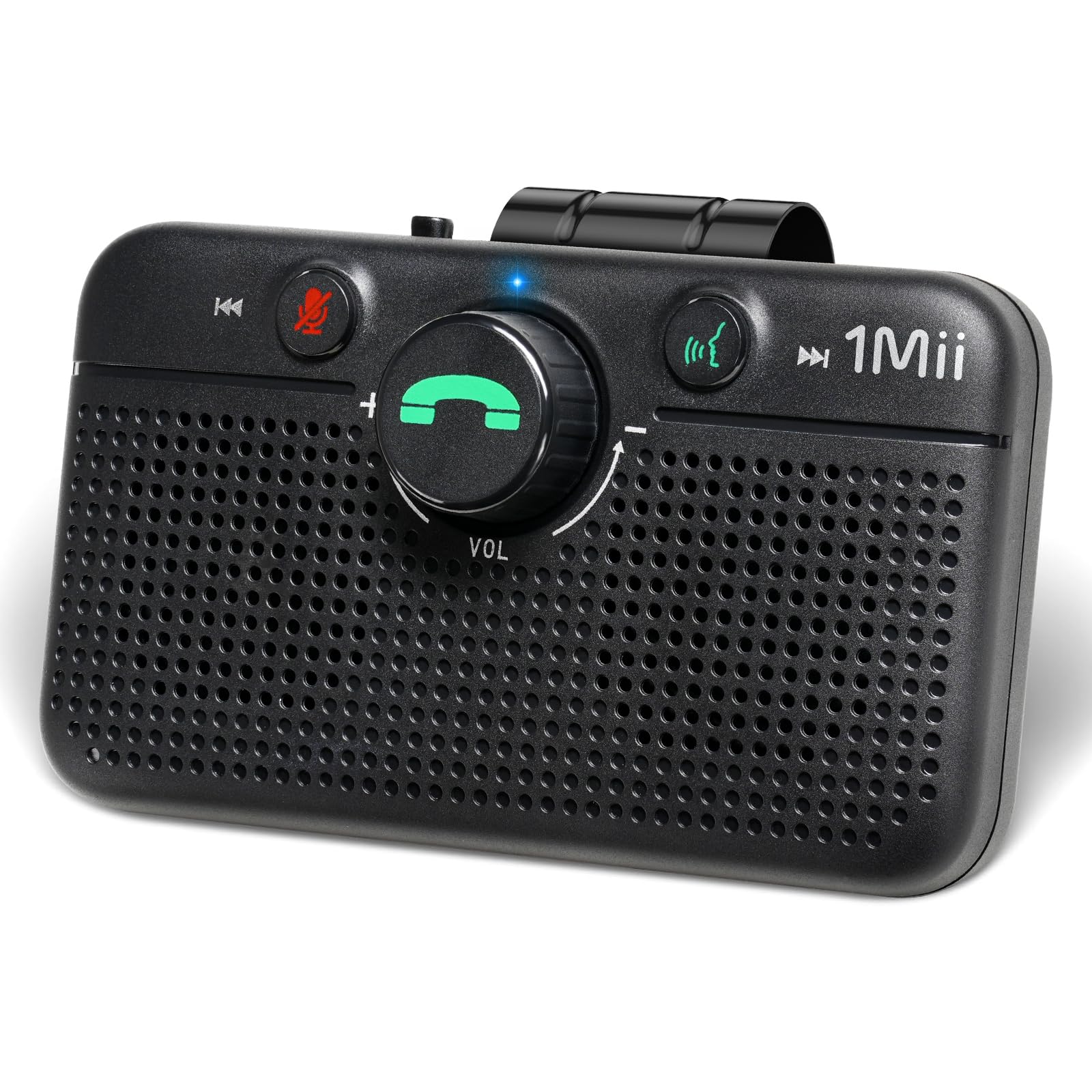
2. 1Mii CarEcho MK02 Bluetooth 6.0 Car Speaker
A no-drama visor kit that switches itself on and keeps talking all week.
This is the pick for the driver who wants the calling side sorted and nothing more. The CarEcho MK02 is built for older cars without Bluetooth — you clip it to the visor, pair once, and from then on it wakes and reconnects when you get in. Its 5W speaker is the biggest among the pure speakerphone picks here, and that extra power is what keeps voices readable over wind and tyres.
Battery is where it separates from the pack. The rated 35 hours of talktime means a commuter can go days of short calls without reaching for the cable, and 90 days of standby covers the car that sits parked between weekend trips. Bluetooth 6.0 (the version number of the wireless standard) is the newest radio here, and it is set up for two phones at once so your work and personal handsets both connect.
The trade-off is honest and the maker prints it on the listing: this is not an audiophile device. Music and podcasts come through fine, but the tuning favors speech, so do not buy it expecting a small stereo. The other thing to know is that it needs recharging eventually — long talktime is still not infinite, so keep the Type-C cable in the glovebox.
Where it earns its spot
- 5W speaker gives voices more headroom than the 3W Avantree CK11
- 35 hours of talktime and 90 days of standby cut charging chores
- Auto on when you enter the car and auto off when you leave
- Bluetooth 6.0 with dual-phone pairing for two handsets
What to weigh first
- Tuned for calls, not for serious music listening
- Needs a periodic Type-C recharge between long stints
Reach for this if: your car predates Bluetooth and you want calls, directions and the odd podcast handled without thinking about it.
Think twice if: your main goal is music quality — the tuning here is aimed at speech.
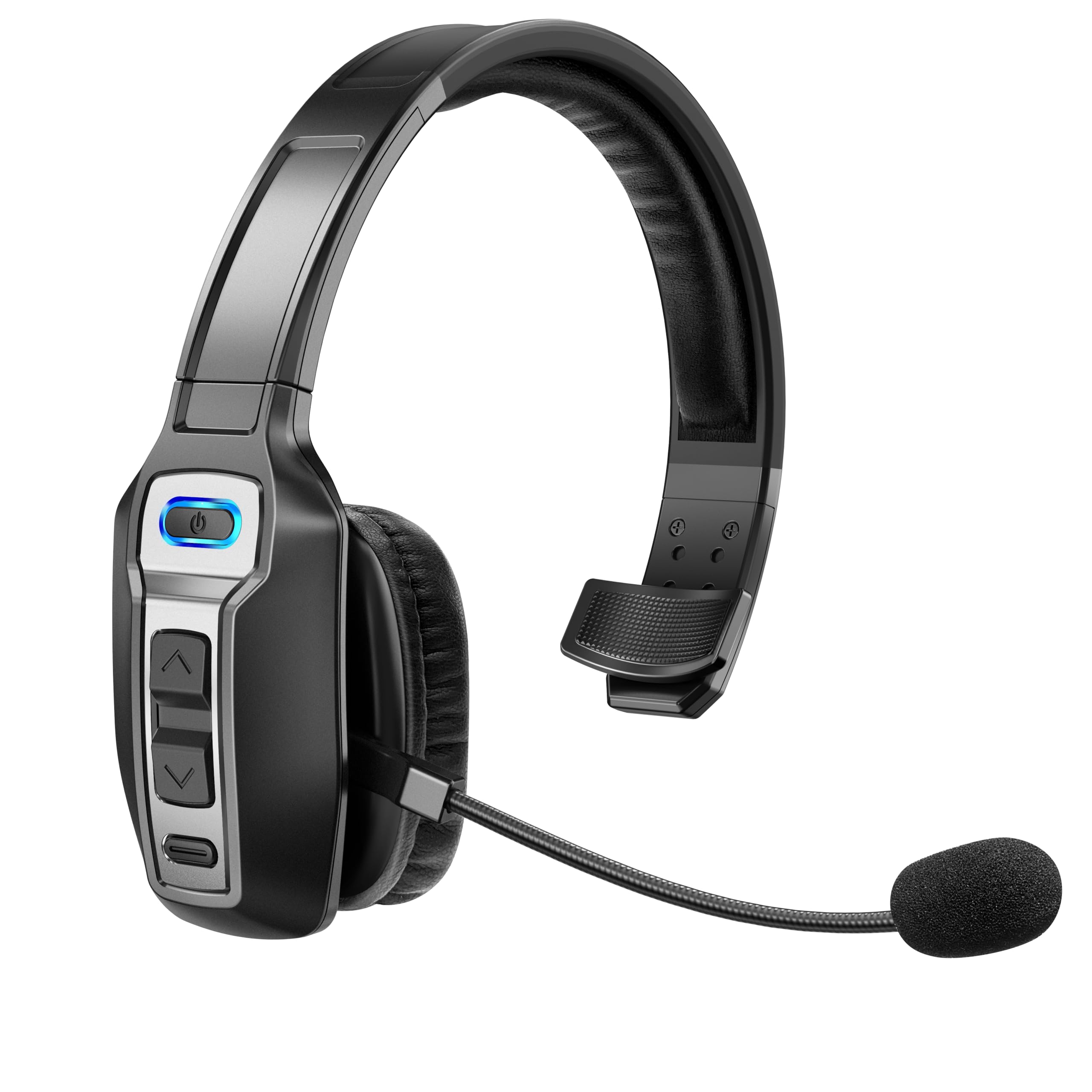
3. Sarevile Trucker Bluetooth Headset V5.2
An on-ear headset for drivers who live in the cab all day.
Not everyone wants their calls broadcast to the whole cabin. If you drive for a living, or share the car with sleeping kids, an on-ear headset keeps the conversation private. The Sarevile puts a directional boom mic next to your mouth and pairs over Bluetooth 5.2 (the wireless version), with multipoint support so two devices stay connected.
You get up to 35 hours of talking or 60 hours of music at 70% volume from a full charge, which takes about 2 hours. That runtime suits a long-haul shift rather than a ten-minute school run. Noise cancellation (a feature that filters out background sound) earns its keep on the motorway, since wind noise is the enemy of every hands-free call.
The honest catch with any on-ear headset is fit: the headband and anti-slip pad help, but comfort over a full shift depends on your head shape. The adjustable headband and anti-slip pad are there to keep it steady, but your head shape still decides comfort over a full day. The other small caveat: the mic button only answers calls on a cell phone, so treat it as a phone companion rather than a desk handset.
The long-shift argument: 35 hours of talk time and a recharge in 2 hours beat what most visor kits can offer, and Bluetooth 5.2 syncs quickly to both a phone and a computer.
Fit is the deciding factor: comfort over an eight-hour shift depends on how the headband sits on your head, so try it on short calls first.
Suits you when: the cabin is shared and you need private, wind-resistant calls with runtimes that last a shift.
Less ideal when: you prefer nothing touching your ears and would rather the car do the talking.
4. Avantree CK11 Bluetooth 5.0 Hands-Free Car Speakerphone

The visor-clip veteran that just keeps answering the phone.
This is the visor kit that shows up again and again in owner discussions, and for good reason. The formula is simple: a built-in 3W speaker aimed at voice clarity, a motion sensor that wakes the unit when the car door opens, and Siri support so you can dial or text without touching the phone. It clips to the visor and pairs with your handset in a couple of minutes.
The 3W speaker is the number to note against the 1Mii CarEcho MK02 above, which runs a 5W speaker. That gap matters on a loud motorway: the CK11 is clear for everyday calls, but it has less power to push past road noise. Where the CK11 gives ground on watts, it gives back in stamina — 18 hours of battery life, a 2 to 3 hour charge, and over 600 hours of standby.
What wins owners over is the clip-and-forget routine: no buttons to press before a call. Clip, pair, forget. With 18 hours of battery and over 600 hours of standby, many drivers report charging it only occasionally. Just know the maker is clear that this is a calling accessory, not a stand-in for your car stereo.
Why drivers stick with it
- Motion wake turns it on when you open the door
- 18 hours of battery and over 600 hours of standby
- Full charge in 2 to 3 hours
- Voice assistant access keeps your hands on the wheel
Where it asks patience
- 3W speaker trails the 5W 1Mii on loud roads
- Not intended as a replacement car stereo
The call to make: pick the CK11 if you value a long-proven visor kit and want Siri at a button press.
Look elsewhere if: maximum speaker power on a noisy commute is your top priority.
5. B-PRO 2B Bluetooth Hands-Free Car Kit

Built for the driver carrying a work phone and a personal one.
Two handsets, one speaker, no manual switching. That is the whole pitch of the B-PRO 2B, and it is a genuinely useful one if you run a business line alongside your own. Multipoint Bluetooth keeps both connected at the same time, so a call from either phone lands in the same place without you re-pairing anything.
The audio setup is twin 3W speakers, which is more capacity than a single small driver and is meant to help you hear conversations clearly. A built-in mic with noise cancellation works to trim background pickup, and the audio plays through the kit itself rather than your car stereo. The 1,300mAh battery is rated for up to 16 hours of talking and recharges over USB-C in about 3.5 hours, with a 12V/24V car charger included for the lighter socket.
The controls are the quiet win here — a large call button plus a separate voice button for Siri or Google Assistant, so navigation and calling stay two separate taps. The recurring honest note on speaker kits of this class is that sound is tuned for speech, not depth, so expect voices rather than hi-fi music.
Two-line convenience: multipoint pairing means a personal call and a work call never fight over one Bluetooth slot.
What sets the ceiling: the 16-hour talktime is real but shorter than the 35 hours the 1Mii offers, so heavy talkers should keep the car charger handy.
Made for you if: you run two lines and want both live on one visor kit with a simple call button.
Not your pick if: you rarely touch the kit and simply want the longest gap between charges.
6. SUNitec BC990P Bluetooth Car Speaker Phone

A double-mic, double-speaker kit for the noisiest cabs.
Two speakers and two microphones is the short version, and it is aimed squarely at vans, trucks and loud cabins. The BC990P runs two 3W multimedia speakers and two noise-cancel mics, with ENC and CVC8.0 echo cancellation — the processing that tries to strip road roar out of what the caller hears. It also packs a Bluetooth QCC chipset for HD voice on the call end.
The auto on/off behavior is the same useful routine as the others: it sleeps when your phone goes out of range at about 10 meters and wakes on any vibration, like a car door shutting. Battery is rated at up to 15 hours of talk or music and about 1500 hours of standby, with roughly 3 hours to a full charge over Type-C. Multipoint pairing holds two phones at once.
Be realistic about this class of device. The build is functional rather than luxurious, and the sound is loud and clear for calls without being a music system. It works equally well as a desktop speakerphone, and a magnetic sun visor clip plus car charger are in the box so it is ready to go on day one.
Volume you can use: dual 3W speakers plus dual noise-cancel mics are built for a truck cab where a single small driver would struggle.
Expect substance over polish: it is a workhorse calling kit, so judge it on call clarity rather than music finesse.
Right for: truck and van drivers who need a genuinely loud, dual-mic kit for hands-free calls.
Wrong for: anyone expecting a hi-fi music upgrade — this is a call machine.
7. Myxtren Car Karaoke Microphone System
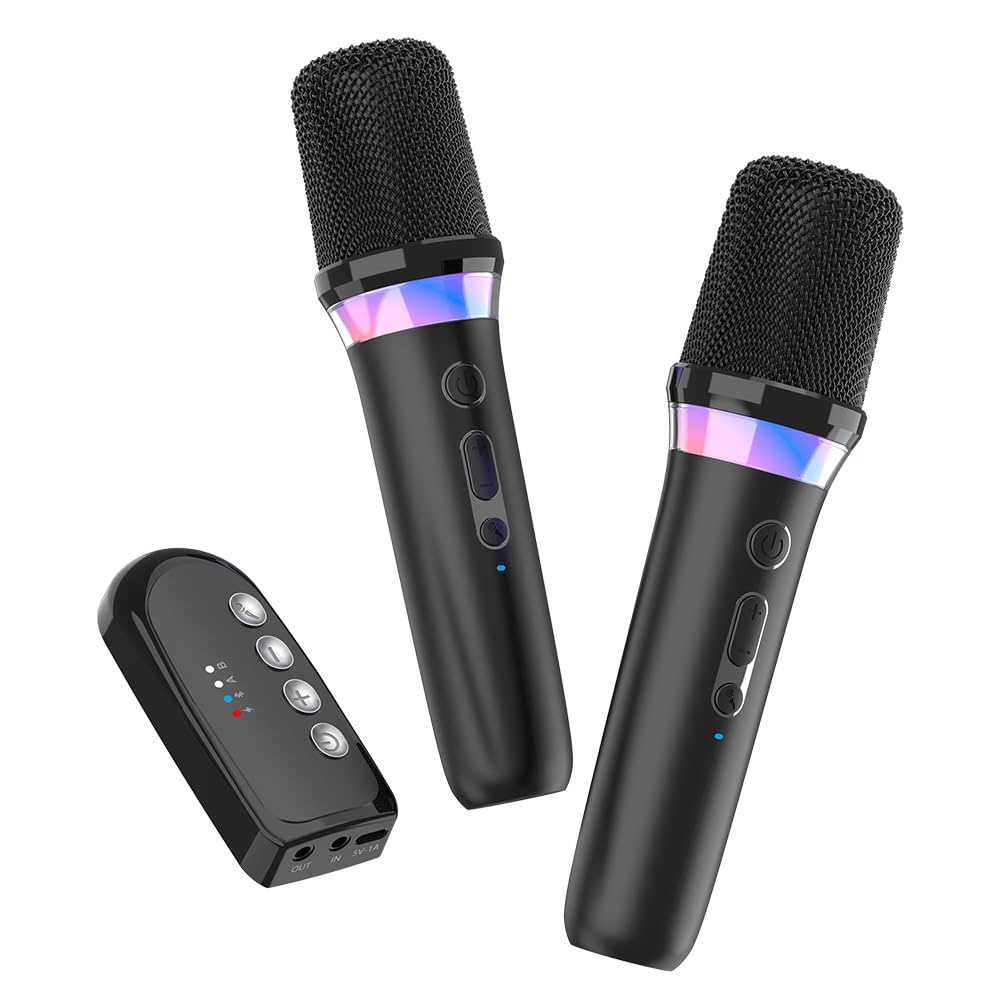
Two handheld mics and a receiver for passengers who both want a turn.
Unlike the single BONAOK handheld above, this kit is built around a duet from the start. You get a pair of handheld dynamic mics plus a small 2.4G receiver that plugs into your car’s AUX input and sends the sound through the stereo. There is no pairing dance — plug the receiver in and sing, with a transmission range of up to 10 meters.
Both the mics and the receiver carry their own rechargeable batteries. The mics run for about 6 hours of non-stop playtime, and the receiver works for up to 10 hours, which is plenty for a long road trip. A professional moving-coil mic core is there to keep the signal stable, and there are four sound effects including male, female, children and monster modes.
The important catch is printed right at the top of the listing: your car needs a 3.5mm audio input jack. No AUX port, no sound through the speakers. The receiver also has a Bluetooth receive function so it can take a feed from a phone or laptop, but it still needs to send that out to a speaker through the AUX cable. Check your dashboard before you order.
What the duet does well
- Two mics plus a receiver, so passengers can sing together
- Runs 6 hours on the mics and up to 10 on the receiver
- Plug-and-play with no Bluetooth pairing needed
- Four voice effects for kids and adults alike
The prerequisite to check
- Requires a 3.5mm AUX input jack in your car
- Karaoke tool, not a calling speakerphone
If your car has an AUX jack: this is the tidy way to get two wireless mics singing through the car stereo.
If it does not: skip this entirely and look at the visor kits — they need no AUX port at all.
8. SUNITEC Bluetooth Speaker for Car

A simple, voice-guided speaker that keeps the basics under control.
This one is for the driver who wants to spend as little as possible to get calls off their hand. It uses DSP noise cancellation (processing that trims background sound) along with built-in volume controls to make speech clearer, and a vibration sensor switches it on and reconnects to your phone automatically when you set off. There is Siri and assistant support for hands-free dialing and directions.
What makes it friendly for a first-time buyer is the spoken feedback. It announces when it powers on, pairs, connects, disconnects and runs low on battery, so you never have to guess what state it is in. Multipoint pairing holds two phones at once, and it charges over USB-C. If you want a simple visor speaker that talks you through setup, this is a reasonable cheap entry.
Set expectations on the sound. It is a basic speaker for voice, and the honest reviews point to the usual trade-offs on a low-cost kit: clarity depends on your cabin noise, and some units have proven less durable than the pricey ones. If you need a loud speaker for a highway commute, the dual-speaker kits higher on this list give you more headroom.
The easy part: spoken prompts walk you through every state change and two phones can stay connected.
The real ceiling: sound and long-term durability are the weak spots for a low-cost speaker, so treat it as a light-duty visor helper.
Pick it if: you want a no-fuss, cheap visor speaker with clear voice prompts for short local trips.
Pass on it if: your daily drive is motorway-heavy and you need extra speaker power to cut through.
9. Besign BK06 Bluetooth 5.0 Car Speakerphone

The starter visor kit that covers hands-free basics for very little.
If you have never used a car speakerphone and want the cheapest sensible way in, the BK06 is that device. It runs Bluetooth 5.0 with EDR (the version that improves data transfer efficiency) for lower power draw, pairs over a simple setup, and clips to the sun visor. It also wakes on the built-in motion sensor when the car door opens, so it is ready to connect as you pull out.
You get up to 20 hours of music or hands-free calling from a full charge of its 1000mAh rechargeable battery (a battery rated at 1000 milliamp-hours, a measure of charge capacity). At 25 g it stays light on a visor — the 1Mii CarEcho MK02 is 22.1 g, so this one is a touch heavier without being noticeable. Dual 2W speakers push calls out, and multipoint pairing (a feature that keeps two phones connected at once) means you can switch between them. A Siri button on the unit activates your phone’s voice assistant with a two-second press.
The expectation to set is on sound. This is a small dual-speaker kit meant for calls, and audio quality is the part to judge for yourself rather than expect studio sound. The battery occasionally shows signs of aging over time, as with any small rechargeable cell. For a first visor kit or a second car, it does the core job without fuss.
The value case
- Up to 20 hours of talk or music per charge
- Motion sensor wakes it as you open the door
- Bluetooth 5.0 with two-phone multipoint
- One-touch Siri from the unit
Where the compromise shows
- Dual 2W speakers are modest for noisy roads
- Sound quality should be judged in person
Good starting point: a first-time visor-kit buyer who wants basic hands-free calling without overspending.
Step up if: your commute is loud and you want the 5W 1Mii or the dual-3W kits instead.
Know the Specs
Speaker wattage (W)
Watts tell you how much power pushes the sound. In a visor kit a 3W driver is fine around town, a 5W or dual 3W setup holds up better on the motorway, and a 26W handheld has genuine party volume. More watts generally means more clarity when the cabin is noisy — but for calls, tuning matters as much as raw power.
Talktime and standby (hours)
Talktime is the hours you can actually be on a call before the battery gives out, while standby is how long it waits idle. A kit rated around 35 hours of talktime outlasts one rated at 16 to 18 hours, and a standby figure in the hundreds of hours means it survives days parked without charging. Plan to plug it in now and then either way.
Bluetooth version and multipoint
The version number (5.0, 5.2, 6.0) signals how current the wireless chip is, and newer versions generally mean quicker pairing and steadier links. Multipoint means one device can hold two phones connected at once. That is worth having if you carry separate work and personal phones and do not want to re-pair each time you swap.
Motion wake and AUX requirements
Motion wake is a vibration trigger that powers the kit up when the car door shuts, so you do not fuss with buttons. It is different from an AUX requirement: some karaoke mics and receiver kits must plug into a 3.5mm audio input jack to play through the car speakers. Check your dashboard for that port before choosing a karaoke-style device.
Common Questions
Will a visor car speakerphone work if my car has no Bluetooth built in?
Do I need an AUX jack for a car karaoke microphone?
How long does a car speakerphone battery actually last?
Can I connect two phones to one car kit at the same time?
Is a visor speakerphone loud enough for a truck cab?
Does a car Bluetooth kit turn on by itself when I open the door?
Can a car karaoke mic also take hands-free calls?
Will a speakerphone block my music or my car stereo?
How long does it take to charge a car speakerphone?
Do these devices support Siri and Google Assistant?
The Bottom Line
For most drivers, the auto bluetooth microphone winner is the 1Mii CarEcho MK02 because it nails the three things that matter on a commute: a 5W speaker for clear calls, 35 hours of talktime so you rarely charge it, and auto on/off that needs no buttons. If you drive long shifts and want private hands-free audio, the Sarevile headset is built for that marathon use. And if the goal is a party in the car, the BONAOK G50 brings 26W of singing volume to the back seat.
The one honest nudge: match the kit to your actual drive — a 3W visor speaker for city streets, dual speakers and noise-cancel mics for a loud highway or truck cab. A light city commuter will be perfectly served by a budget visor kit, while a loud highway or truck cab rewards paying a little more for dual speakers and noise-cancel mics.
How we choose
We do not accept paid placement. Every pick is matched to a real buyer and a real use-case; we do not hands-on test units.
Sources
Specifications: manufacturer listings and product documentation. Review insights: verified customer reviews, as of November 2026. Pricing: not shown on this page (it changes often); check the current price via the retailer link.
As an Amazon Associate, Gamepad Test earns from qualifying purchases. This does not affect which products we feature.