
Specs are compiled from manufacturer listings and verified buyer reviews and can change over time — please confirm the key details on the product page before buying.
You want a Dungeons & Dragons fix on your PC, and the shelf is a maze of expansions, ancient discs, and rulebooks that are not actually video games at all. This guide sorts five real D&D PC games and rule-based adventures by what they do for you — the level range you get to play, the party you control, the combat system, and whether the thing will even load on a modern Windows machine. If you want the short answer: the sprawling, expansion-stuffed role-playing classic is the safest buy for most people, and the dragon anthology is the pick for anyone who runs game night.
This guide is built by comparing the manufacturers’ published specifications and the patterns across verified customer reviews, so you get each pick’s real strengths and trade-offs instead of marketing spin.
Some picks here are dungeon-crawling video games; one is a boxed set of ready-to-run dragon adventures for your table. Knowing which is which keeps you from buying a tabletop book when you wanted a game to install.
Top Picks


How To Choose The Best DnD PC Games
The first decision is not about graphics or difficulty. It is about which rule set the game runs on, because that single choice determines how familiar the game feels the moment you open the character screen. A game built on D&D 3.5 rules (the third edition revision that added feats and skill points) plays very differently from one built on AD&D (the older second-edition rules with a tighter, more punishing magic system). If you have played the tabletop, pick the rule set you already know and skip most of the learning curve.
Rule set: does it match the edition you know
Both rule sets are listed on the games below, and neither is wrong. The newer 3.5 set gives you more character-building choices — feats, skills, and multiclass paths — while the older AD&D set keeps characters simpler and combat faster to resolve. Someone who has only seen the newer tabletop books will feel at home with 3.5 almost immediately.
Level range and party control
Your real playtime depends on the level band a role-playing game covers. A game built for levels 1–15 hands you a long arc from fragile beginner to near-legendary; a tighter band means a shorter, more focused run. Party size matters too. Controlling a full party lets you build a tank, a healer, and a spellcaster and cover every job yourself. Controlling a single character — like in a Dungeons & Dragons Online-style game — leans on other players for the gaps.
Compatibility and the modern Windows problem
These are legacy disc-based releases, and the biggest real-world complaint in the review pages is not about story at all — it is about getting old discs to run on newer versions of Windows. Check the listing for any compatibility notes before you commit, and factor in that a digital or patched version may be the smoother route.
Video game or tabletop box
One product in this lineup is not software. It is a printed adventure anthology for Dungeon Masters — the person who runs the tabletop game. If your goal is a Friday-night session with friends at a table, that box is the one; if you want to play alone on a screen, skip past it to the actual games.
Side-by-Side Comparison
| Model | Best For | Format | Rule Set / Scope | Age Rating | Amazon |
|---|---|---|---|---|---|
| D&D: Dragon Delves★ Best Overall | Dungeon Masters running game night | Hardcover adventure anthology | 10 adventures, levels 1–12 | Adult | Amazon |
| Icewind DaleBest for Party Building | Party-building dungeon crawls | PC game disc | AD&D, levels 1–15 | Teen | Amazon |
| DDO: StormReach | Active, skill-based combat | PC game DVD | D&D v3.5, 5 races / 9 classes | Teen | Amazon |
| Temple of Elemental Evil | Tactical turn-based combat | PC game disc | D&D 3.5, 5 characters + 3 followers | Teen | Amazon |
| Neverwinter Nights Diamond | Endless solo and multiplayer RPG mileage | PC game disc | Full game plus expansions | Mature | Amazon |
Detailed Reviews
1. Dungeons & Dragons: Dragon Delves (D&D Adventure Anthology)
Our pick — 4.5+★ from 150+ verified ratings; the strongest balance of quality and price.
Ten dragon hunts for levels 1–12, prepped so tomorrow’s game night still happens.
This is the one pick here that is not software — it is a boxed anthology of 10 dragon-themed Dungeons & Dragons adventures for characters level 1–12, and it carries the highest score in this lineup at 4.5+ stars across 150+ ratings. If you are the Dungeon Master — the person who builds and runs the world for everyone else — that level band is the whole pitch. It means the same book works whether your group is scraping by at level 1 or has already earned a name for itself at level 12.
what separates it from a single long campaign is modularity. Each adventure runs as a standalone night, or you can thread them into a larger campaign when your table wants a through-line. Every one is set in a different fantasy location, from a stolen pirate base to city ruins, and each gets its own distinctive dragon lair. You get all of D&D’s chromatic dragons (the classic villainous colour-coded line) and metallic dragons (their noble counterparts) to work with — a brass dragon’s treasure hoard, a red dragon’s rage, a rambunctious gold dragon to corral.
Prep time is where this earns its place at the top. Each adventure ships with maps and step-by-step Dungeon Master prep plus a quick-start guide, so a session you agreed to run tomorrow does not require three evenings of homework. The artwork is a genuine selling point too: 10 unique art styles across the set, plus a gallery of dragon art from D&D’s history and a behind-the-scenes look at the new dragon redesigns.
Amazon’s own read of the reviews backs the shape of it: the adventures themselves are what people enjoy, with the breadth of dragons close behind. The one thread worth flagging honestly is physical quality — some owners call the build excellent, others were disappointed with how the package arrived or held up. That is a fair caveat for a box you will carry to game nights, not a reason to skip a book whose content lands so consistently.
What lands best
- 10 adventures for levels 1–12, so one book covers a whole campaign arc
- Step-by-step DM prep and a quick-start guide for last-minute sessions
- Every chromatic and metallic dragon gets a turn, each with its own lair
- 10 distinct art styles plus a historical art gallery and redesign feature
What to weigh first
- It is a printed anthology, not a playable PC game — no screen here
- Package quality drew split reactions, so inspect the box on arrival
- You need a group and a Dungeon Master to use it at all
Reach for this if: you run the table and want ten ready dragon hunts instead of a single long campaign.
Look elsewhere if: you want to sit down alone at a keyboard — this box needs a group.
2. Icewind Dale – PC
Fifteen levels of frost giants, cyclopes, and a party you build from scratch.
Where the dragon anthology asks you to run the world, Icewind Dale hands you the classic dungeon-crawl bargain: you create an entire party of adventurers, then push them through the frigid north and the enormous caverns and dungeons beneath the Forgotten Realms. It runs on the award-winning engine from Baldur’s Gate, and it covers character advancement across levels 1–15 in the AD&D rule set — the older second-edition D&D rules, which resolve combat faster and keep character sheets simpler than the 3.5 games on this list.
The scale of what you fight is the memorable part. You combat monstrous Cyclopes and frost giants that dwarf your characters while you search for an evil lying deep within the Spine of the World. If you like the planning half of role-playing — building a balanced party, assigning the tank and the healer and the caster, then watching that plan meet a giant — this is the pick for you. Building the whole party yourself is a different pleasure from controlling one hero.
The honest reality check: this is a 2000-era PC disc, and the score here sits lower than the others in the lineup. Budget an evening for patching and compatibility settings before your first dungeon.
Who this fits: the tinkerer who enjoys stat-building and does not mind a legacy install. If you want to install and play the same day, pick a title with fewer compatibility reports.
Your kind of game if: the fun is in assembling and balancing a six-slot party before you ever enter a dungeon.
Set it aside if: a 2000-era disc and its setup quirks will test your patience more than the frost giants will.
3. Dungeons & Dragons Online: StormReach – PC (Standard (DVD))

Real-time combat where the swing you time matters more than the stat you stacked.
StormReach is built on D&D v3.5 rules and heavily customised into your character — five races, nine classes, and hundreds of skills, feats and looks to mix. That is the widest character-building spread on this list, and it is the reason this pick suits someone who wants to spend an hour on a build before playing. Unlike the Level 1–15 arc of Icewind Dale, this one leans on you making a hero you actually care about and then living with the choices.
Combat is the real divider. You fight using active combat where skill matters and seconds count — you are not queuing orders and waiting. The quests themselves are pitched as private adventures focused on adventure rather than grinding, and the dungeons are unforgiving: fiendish traps and foes that punish the foolish. If you have ever wanted a D&D game to feel like a fast, reflex-driven fight rather than a turn-based chess match, this is the one that delivers that.
The catch worth knowing up front is the same one every legacy disc on this list carries. This is a 2006-era PC DVD, so getting it onto a current machine takes some care, and it is a PC-only product — there is no console version waiting if the install fights you. For many players the real-time, timing-based combat is worth the install hassle.
What wins people over
- Five races and nine classes make it the deepest character builder here
- Active combat makes skill and timing matter, not just stats
- Runs on the D&D v3.5 rules, so it matches the modern tabletop most people know
The honest downside
- A 2006-era DVD install means setup care on modern PCs
- PC only — no console fallback if the disc gives you trouble
Pick this for: a real-time dungeon run where your reflexes share the workload with your build.
Not for you if: you want your combat resolved calmly, one order at a time.
4. Temple of Elemental Evil: A Classic Greyhawk Adventure – PC

One classic module, five characters, and turn-based combat that rewards a plan.
This is a printed adventure module from D&D’s history — the Temple of Elemental Evil, a Greyhawk classic — rebuilt as a full PC game and expanded under the D&D 3.5 rule set. You control five characters with three followers in each party, and the combat is tactical and turn-based, so every fight is a plan you set up and then execute. If a real-time scramble is not your idea of a good dungeon, the turn-based pacing here is the opposite of StormReach’s seconds-count fights.
The structural draw is choice. Multiple story paths and multiple endings mean the game genuinely supports all alignments — a lawful-good run and a more self-interested one are both playable, not punished. That is a rare thing in a set of legacy D&D titles, and it is the real reason to pick this over the others if replaying with a different moral compass matters to you. Owners describe the game as fun and enjoyable above all, which is the right centre of gravity for a remake of a tabletop module.
What the reviews agree on: gameplay is the thing people keep coming back to as the strength, and compatibility issues rarely surface — players report that it runs without problems. That makes it one of the more dependable legacy discs here, even if its overall score trails the top two.
Where it sits in the lineup: it is a focused, faithful remake rather than an endless open campaign, so expect a tighter arc and lean into the multiple endings if you want replay value.
The one to grab for: a tactical, turn-based party-of-eight build where your plan matters more than your reflexes.
Think twice if: you want a sprawling open world — this is a single classic module brought to life.
5. Neverwinter Nights Diamond
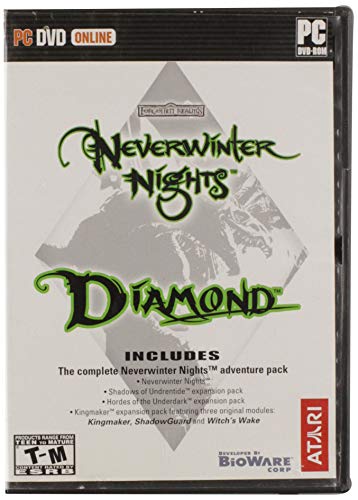
The original campaign, every boxed adventure, and expansions — plus a community of user-made modules.
If you want the most hours per box here, this is the full package: the base Neverwinter Nights game plus all boxed adventures and expansions in one disc. It carries 4.0+ stars, the strongest overall reputation in the lineup after the anthology — and the review pages describe it as one of the best RPGs owners have played, with gameplay that fills hours. It also arrives light, at just 1.6 ounces versus 9.6 ounces for StormReach, so shipping and storage are a non-issue.
What makes Diamond the runaway favourite over the other PC discs is structural: you get the game plus the expansions in a single box, and you get access to many user-created modules — community-built adventures — so the content keeps flowing long after the campaigns are done. Fans of the original talk up the multiplayer modes too, which the other PC titles in this lineup do not lean on the same way. For an old RPG, the online play and endless fan-made adventures are the real longevity engine.
The one honest snag is compatibility. The review consensus reads clearly: it runs well on older systems, but some buyers report trouble getting it working with Windows Vista. On a modern machine, budget for the same setting-up-era friction as the rest of this list. Given how much of the content it delivers in one box, the hassle is on the setup side, not the game inside.
Why it ranks high
- Base game plus all boxed adventures and expansions in one disc
- User-created modules keep new content coming long after you finish
- Multiplayer adds a long tail the other discs struggle to match
Where it stumbles
- Some owners hit compatibility trouble getting it running on newer Windows
- It is a legacy disc, so expect setup care on a modern machine
The pick for mileage: one box with the base game, the expansions, and years of fan-made adventures baked in.
Only hesitate if: wrestling an old disc onto a fresh Windows install is a deal you would rather not make.
Know the Specs
Level Range
This is the stretch of character progression the game covers. A title built for levels 1–15 or 1–12 is telling you how long and how far you will grow — from a fragile beginner to a near-legendary hero. The wider the band, the more playtime lives inside a single purchase. Check it against your patience: a deeper band rewards long-haul players, while a tighter one delivers a focused story you can finish and move on from.
Rule Set (3.5 vs AD&D)
The rule set is the mechanical engine under a game, and it decides what your character sheet looks like. D&D 3.5 rules add feats and skills and give you more character-building choices; AD&D, the older second-edition rules, keeps characters simpler and combat faster. Neither is better — pick the one that matches the tabletop edition you already know.
Common Questions
Will these D&D PC discs actually work on my current Windows machine?
Is Dragon Delves a playable PC game?
What level range do these D&D games cover?
Should I get the D&D 3.5 rule set or the AD&D rule set?
How many characters can I control in a party?
Which of these D&D titles has the most content in one box?
Do any of these D&D PC games support multiplayer?
Can I play Temple of Elemental Evil with any moral alignment?
Is StormReach combat turn-based or real-time?
Do I need the tabletop rulebooks to play these PC games?
The Bottom Line
For most people hunting the best dnd pc games, the safe bet is the Dragon Delves anthology if you run the table, and Neverwinter Nights Diamond if you want to play on screen — it packs the base game, all boxed adventures and expansions, and fan-made modules into one box for the longest hours per purchase. Want a tactical, turn-based fight instead of real-time? Temple of Elemental Evil gives you five characters, three followers, and all alignments supported. And if active, seconds-count combat is your thing, StormReach puts five races and nine classes in your hands.
The one nudge: every PC title here is a legacy disc, so read the compatibility notes before you buy and go in with a little setup patience. The games hold up; getting a 2000s disc onto modern Windows is the real hurdle.
How we choose
We do not accept paid placement. Every pick is matched to a real buyer and a real use-case; we do not hands-on test units.
Sources
Specifications: manufacturer listings and product documentation. Review insights: verified customer reviews, as of November 2026. Pricing: not shown on this page (it changes often); check the current price via the retailer link.
As an Amazon Associate, Gamepad Test earns from qualifying purchases. This does not affect which products we feature.