
Specs are compiled from manufacturer listings and verified buyer reviews and can change over time — please confirm the key details on the product page before buying.
Buying a Switch console in 2025 is mostly a question of which screen you want in your hands and how much room you need for games. The short answer: if you play mostly on the TV and want the biggest, fastest system, the Switch 2 is the one to beat. If you play on the bus or in bed, the OLED model’s screen is still the nicest thing Nintendo has put in a handheld. Everything else on this list is a variation on those two choices — a bundle, a renewed unit, or an older model that still plays the same library.
This guide is built by comparing the manufacturers’ published specifications and the patterns across verified customer reviews, so you get each pick’s real strengths and trade-offs instead of marketing spin.
Below you’ll find the eight Switch consoles worth considering, sorted by what they actually do well rather than by sticker shock. The plain-English spec breakdown comes first, so you can tell a 32 GB model from a 256 GB one before you spend anything on a Switch Gaming Console.
Top Picks


How To Choose The Best Switch Gaming Console
Most people buying a Switch are really choosing between three things: the screen, the storage, and whether they want a bundle or a bare console. Get those three right and the rest of the decision falls into place quickly.
Screen: OLED, LCD, or the Switch 2 panel
An OLED screen lights each pixel on its own, so blacks go truly dark and colors look richer — that’s why the OLED models are the ones people describe as looking better in handheld mode. The original Switch uses a 6.2-inch LCD touch screen, which is fine but flatter. The Switch 2 steps up to a 7.9-inch LCD touch screen with support for HDR (high dynamic range, which keeps bright and dark parts of a scene both visible) and up to 120 fps (frames per second, meaning smoother motion).
Storage: how many games fit
Internal storage is where your downloaded games live. The original Switch models carry 32 GB, the OLED models carry 64 GB, and the Switch 2 carries 256 GB. One thing to know: a portion of that space is always reserved for the system itself, so you never get the full number for games. All of them take a microSD card for expansion, though the Switch 2 uses the newer microSD Express format.
Bundles vs the bare console
A bundle throws in a game download, and sometimes a membership. Whether it’s worth it depends on one thing — do you actually want that specific game? A Mario Kart bundle is great value if Mario Kart was already on your list, and pointless if it wasn’t. Check exactly what’s in the box before you decide, because a few bundles have shipped without the advertised game.
Side-by-Side Comparison
| Model | Best For | Storage | Screen | Battery Rating | Amazon |
|---|---|---|---|---|---|
| Nintendo Switch with Neon Blue and Neon Red Joy‑Con★ Best Overall | Everyday all-rounder | 32 GB | 6.2-inch multi-touch LCD | 4.5–9+ hours | Amazon |
Detailed Reviews
1. Nintendo Switch with Neon Blue and Neon Red Joy‑Con
Our pick — 4.5+★ from 80,500+ verified ratings; the strongest balance of quality and price.
The one console that covers TV, tabletop, and handheld play, for a household that hasn’t settled on one.
What makes this the default pick is the flexibility, not any single headline number. It’s a home console when it’s sitting in the dock and a handheld the moment you lift it out — three play modes (TV, Tabletop, Handheld) covering the couch, the train, and the kitchen table. That’s the reason it works for a household where one person wants the big screen and another wants to play in bed.
The screen is a 6.2-inch multi-touch capacitive touch screen — capacitive meaning it responds to a fingertip the way a phone does, with no stylus needed. On the battery side, Nintendo rates it at 4.5-9+ hours depending on what you’re playing, so a light indie title gets you through a long flight and a big open-world game does not. It has 32 GB of internal storage, which fills up fast once you go digital, so budget for a microSDXC card. Local wireless multiplayer connects up to 8 consoles, which is the mode that turns four kids in one room into a Mario Kart tournament.
What wins people over here is simply how much this thing does — quality is the thing buyers praise most about it, and the family-friendly gameplay side of it follows close behind. The honest trade-off sits in two areas. Reliability is genuinely mixed, with some owners reporting years of trouble-free use and others hitting a console that stops working. Battery life is mixed too, with some units holding a charge well and others losing it after a few months. Neither pattern is universal, but both are worth knowing if you’re buying for a long-term household.
What you’re actually buying
- Three ways to play from one system — TV, Tabletop, Handheld
- 4.5-9+ hour battery rating that depends on the game you load
- Local wireless for up to 8 consoles in one room
- Full in-box kit: console, dock, both Joy-Con, straps, grip, HDMI cable, AC adapter
Where it asks patience
- 32 GB fills quickly with digital games
- Battery life depends heavily on the title you’re playing
- Reliability experiences vary across units
Reach for this if: you’re buying one console for a whole household and want the widest spread of ways to play it.
Think twice if: you plan to go all-digital — the 32 GB of built-in storage will need a microSDXC card almost immediately.
2. Nintendo Switch – OLED Model w/White Joy-Con
A 7-inch OLED panel and 64 GB of storage, for players who mostly hold the console in their hands.
Here’s the direct comparison worth making: this model gives you a 7-inch OLED screen against the 6.2-inch LCD on the standard Switch above. Those two numbers don’t look far apart written down, but in your hands the extra panel space changes handheld play more than any spec on the sheet. An OLED screen lights each pixel individually, so dark scenes in a Zelda dungeon stay genuinely dark instead of washing grey.
Storage doubles to 64 GB over the 32 GB original, and a portion of that is reserved forollers attach magnetically instead of sliding onto a rail, and they add mouse controls in compatible games — a genuine change to how some titles play. GameChat lets you voice chat, share your screen, and video chat while you play, which turns the console into something closer to a social hub. It plays compatible physical and digital Switch games, so your old library isn’t stranded.
Smoothness is the thing buyers praise most about the Switch 2 — games run without the stutter people had learned to tolerate. Graphics get called crisp and clear, and families treat it as a genuine upgrade over the first Switch. The recurring honest note is battery life, which draws a split verdict: fine for some sessions, short for others. The other thing to weigh is that this is the bare system, so you’ll buy your first game separately.
The genuine step forward
- 256 GB internal storage against 32 GB on the original
- 7.9-inch screen with HDR and up to 120 fps
- Magnetic Joy-Con 2 with mouse controls in supported games
- Plays compatible Switch 1 physical and digital games
Budget for these
- Battery life draws a split verdict across sessions
- No game included — this is the bare console
- microSD Express cards are the newer, pricier format
Pick this if: you want the fastest Switch with the most built-in room for games and don’t need a pack-in title.
Look elsewhere if: you want a game in the box on day one — the Mario Kart bundle below handles that.
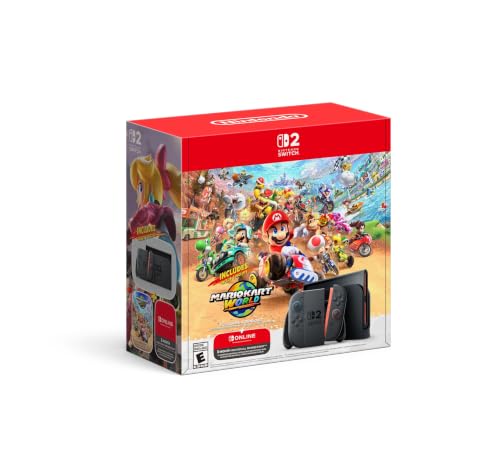
3. Nintendo Switch 2 + Mario Kart World Bundle
The Switch 2, a Mario Kart World download, and 3 months of Switch Online in a single purchase.
The pitch is straightforward: the Switch 2 system, the Mario Kart World digital download, and 3 months of Nintendo S than a full manufacturer term. It weighs 3.1 pounds, against 3.5 pounds for the Switch 2 Mario Kart bundle — a small difference that mostly shows up when you’re carrying it in a bag. Storage is 64 GB. On screen, it runs at 720p handheld and up to 1080p docked on the 7-inch OLED panel.
Owners describe these landing in genuinely good shape, and the build quality reads strong — the thing that wins people over is how close it feels to new. The appearance holds up too, with the Splatoon special edition looking the part. That’s the reason a renewed OLED makes sense: you get the screen without paying full new pricing.
Two honest notes before you buy. The Splatoon 3 game is not always in the box, despite the listing, so confirm what’s actually included before you order — it’s the single most common complaint on this listing. And as with any renewed console, functionality can vary, with a few units reported not powering on. The 90-day warranty is your safety net there. A quick test on arrival settles both concerns.
Why renewed OLED makes sense
- 7-inch OLED screen with 720p handheld and up to 1080p docked
- 64 GB of storage
- Splatoon 3 special edition styling
- 90-day limited warranty covers the early-failure window
Confirm before you order
- Splatoon 3 game is not always included
- Renewed units can arrive with power issues
- 90-day warranty, not a full manufacturer term
Worth it when: you want the OLED screen at a lower tier and you’re comfortable testing a renewed unit on arrival.
Not worth it when: the Splatoon 3 game is the reason you’re buying — verify the contents before checkout.
Know the Specs
Internal storage: 32 GB, 64 GB, or 256 GB
Storage is where downloaded games live, so it decides how many titles you can carry without a memory card. The original Switch models give you 32 GB, the OLED models give you 64 GB, and the Switch 2 gives you 256 GB. A portion of every one of those is reserved for the system itself, so the usable number is always smaller than the printed one. Expansion goes through a microSD card, and the Switch 2 uses the newer microSD Express format. If you mostly buy physical game cards, storage barely matters. If you buy digital, it’s the first thing to check.
Play modes: TV, Tabletop, and Handheld
Three play modes means the console works three ways: docked to your TV, propped on its own stand for a small group, and held in your hands. Every Switch on this list supports all three, which is the whole reason the platform works for a household where people play differently. Tabletop mode is the one people underestimate — it’s what makes a console shareable at a table without a TV nearby. Handheld mode is where the screen quality argument lives, and where OLED versus LCD actually shows up.
Battery ratings and why they vary
A battery rating on a Switch is always a range, because the game you’re playing decides how hard the system works. The standard Switch and the renewed black model both carry a rating of 4.5 to 9+ hours depending on software, with roughly 5.5 hours cited for a large open-world title. That range is the honest number — treat the low end as your realistic figure for a big game and the high end as a light indie session. If you play mostly handheld, plan for the shorter end.
Joy-Con attachment: rail versus magnetic
The original Switch Joy-Con slide onto a rail on each side of the screen. The Switch 2’s Joy-Con 2 controllers attach magnetically, which is a firmer connection and adds mouse controls in compatible games. The practical difference is how the console feels when you pick it up by one side and how quickly you can detach a controller to hand to a friend. Both systems support local wireless play, and the original supports up to 8 consoles connected locally.
Common Questions
Can the Switch 2 play my old Switch games?
Do I need a microSD card if I buy digital games?
Is a renewed Switch a bad idea compared with a new one?
How long does the battery actually last on a Switch?
What’s the difference between the OLED screen and the standard LCD?
Can I play multiplayer without an internet connection?
Does the Switch 2 output in 4K?
Which bundle is better if I don’t want Mario Kart?
Why does the Splatoon OLED bundle sometimes arrive without the game?
Is the standard Switch still worth buying over the OLED or Switch 2?
The Bottom Line
For most households, the switch gaming console that covers the widest ground is the Nintendo Switch with Neon Blue and Neon Red Joy‑Con, because it plays docked, propped up, and in your hands, and the whole family can use it without a second purchase. If the screen is where you spend your time, reach for the Nintendo Switch OLED Model w/White Joy-Con — the 7-inch OLED panel is the single biggest daily-use difference on this list. And if you want the newest hardware with 256 GB of built-in room for games, the Nintendo Switch 2 System is the one to plan around.
One last thing worth doing: decide between the two bundles before you buy, not after. The Mario Kart World bundle and the Choose Your Game bundle are the same console with a different download inside, and matching that game to what you’ll actually play is the difference between a great first night and a download you never open.
How we choose
We do not accept paid placement. Every pick is matched to a real buyer and a real use-case; we do not hands-on test units.
Sources
Specifications: manufacturer listings and product documentation. Review insights: verified customer reviews, as of November 2026. Pricing: not shown on this page (it changes often); check the current price via the retailer link.
As an Amazon Associate, Gamepad Test earns from qualifying purchases. This does not affect which products we feature.