
Heads up: This post contains affiliate links. As an Amazon Associate I earn from qualifying purchases, at no extra cost to you. Learn more
Specs are compiled from manufacturer listings and verified buyer reviews and can change over time — please confirm the key details on the product page before buying.
A 3-piece SUP paddle exists for one reason: to fit in your car, your closet, and your board bag without eating the whole trunk. The catch is that every joint you add is a place where a paddle can rattle, spin, or snap. So the real question is not which paddle looks best — it is which one stays stiff and quiet once you have clicked all three sections together. This guide covers six paddles that break down into exactly three pieces, and it tells you which ones people actually trust on the water.
This guide is built by comparing the manufacturers’ published specifications and the patterns across verified customer reviews, so you get each pick’s real strengths and trade-offs instead of marketing spin.
You will see shaft materials compared, blade sizes compared, and honest notes on where the clamps slip. Everything below is aimed at one job: picking the right 3-Piece SUP Paddle the first time so you are not re-buying next season.
Top Picks
How To Choose The Best 3-Piece SUP Paddle
Most buyers get this wrong by shopping blade graphics first. The shaft material and the clamp system decide whether you enjoy the paddle in month three. Start there.
Shaft material sets the weight and the arm fatigue
A carbon fiber shaft is the light end of the market. The Abahub paddle comes in around 30.5 oz (865g) at full assembly; the Overmont carbon model lists 1.7 pounds. Aluminum shafts, like the FunWater build, are cheaper but heavier in the hand. Over a 90-minute flatwater session, that weight gap is the difference between tired shoulders and fresh ones. Fiberglass sits between the two on weight and cost.
The clamp is where 3-piece paddles live or die
Every joint is a wobble risk. Look for a lever-lock clamp (a flip lever that squeezes the section tight) or an anti-twist clip with a rubber ring at the joint. SereneLife uses a lever-lock clamp; Overmont pairs an anti-twist clip with a rubber ring at the shaft joint. Two of these paddles ship with a written warning to check and tighten the clamp screws before first use — that is not fine print you skip.
Match the length range to your body, not the listing photos
The standard formula on these listings is your height plus 6 to 8 inches for surfing, and taller for flatwater and racing. A range like 71″ to 87″ (the SereneLife) or 67″ to 86″ (Abahub and OceanBroad) covers most adults. If you are under 5 feet, the Abahub listing explicitly says its adjustment range suits paddlers above that mark — check yours before you buy.
Blade area and float matter more than you think
Blade surface runs 98 square inches on the OceanBroad and 102 square inches on the Abahub, both with grooved or concave faces. A grooved face holds water without flutter, so the blade tracks straight through the catch instead of shimmying. Floating matters just as much: drop a non-floating paddle in deep water and you are swimming after it. Several of these list floatation, but owner experience on floating is genuinely split on a couple of models, so treat that claim as a nice-to-have you verify in shallow water first.
Side-by-Side Comparison
| Model | Best For | Length Range | Shaft Material | Stated Weight | Amazon |
|---|---|---|---|---|---|
| Abahub Carbon Fiber 3-Piece★ Best Overall | All-round first paddle | 67″–86″ | Carbon fiber | 30.5 oz (865g) | Amazon |
| Niphean 3/4-Piece SUP PaddleBest for Beginners | Beginners and family sharing | 66″–82″ | Aluminum alloy | 2 lbs (SUP mode) | Amazon |
| FunWater 3-Piece SUP Paddle | Budget-friendly spare | 165–215cm | Aluminum | — | Amazon |
| SereneLife 3-Piece SUP Paddle | Fast lever-lock adjustments | 71″–87″ | Carbon fiber | — | Amazon |
| OceanBroad Carbon Fiber SUP Paddle | Big-blade cruising | 67″–86″ | Carbon fiber | 1.9 lb | Amazon |
| Overmont Carbon Fiber Paddle | Travel-packed touring | 69″–85″ | Carbon fiber | 1.7 lb | Amazon |
Detailed Reviews
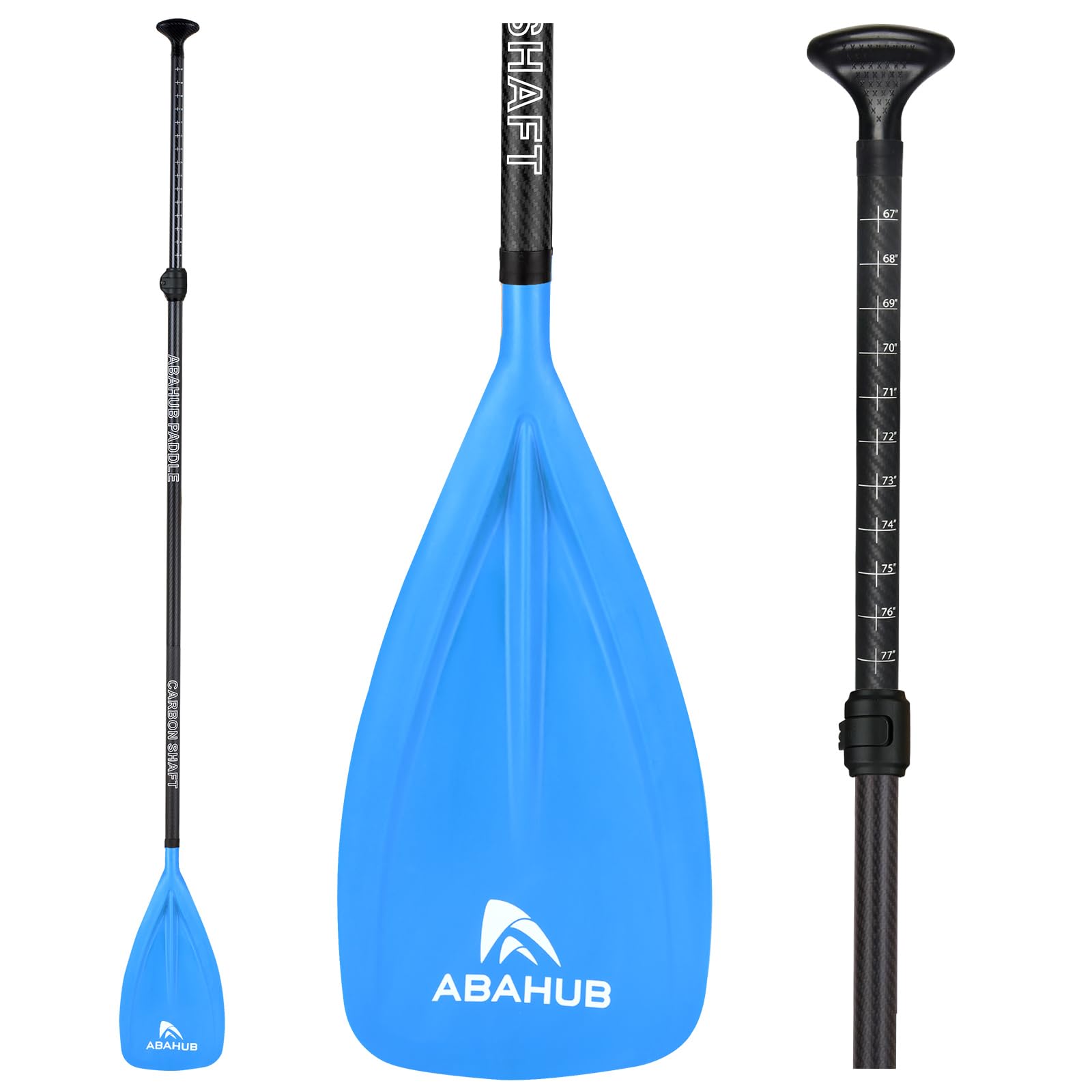
1. Abahub Carbon Fiber SUP Paddle 3-Piece
Our pick — 4.5+★ from 200+ verified ratings; the strongest balance of quality and price.
A carbon shaft with a 102 square inch grooved blade, at a weight your arms can live with.
The number that decides this pick is 30.5 oz — that is 865g for the whole assembled paddle, and it is the reason this one earns the top spot. A carbon shaft does two jobs at once here: it keeps the paddle light enough to stroke for hours without shoulder burn, and it keeps enough flex to survive a hard power stroke instead of cracking. The blade is a 40% fiberglass and 60% PP mix (PP meaning polypropylene, a tough plastic) across 102 square inches, with concave grooves that cut flutter so the blade tracks straight through the water.
Adjustment runs 67″ to 86″, or 170cm to 218cm, which covers most adults on the river. The listing’s own rule of thumb is your height plus 6 or 8 inches — do that math on a sticker before you paddle, because getting it wrong is the fastest way to hate a good paddle. The Abahub states it floats in all waters once fully assembled, which is the single most useful safety property on this list. It also ships with a 36″ x 10.6″ travel bag with a shoulder strap and an inner blade flap, which is the difference between a paddle in your trunk and a paddle in your trunk with a scratched blade.
Where you need to be careful is the durability question. Owner feedback splits: plenty of paddlers get seasons out of it, and some report it breaking in use. Read that as a fit note rather than a defect — if you are cranking full-power sprint strokes against surf, buy above this tier; if you cruise flatwater and pack it away properly, it holds. The clamps need a screw check before every first assembly, and the manufacturer says that outright. The paddle also has more reported quality wins than anything else in its feedback, so the build is not the worry — your stroke style is.
What earns the top spot
- Carbon fiber shaft keeps the whole paddle at 30.5 oz (865g), so long sessions cost your arms less
- 102 square inch blade with concave grooves for a straight, low-flutter power stroke
- Floats in all waters when assembled, so a dropped paddle is not a lost paddle
- Included 36″ x 10.6″ bag with shoulder strap and blade flap for real travel protection
- Adjusts 67″ to 86″ (170cm to 218cm) to cover most adult paddlers
What to weigh first
- Durability feedback is split — hard surf strokes against this blade are a known stress point
- Clamp screws need checking and tightening before each first use
- Listing says it suits paddlers above 5 feet, so shorter kids are out of range
Take this one if: you want one paddle that packs into a trunk, floats, and disappears from your hands while you stroke flatwater.
Look elsewhere if: your sessions are surf-heavy and you regularly bury the blade at full power — the split durability feedback points at that exact use.
2. Niphean 3/4-Piece Kayak Paddle
Packs down to a 32.28 inch bundle — the shortest packed footprint of the group.
Here is the exact comparison that sells this one: packed down, the Niphean measures 32.28 x 9.84 x 1.97 inches, against 86.61 x 7.64 x 1.46 inches for the SereneLife. The Niphean disappears into a hatch or a duffel where the SereneLife would not. For anyone carrying a board in a small car, that is the deciding fact, not the blade.
The build is an aluminum alloy shaft with a fiberglass and PP (polypropylene) blade, and it adjusts from 66″ to 82″ (170cm to 211cm) in seconds. The handle is a non-slip, easy-to-hold design that stays grippable when wet or sweaty. It weighs 2 lbs in SUP mode and 2.95 lbs set up as a kayak paddle, which tells you it does double duty if you also paddle a kayak. Niphean backs it with a 12-month complete replacement guarantee, and the quality of the build is what wins people over most — it is the single most-praised trait in its feedback by a wide margin.
The honest counterweight: floatability and stability draw real disagreement from owners. Some say it rides the surface fine; others say it sinks when laid flat. Stability is the weakest trend, with paddlers reporting the sections not staying put and the paddle coming apart in the water. That does not make it a bad buy — it makes it a beginner’s paddle you assemble carefully and tighten firmly at every joint. Treat the joints as the job and this purchase makes sense.
Where it wins: packed size and a real replacement guarantee. The 32.28 inch packed length is the tightest on this list, and a 12-month complete replacement takes the sting out of a first-paddle mistake.
The caveat to respect: floatation and joint stability split owners — check the clamps are seated hard before you commit the paddle to deep water.
Reach for this if: storage space is tight and you want a convertible SUP-to-kayak paddle with a year of cover behind it.
Pass if: you need a paddle you never think about again — the joint stability reports mean this one rewards a careful setup routine.
3. SereneLife SUP Paddle 3 Piece
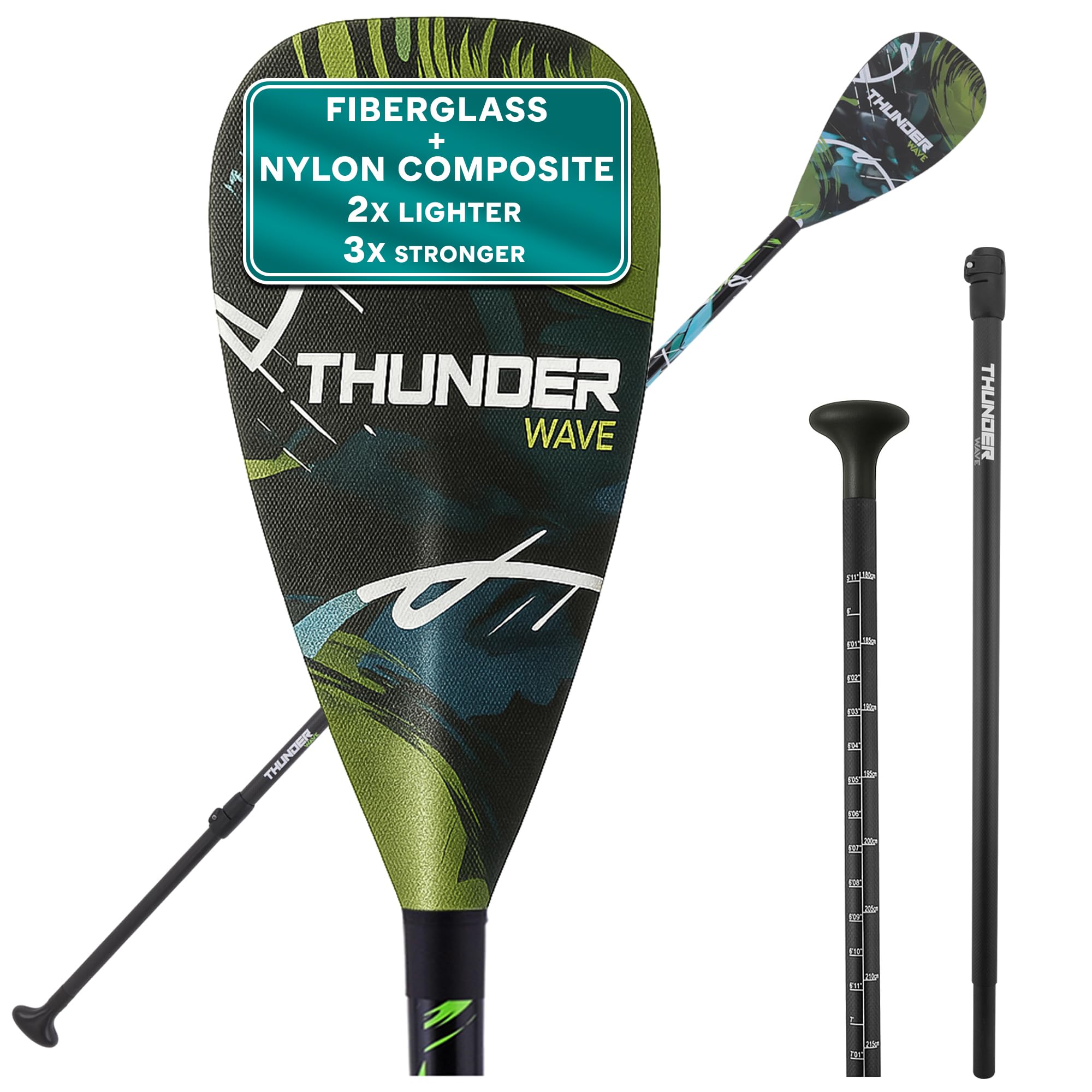
The tallest setting here, for the paddler who is tired of a paddle that tops out too short.
If you are tall, or you race, this is the range that fits: 71″ to 87″, against the Abahub’s 67″ to 86″ and the Niphean’s 66″ to 82″. SereneLife also gives you the clearest length guidance in the group. The listing spells out your height plus 6-8″ for surfing, 8-10″ for flatwater, and 10-12″ for racing, so you can solve your own number instead of guessing.
The lever-lock clamp is the other reason this one earns its place — a flip lever tightens the section fast, with no screwdriver and no fumbling on a windy beach. The shaft is carbon fiber, the model name is the SLPADDLE30, and it breaks into three for transport with a carrying bag with a zip and handle included. It ships in a 37.5 inch package, so budget trunk space accordingly. What wins people over most is quality, with value close behind, and the functionality notes are uniformly positive.
Now the trade-off to size honestly. Floatability is genuinely split in owner experience — half say it moves the board through the water nicely, half say it does not float at all. That is a real discrepancy rather than a fluke, so if you paddle deep water, leash it to yourself or stay shallow until you have tested it. The tall range also means more shaft extension, so check that clamp screw is snug at your height before your first session.
The tall-paddler answer: an 87″ maximum and an explicit height-plus-inches formula make this the easiest of the six to size correctly.
Keep an eye on: floating is the one claim here owners cannot agree on — leash it or test it in the shallows first.
Made for: tall paddlers, racers, and anyone who wants a flip-lever clamp instead of a fiddly screw.
Not your pick if: you plan long solo crossings where a sunken paddle would end the session — the float report is too inconsistent to bank on.
4. OceanBroad Carbon Fiber SUP Paddle

A 98 square inch grooved nylon blade on a carbon shaft, built to grab water and hold it.
Start with the blade, because that is where this paddle makes its case. It measures 98 square inches with a curved and grooved face, and the point of those grooves is stability — the blade resists over-flex and flutter, so your stroke pushes water backward instead of sideways. The blade itself is UV-stable fiberglass-reinforced nylon, which is the price-friendly way to get a stiff blade. The carbon fiber shaft holds the whole assembled paddle to roughly 850g, or 30 oz, which is why owners describe it as very light rather than merely acceptable.
Then the joint detail that earns its keep on a 3-piece: an upgraded patterned oval handle plus an extra clamp that double-secures the third section with almost zero tolerance, and water stoppers in the assembly. In plain terms, two things hold that last section instead of one, which is exactly what a travel paddle needs. It adjusts 67″ to 86″ (170cm to 218cm) so families of different heights can share it, and it breaks down to 3 pieces with a maximum section length of 37″. A travel bag is in the box.
The drawback that repeats most is the clamp itself. Some paddlers report the handle portion spinning inside the clamp, and the overall durability picture is divided — some call it sturdy, others report a break in normal use. So: tighten those clamp screws every session and this paddle delivers its big blade and its 30 oz weight happily. Assume it self-secures and you may meet the spin.
Why the blade fans stay: 98 square inches with a grooved, UV-stable face gives you a stroke that feels planted, not sloshy.
Worth knowing: carbon at around 850g (30 oz) with a double-clamped third section — a lot of shaft discipline at this tier.
Pick this for: cruisers who want a big, stable blade and a light shaft, and who do not mind a two-second clamp check before launch.
Think twice if: you want a paddle that never needs attention — the spinning-handle report is small but real.
5. Overmont Carbon Fiber Paddle Board Paddle

At 1.7 pounds, this is the lightest paddle on the list by its own spec sheet.
Weight is the whole pitch. Overmont lists 1.7 pounds with a carbon fiber construction, against the OceanBroad’s 1.9 pounds and the Abahub’s 30.5 oz — and for a paddle you carry down a trail to the put-in, that is the number that changes your day. The carbon build is also aimed at stiffness, so the stroke feels responsive rather than flexy, and the maker frames it as a way to cut arm fatigue on longer touring sessions. Adjustability is 69″ to 85″, or 175 to 215 cm, tightened by a secure anti-twist clip.
Where this one thinks harder than the rest is the joint. A quick-release button handles assembly and breakdown, a rubber ring at the shaft joint damps unwanted movement once the sections are together, and an anti-twist locking system holds them in line. For a 3-piece paddle, that rubber ring is a genuinely useful detail — it is the cheap fix that stops the rattle that plagues travel paddles. The curved T-grip rests in your palm for steering control, and it breaks down for storage in a car, RV, or gear bag.
The friction point is stability. Some owners find it rigid even when paddling hard; others call it flimsy and report it breaking quickly, and functionality opinions divide the same way. Value is the counterweight — owners rate it as excellent value and say they would buy it again — so the paddle is not the problem, the expectation is. If you treat this as a light recreational touring paddle and not a surf stick, it earns its keep.
Standout specs
- 1.7 pounds — the lightest listed weight in this group
- Rubber ring at the shaft joint reduces wobble after assembly
- Anti-twist locking system keeps the three sections aligned
- Quick-release button for fast breakdown into a car or RV
- Curved T-grip for steering control in your palm
Where it asks more of you
- Stability feedback splits — fine for cruising, contested for hard paddling
- Functionality draws mixed opinions from owners
- 85″ top end puts the tallest paddlers near the ceiling of its range
Best matched to: the paddler who walks to the water and wants the least weight on the carry.
Step up instead if: you need to lean hard into the blade — stability is contested here in a way the Abahub’s carbon build is not.
6. FunWater SUP Paddles 3 Piece
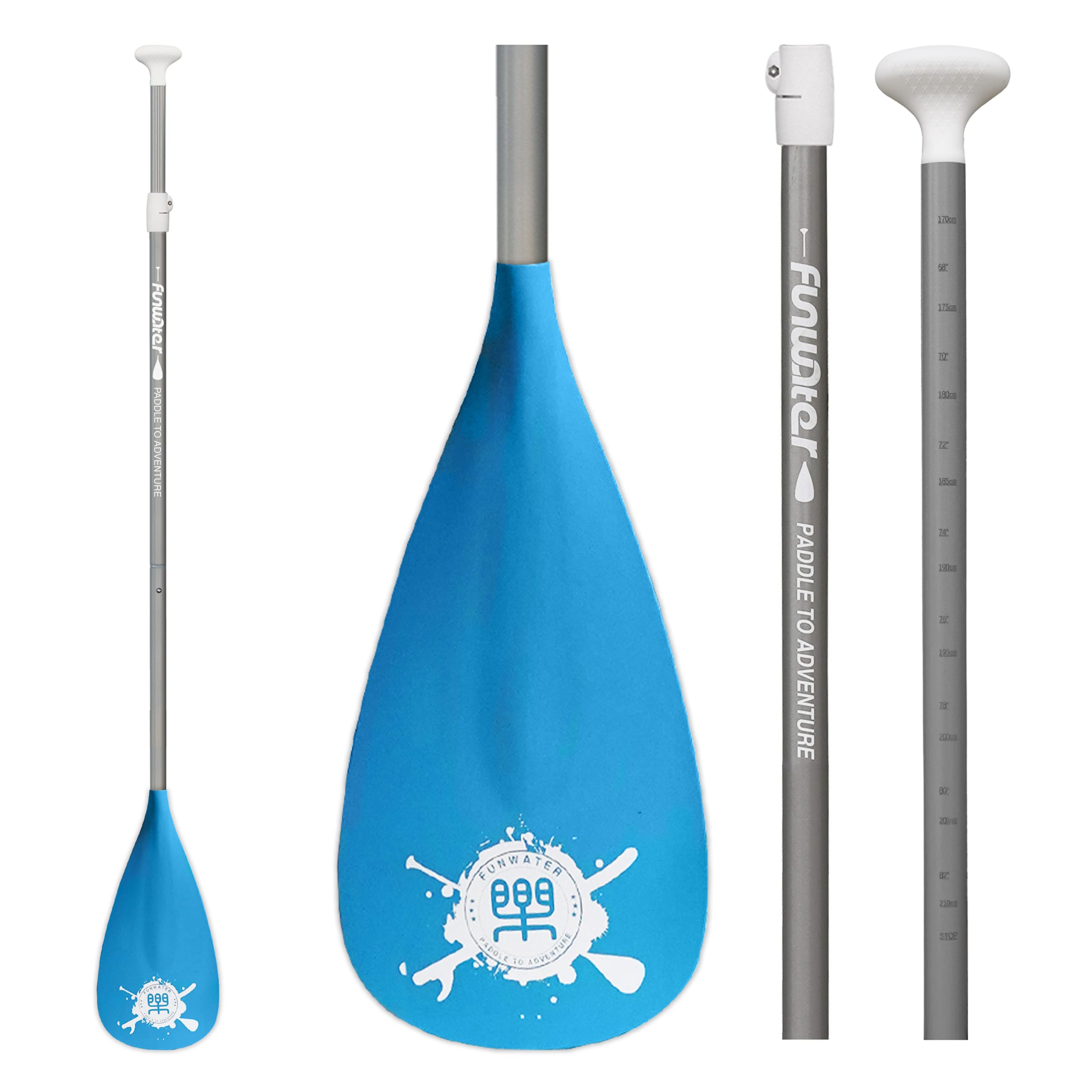
The aluminum alloy starter paddle that gets you on the water without a big outlay.
This is the entry point of the list, and it is honest about what it is: a high-quality aluminum alloy shaft reinforced with aluminum rods, adjusting from 165cm to 215cm. The blade has an inclined shape and size meant to give a longer stroke than a standard kayak blade, plus a comfortable handle grip for a firmer hold. It floats, so if you fumble a handoff it stays on the surface instead of sinking out of reach. It breaks into 3 stages for travel and storage.
Owner feedback here is a mixed bag, and you should hear it straight. The construction and functionality notes are positive — the paddle is well made and it works. But durability is the loudest theme, with multiple reports of it breaking on first use or not holding up over time, and quality and value both split roughly down the middle. That is not a hidden flaw; it is a thin material margin at the bottom of the market. It suits a lake weekend or a spare to keep in the car, not a paddling season you plan to lean on.
If you are testing whether you even like SUP, this gets you there for the least money and floats while you learn. If you already know you will paddle every weekend, the Abahub carbon build is the longer-term money. Buy this one as the experiment, not the commitment.
The case for it: aluminum and an adjustable 165–215cm range get you paddling, and the float means a dropped paddle bobs instead of vanishes.
The honest limit: durability is the most-discussed theme in its feedback and not cheerfully — treat this as a light-use spare, not a season-long workhorse.
Good first buy for: an occasional lake day, a spare to leave in the car, or a rental-grade extra for guests.
Buy above it if: you paddle weekly — the strong carbon alternatives here are built for the long haul this one is not.
Know the Specs
Shaft material and the weight number
The shaft is the long tube you hold, and its material sets the paddle’s weight. Carbon fiber is the light option — the Abahub comes in around 30.5 oz (865g) and the Overmont at 1.7 pounds. Aluminum alloy, used on the FunWater and Niphean, is heavier and cheaper. A carbon shaft is lighter than an aluminum one, and you feel that in your shoulders by hour two. Fiberglass blades sit between the two on stiffness.
Adjustment range and how to match it
Each paddle lists a range like 67″ to 86″, which is simply the shortest and longest it reaches. The standard formula on these listings is your height plus 6 to 8 inches for surfing, and more for flatwater and racing. Pick a paddle whose range comfortably contains your number, not one where you sit at the very top or bottom. The SereneLife goes to 87″ and the Niphean tops at 82″, so the ceiling matters if you are tall.
Blade surface area
Blade size is measured in square inches, and it changes how much water you catch per stroke. The Abahub lists 102 square inches and the OceanBroad 98, both with grooved faces that cut flutter. Grooves keep the blade from wobbling, so your stroke pushes you forward instead of sideways. A bigger blade catches more water but takes more strength per stroke, so beginners often prefer a smaller face while racers want the surface.
Clamps, joints, and floatation
Three pieces mean two joints, and each joint is a spot where a paddle can spin or rattle. Look for a lever-lock clamp, an anti-twist clip, or a rubber ring at the joint to keep things snug. Floatation is a separate claim worth checking: the Abahub states it floats in all waters when fully assembled, while the Niphean and SereneLife float reports are split. Test any floating claim in shallow water before you trust it in deep water.
Common Questions
Is a 3-piece paddle worse than a one-piece paddle?
How do I know what length to set my SUP paddle?
Do these paddles actually float?
Is a carbon fiber shaft worth the extra over aluminum?
Does a bigger blade make a paddle faster?
What should I check before my first paddle with a 3-piece SUP paddle?
Can I use a 3-piece SUP paddle for kayaking?
How do I store a 3-piece paddle so it lasts?
Is the handle supposed to be removable on these paddles?
Which of these paddles is lightest for carrying to the water?
The Bottom Line
For most paddlers, the 3-piece sup paddle to buy is the Abahub Carbon Fiber 3-Piece, because it pairs a carbon shaft you can stroke for hours at 30.5 oz with a 102 square inch grooved blade, a stated float claim, and a real travel bag. If tall-paddler fit is your worry, the SereneLife reaches 87″ on a lever-lock clamp. And for a light tourer who walks to the put-in, the Overmont at 1.7 pounds is the one to grab.
How we choose
We do not accept paid placement. Every pick is matched to a real buyer and a real use-case; we do not hands-on test units.
Sources
Specifications: manufacturer listings and product documentation. Review insights: verified customer reviews, as of November 2026. Pricing: not shown on this page (it changes often); check the current price via the retailer link.
As an Amazon Associate, Gamepad Test earns from qualifying purchases. This does not affect which products we feature.