
Heads up: This post contains affiliate links. As an Amazon Associate I earn from qualifying purchases, at no extra cost to you. Learn more
Specs are compiled from manufacturer listings and verified buyer reviews and can change over time — please confirm the key details on the product page before buying.
Most 48V e-bike batteries die early for one boring reason: the amp-hour rating and the physical fit were checked, but the discharge current limit and the BMS board were not. This guide sorts three real 48V packs by voltage fit, amp-hour capacity, and the BMS board that decides whether your motor gets fed or choked.
This guide is built by comparing the manufacturers’ published specifications and the patterns across verified customer reviews, so you get each pick’s real strengths and trade-offs instead of marketing spin.
You will see the exact amp-hour, BMS amp rating, and case size that decides whether a pack drops into your frame or sits on the shelf, so the hunt for the 48v lithium ion battery for e-bike ends with a pack that actually fits and runs.
Top Picks
How To Choose The Best 48V Lithium Ion Battery for E-Bike
A 48V pack is only half the decision. The other half is whether the pack can feed your controller without tripping its own protection board, and whether the case drops into the space your frame actually has. Get the voltage right and the other two wrong, and the battery sits in a box.
Match the BMS amp rating to your controller first
The BMS (battery management system — the small circuit board inside the pack that cuts power when something goes wrong) has a current limit, and the controller pulls current the moment you climb or twist the throttle. A 30A board and a 40A board behave very differently on a 1000W motor. Look at your controller’s rated current before you look at the price tag.
Read amp-hours as distance, not as a spec number
Amp-hours (Ah) are the fuel tank. A 20Ah pack holds twice the charge of a 10Ah pack, and that is the single clearest distance signal on the spec sheet. If your commute is short and flat, a 10Ah pack covers it. If you ride loaded or hilly, the bigger tank is what keeps you from pedaling a dead bike home.
Measure the frame before you trust the listing
Case dimensions are published for a reason. Battery space is fixed by your frame triangle or rear rack, so grab a tape measure before ordering. A pack that is 14.47 inches long will not slide into a frame that was built for a 10.6-inch case, no matter how good the specs look.
Decide between lithium ion and LiFePO4
Lithium ion packs are the lighter, more common choice. LiFePO4 (lithium iron phosphate — a different cell chemistry the maker rates as non-combustible) trades some weight for heat tolerance and long cycle life. Neither is wrong; they solve different problems, and the weight difference shows up every time you lift the bike onto a rack.
Side-by-Side Comparison
| Model | Best For | Capacity | BMS Rating | Case Size | Amazon |
|---|---|---|---|---|---|
| LFPNERYE 48V 10AH 5Pin★ Best Overall | Short, flat commutes | 10 Ah | 30 A | 14.47 x 3.7 x 3.5 in | Amazon |
| BtrPower 48V 20AH LiFePO4 | Long range, heavier loads | 20 Ah | 40 A | 10.6 x 5.5 x 3.74 in | Amazon |
| Joyisi 48V 20AH with Charger | Big motor builds and full kits | 20 Ah | 40 A | 14.5 x 3.5 x 4.5 in | Amazon |
Detailed Reviews
1. 48V 10AH Lithium Battery
Our pick — 4.0+★ from 60+ verified ratings; the strongest balance of quality and price.
The pack that slips into bikes built around compact frames and keeps the wiring simple.
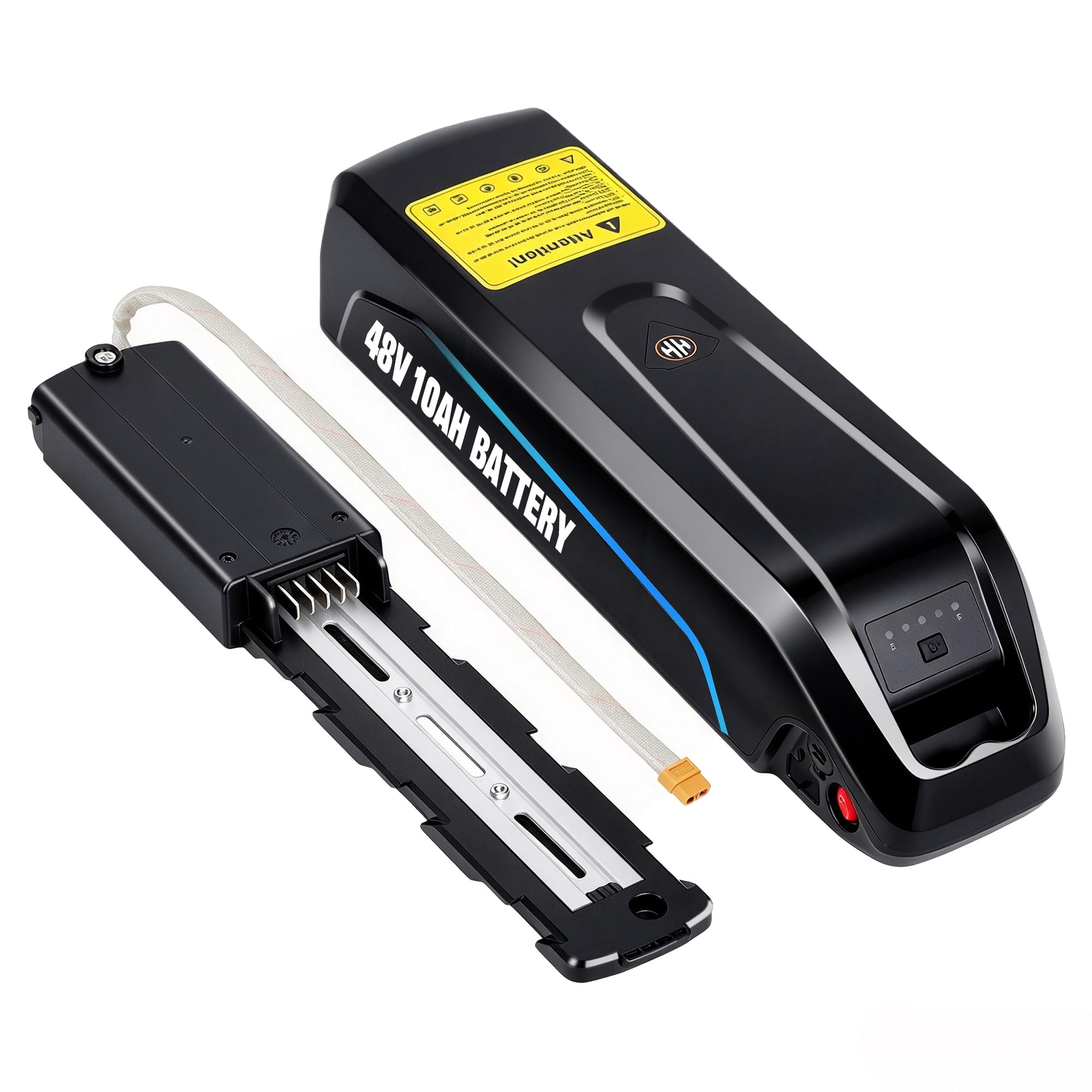
The 5Pin discharge socket is the reason this one leads the group. That connector is a slot-and-pin mount, so the battery drops onto the included mounting plate and locks in with the two supplied keys — no soldering, no adapter hunt. If your controller already uses a 5Pin interface, this is the closest thing to a plug-and-play swap you will find here. The kit bundles the male XT-60 pigtail too, so you can wire the other end of your harness without a second order.
This pack earns its keep by fitting where others won’t. At 14.47 x 3.7 x 3.5 inches, it is a long, slim case that slides into rear-rack trays and slim frame triangles. The 30A BMS (the protection board that caps current) supports motors rated 0 to 1000W, so you can run a 1000W motor without tripping the board. The charge port takes a 54.6V 3A charger — the correct top voltage for a 48V pack — so the charger and battery are matched from the start rather than guessed at. On capacity, 10Ah is the smallest tank of the three here; the BtrPower holds 20Ah, a 2.0x gap that shows up as roughly double the charge in the tank.
Build quality wins people over — the internal boards and cell welds come up again and again in the review pages, and the quality of the assembly is the most-praised part of the pack by a wide margin. Installation lands well too: the mount plate and pre-keyed lock make it a bolt-on job rather than a wiring project. The honest trade-off is the 30A limit — a 1000W motor at full throttle with a heavy rider can pull close to that ceiling, so riders who climb all day should size down their expectations or size up to a 40A pack.
What pushes it to the top
- 5Pin socket and included mounting plate make swapping a bolt-in job
- Two keys shipped so a spare stays home — a genuinely useful detail on a keyed lock
- Matched 54.6V 3A charger voltage, no guesswork
- Built-in 30A BMS with active equalization keeps cell voltages level
- Maker-rated for more than 1,000 recharge cycles
Where it runs out of road
- 10Ah is the smallest capacity in this lineup
- 30A current limit is tight for full-throttle 1000W use
- Long case length rules out smaller frame triangles
Made for you if: you run a 5Pin-equipped bike under 1000W and want the simplest install path on this list.
Keep looking if: your controller pulls near 30A on hills or you need big range from a single charge.
2. 48 V 52 V 18AH / 20AH 30AH 40AH 50AH LiFePO4 Ebike Battery
Twenty amp-hours of lithium iron phosphate, and a case shaped to fit where long packs cannot.
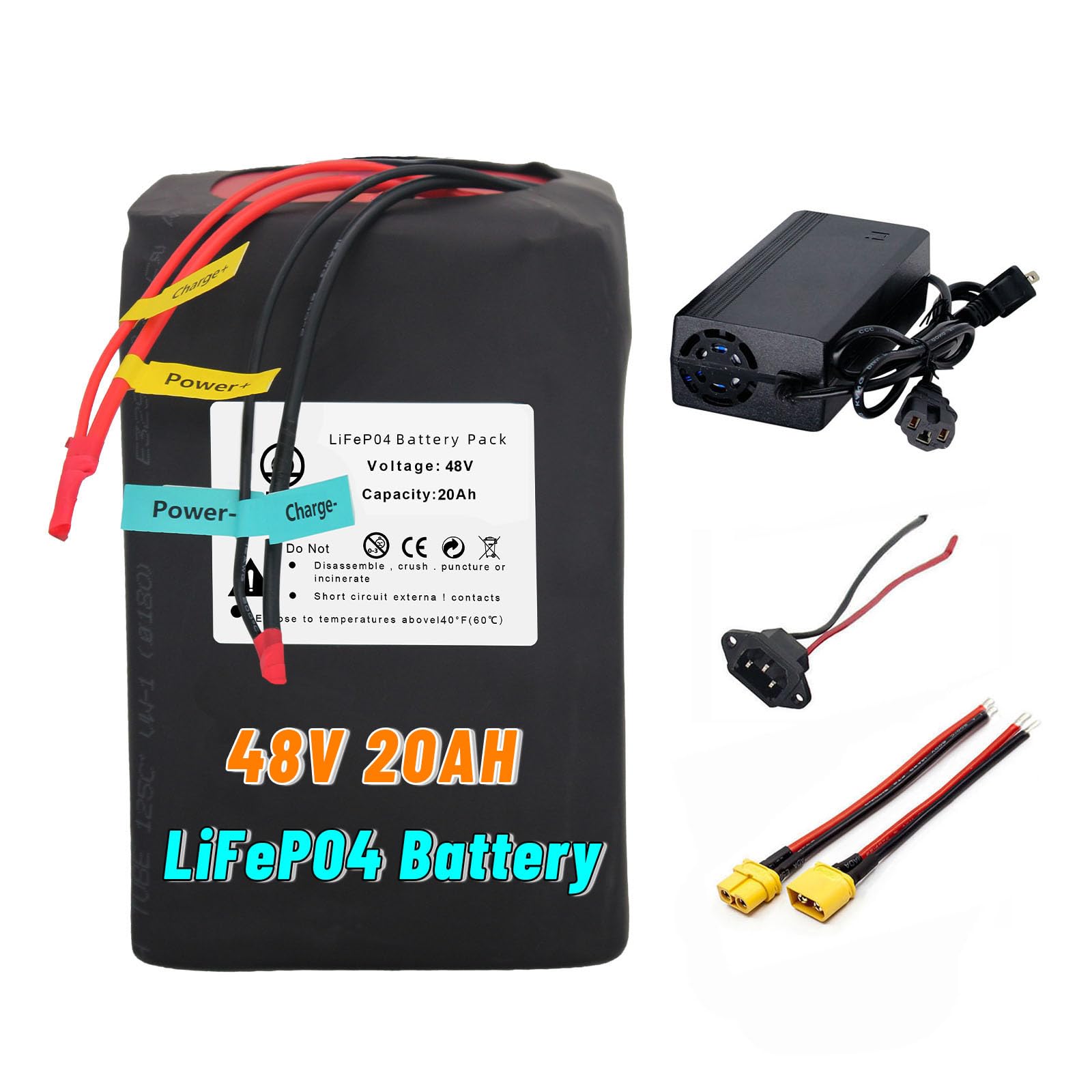
Double the capacity of the LFPNERYE pack, in a shorter case. The math here is simple: 20Ah against 10Ah is a 2.0x capacity gap, and the maker rates it at 20+ miles per charge without pedaling. The dimensions tell the other half of the story — 10.6 x 5.5 x 3.74 inches is a short, fat box rather than a long slim one. That shape is the reason this pack fits rear racks and wider triangles where the 14.47-inch case simply will not go. Compared head to head, the BtrPower takes up 37% more volume in the body but reclaims it in a footprint that clears shorter frames.
The 40A BMS is the second big difference. That board supports motors up to 1500W and holds a max constant discharge current of 40A, which is 33% more current headroom than the 30A board on the LFPNERYE. Put plainly, a 1500W build that would choke a 30A pack has room to breathe here. The LiFePO4 chemistry is a deliberate choice too: the maker rates the cells incombustible, and it tolerates heat better than standard lithium ion cells. Expect a 6.5-hour charge time from empty, and expect the pack to sit heavy on the frame at 11.7 pounds.
Owners talk most about straightforward performance — it works, it keeps working, and it does not throw faults. Several go further and rate the cell quality as the best they have used. The catch worth knowing before you order is voltage behavior: because LiFePO4 cells settle after charging, the pack reads in the 53.6V to 58.4V range at full charge, and it is normal for voltage to fall back to 3.35V per cell after it powers off. If your display throws a low-voltage warning right after a fresh charge, that is the chemistry, not a dead pack.
The verdict: the best capacity-per-fit trade on this list for riders who want distance from a compact footprint.
Check this first: confirm your controller and display are happy with LiFePO4 voltage ranges, and budget for the 11.7-pound weight.
3. Joyisi 48V 20AH Ebike Battery

A full kit for the rider building up a 1500W rig from a bare frame.
This is the pack for the person assembling a bike rather than replacing a battery. The 48V 20Ah cell set is built around LG cells, and the 40A BMS board covers overcharge, over-discharge, over-current, and short-circuit protection. It arrives with a 3A charger, so you are not buying a charger separately — and the charger is the one part of this kit that draws the most divided opinion. Expect to charge for at least 8 hours with the switch open, and wait for the light to turn from red to green before you ride.
Size matters with this one. At 14.5 x 3.5 x 4.5 inches it is the longest and tallest case of the three, so measure your frame first. The upside of that bigger shell is the extras: a black hard plastic case that shrugs off knocks, an LED battery-level light so you can see your charge at a glance, and a USB port that lets you top up a phone mid-ride. The XT60 connectors come standard, and the maker says other connector types can be arranged by contacting them.
What owners talk about most is battery life — the pack holds up through repeated cycles, works better as it settles in after a few charges, and holds its output on long rides. Quality is close behind, with the cells described as flawless by most buyers. The durability picture is more mixed: the shell and cells hold up well, but a handful of packs have needed a second look after months of use. Mounting draws a similar split — the bracket system works for most frames, though a few riders had to shim it to sit flat. What everyone agrees on is the power output, which was never called out as weak.
The real buying case: you get the cells, the 40A board, the charger, and the USB port in one box, which makes a bare-frame build simpler than sourcing each part separately. The maker’s 1000+ deep-cycle rating on the cells matches the long-life reports.
Where to be careful: the charger is the weak link in an otherwise strong kit — a few owners found it slow or fussy about the charge routine, so plan on the full 8-hour window rather than a quick top-up.
Right for builders: riders pairing a 1000W-class motor with a fresh frame who want cells, BMS, and charger in a single order.
Not the fit if: you need a quick-charge routine or a case that slides into a tight triangle.
Know the Specs
Voltage (the 48V in the name)
Voltage is the pressure the pack pushes into your motor, and 48V is the common standard for mid-power e-bike builds. Your controller must be rated for 48V or the pack will not work, and a 48V charger must top out near 54.6V — that is why matched chargers list a top voltage higher than the pack’s nominal number. Never drop a 52V or 36V pack into a 48V system and expect clean behavior.
Amp-Hours (Ah)
Amp-hours are the size of the fuel tank. A 20Ah pack holds twice the charge of a 10Ah pack, and the maker’s rated riding distance scales with it. Buy Ah for your longest typical ride, not your average one, and remember that heavier riders and hilly routes drain the tank faster than flat commuting.
BMS Amps (30A vs 40A)
The BMS board is the pack’s internal traffic cop, and its amp rating is the ceiling on current the pack will deliver. A 30A board suits controllers rated at or below 30A; a 40A board (33% more current headroom in this lineup) is what you want for a 1000W or 1500W build that pulls hard on climbs. Match this number to your controller’s rated current before anything else.
Case Size and Connector Type
Case dimensions decide whether the pack fits your frame, and the connector type decides whether it plugs into your existing wiring. 5Pin sockets mount to a plate and lock with a key; XT60 connectors are the standard bullet-style plugs on many DIY builds. Measure your battery space and check your controller’s plug before you order — the wrong combination means a return.
Lithium Ion vs LiFePO4
Standard lithium ion cells are lighter and more common. LiFePO4 cells are the heat-tolerant chemistry, maker-rated incombustible, with a long cycle life. The trade-off is weight: a LiFePO4 pack tends to sit heavier on the frame. Pick the chemistry for your climate and how much you lift the bike.
Charge Time and Charger Matching
Charge time runs from 6.5 hours on a 20Ah pack to a required 8-hour window on another. The charger must match the pack’s chemistry and voltage; a mismatched charger is the quickest way to cook a good battery. Pay attention to whether a charger is included or sold separately.
Common Questions
Will a 48V 20Ah pack work with my 1000W motor?
Why does my LiFePO4 battery read 53.6V to 58.4V instead of exactly 48V?
Do I need a special charger for a 48V pack?
Can I swap a 10Ah battery for a 20Ah one in the same bike?
What does the BMS actually do?
How long should I charge a new e-bike battery the first time?
Are LiFePO4 batteries safer than standard lithium ion?
Will the 5Pin socket on the LFPNERYE fit my existing controller?
How heavy is a 48V 20Ah battery to carry?
Do these batteries include a warranty?
The Bottom Line
The pack to start with is the LFPNERYE 48V 10Ah 5Pin battery, because the 5Pin socket and included mounting plate make it the simplest install of the three. It also has the strongest build reputation in its class, backed by 4.0+ stars, and it is the value leader of the group. The BtrPower 20Ah runs it close on performance and wins clearly on range, so riders who need to go farther should look at the BtrPower LiFePO4 pack for its 40A board and 20Ah capacity.
If you are assembling a bike from a bare frame, the Joyisi 48V 20Ah kit bundles the charger, the USB port, and the 40A protection board in one order. Whichever you choose, measure the frame first and match the BMS amps to your controller — those two checks decide whether the pack ends up in the bike or back in the box.
How we choose
We do not accept paid placement. Every pick is matched to a real buyer and a real use-case; we do not hands-on test units.
Sources
Specifications: manufacturer listings and product documentation. Review insights: verified customer reviews, as of November 2026. Pricing: not shown on this page (it changes often); check the current price via the retailer link.
As an Amazon Associate, Gamepad Test earns from qualifying purchases. This does not affect which products we feature.