
Heads up: This post contains affiliate links. As an Amazon Associate I earn from qualifying purchases, at no extra cost to you. Learn more
Specs are compiled from manufacturer listings and verified buyer reviews and can change over time — please confirm the key details on the product page before buying.
You want a sharp edge you can trust, not a wheel that shakes the bench and scorches your chisel. The short answer: a low-RPM, six-inch grinder with cast-iron weight behind it gives you control, and the WEN 4276 is the one most people should buy first if they want a workhorse that runs smooth and costs little. This page explains what each model does well, and which one fits your bench.
This guide is built by comparing the manufacturers’ published specifications and the patterns across verified customer reviews, so you get each pick’s real strengths and trade-offs instead of marketing spin.
Below you will find eight 6-inch grinders lined up by what they actually do, from slow-speed sharpening rigs to high-speed general-duty wheels. Compare the wheel size, motor and base before you click, because the right 6 Inch Bench Grinder is the one that matches your sharpening routine.
Top Picks


How To Choose The Best 6 Inch Bench Grinder
A six-inch grinder is a small machine with a big job: it spins two abrasive wheels so you can bring a dull edge back to life. The wheel diameter is the fixed part. The rest, from motor speed to base material, is what decides whether the tool feels like a precision instrument or a shaky toy. Start here before you look at any model.
Speed decides how much control you get
Low-speed models turn at 1750 RPM, which is half the pace of a high-speed unit. At 1750 RPM the abrasive bites instead of scorching, which suits chisels, plane irons, and carving tools where heat ruins the temper. High-speed models run at 3450 RPM and remove metal faster, which suits rough shaping and reviving old lawn-mower blades. Pick a speed that matches the edge you sharpen most.
Grit and wheel compound set the finish
Grit is the size of the abrasive particles in the wheel. A 36-grit wheel is coarse and chews through material, while a 60-grit or 80-grit wheel smooths the edge after shaping. Most six-inch grinders ship with one coarse and one fine wheel, so you can shape on one side and finish on the other. Check the included grits, because a pair that matches your work saves you from buying wheels separately.
Vibration, base weight, and stability matter more than horsepower
A grinder that wobbles grinds a wavy edge instead of a flat bevel. Look for a cast-iron or cast-aluminum base, rubber feet, and a design that holds the wheels true. A heavier body tends to settle on the bench and reduce shake, while a light body can skate when you press the steel into the wheel. A grinder that shifts mid-pass tips the bevel off angle and digs the wheel into the edge.
Safety extras are non-negotiable
A clear eye shield keeps flying debris out of your face, and a spark arrestor directs hot metal away from your hands and bench. Look for adjustable shields so you can angle them to the wheel. A tool rest that adjusts without tools lets you hold a steady angle, which is the whole point of grinding an edge rather than guessing at it.
Side-by-Side Comparison
| Model | Best For | Motor | Speed | Weight | Amazon |
|---|---|---|---|---|---|
| WEN 4276★ Best Overall | All-around home workshop | 2.1-Amp | 3450 RPM | 16 lb | Amazon |
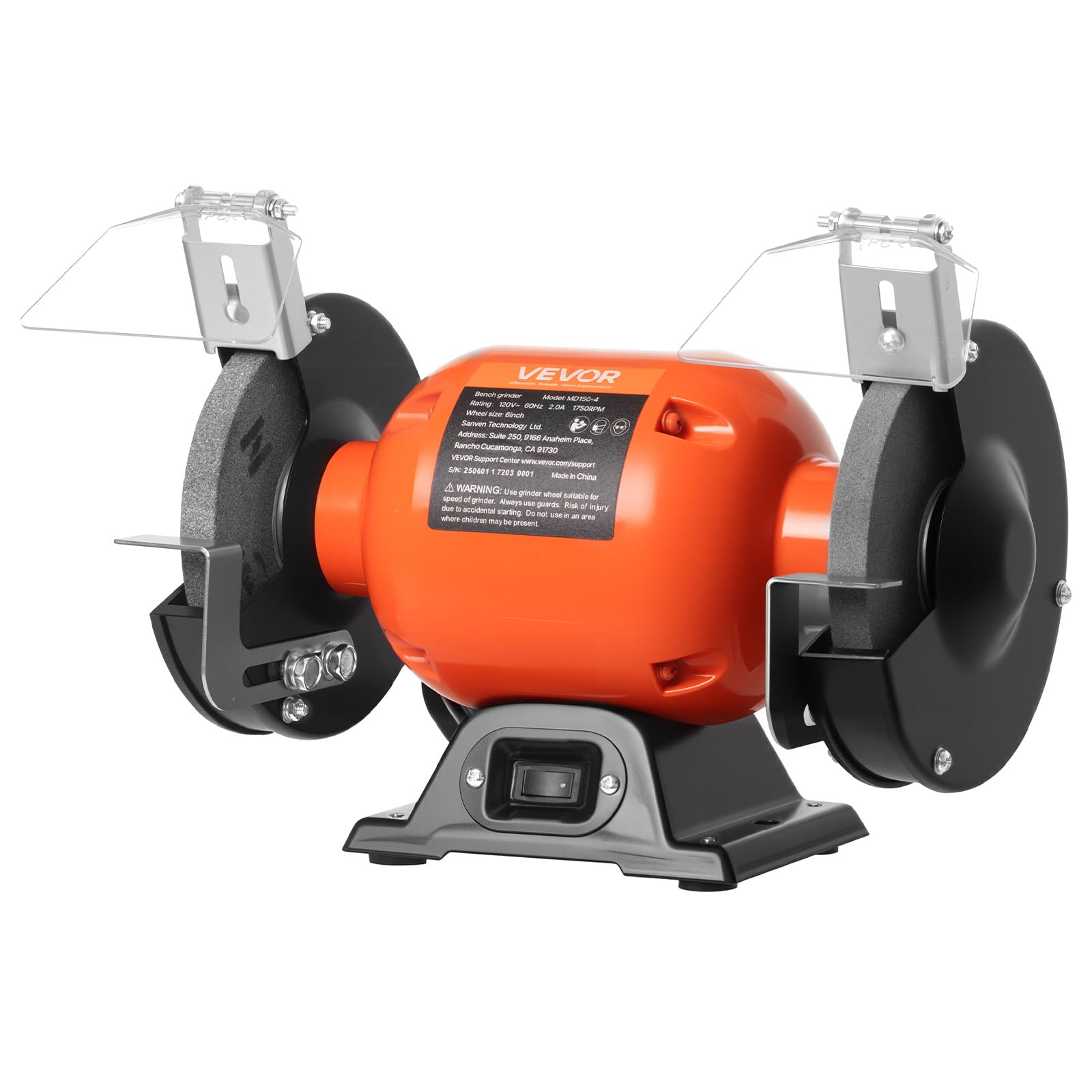
| VEVOR MD150-4Top Precision | Precision low-speed work | 250W, 2.0A | 1750 RPM | 17.3 lb | Amazon |
| WEN BG4260Budget Sharpener | Budget sharpening | 2.1-Amp | 3450 RPM | 14 lb | Amazon |
| Genesis GBG600L | Lighted dual-wheel work | 1/2 HP | 3550 RPM | 20 lb | Amazon |
| BUCKTOOL TLG-150S | Chisel and blade sharpening | 1/3 HP | 1750 RPM | 10.16 kg | Amazon |
| Woodskil TDS-150CL-A | High-speed general grinding | 1/2 HP, 2.8A | 3450 RPM | 7.71 kg | Amazon |
| Grizzly G9717 | Versatile all-round grinding | 1/3 HP | 3450 RPM | — | Amazon |
| JET JBG-6 | Quiet, smooth long sessions | 1/4 HP | 3450 RPM | 32 lb | Amazon |
Detailed Reviews
1. WEN 4276 Bench Grinder
Our pick — 4.5+★ from 4,500+ verified ratings; the strongest balance of quality and price.
The go-to home grinder that quietly sharpens a shop full of dull edges.
Here is the one most buyers land on first: a 2.1-amp motor that turns 6-by-3/4-inch wheels at 3450 RPM at no load, with a 1/2-inch arbor. That speed is quick enough to bring back a mower blade or an old chisel without a long wait. The worklight is flexible, so you can aim it right where the wheel meets the steel and see the burr form. It weighs 16 pounds, which is light enough to lift onto a bench shelf when you are done.
The WEN 4276 is the crowd favorite at 4.5+ stars from 4,500+ owners, and the reason is simple: it works without fuss. The quality and functionality of this little machine win people over, and owners regularly call it a steal for what it does. It runs surprisingly quiet for a high-speed unit, so it will not drown out the shop radio. For a home garage sharpening station, this is the balance most people want.
The honest catch is the lamp. The gooseneck light is not the sturdiest part of the design, and it can struggle to hold its angle when the wheel is throwing heat and grit. The build is also mixed for heavy use: some owners find it solid for home jobs, while others say it is not built for constant-duty work. Treat it as a home and hobby grinder, not a production-fab machine. It ships with a two-year warranty, which covers you if a motor or switch issue shows up.
flexible work light
- 2.1-amp motor at 3450 RPM handles sharpening, deburring, and heavy shaping at home.
- 16 lb body is light enough to move but steady enough to stay put on the bench.
- Flexible worklight lights the wheel contact point so you can see the edge as it forms.
- Two-year warranty and a 4.5+ star reputation from thousands of owners.
no variable speed
- The gooseneck lamp can drift out of position under heat and vibration.
- Build and power are not meant for all-day production work.
- Wheels are the standard 6-by-3/4-inch size, so expect normal wear and recoating.
buy for light: you sharpen chisels, blades, and garden tools at home and want a proven unit with a light built in.
skip for speed: you need a machine that runs steady for hours in a busy shop.
2. VEVOR Bench Grinder 6-inch
Half the speed of a standard grinder, and twice the control on hard steel.
The number that matters here is 1750 RPM. That is a low-speed rotation, and it is the whole reason this VEVOR suits carving tools, drill bits, and fine shaping. Its 250W, 2.0A induction motor turns the wheels slower so the abrasive bites instead of burning. Compare it to the WEN 4276 above at 3450 RPM and you see the trade: the VEVOR gives you a cooler, more measured pass, while the high-speed WEN removes metal faster. On chisels and plane irons, the 1750 RPM pass keeps the steel cool enough to hold its temper.
You get two brown fused alumina wheels in the box: a 36-grit for fast material removal and a 60-grit for the fine finish. The transparent eye shield adjusts to multiple angles, and the tool rest moves without tools, so you can set your angle and hold it. The cast-iron body and steel plate base cut wobble, and rubber feet reduce vibration. It measures 15 inches long by 7.9 wide by 10.2 tall, which gives it a slightly larger footprint than the WEN BG4260 at 12 by 7.5 by 8 inches. It weighs 17.3 pounds.
single speed simple: the quality and performance earn the most praise, with owners calling it a solid machine that runs with very little vibration. For home use it lands well, and the fit and finish feel heavier than the price tier suggests.
fixed 175 rpm: power is a mixed bag. Some owners find the motor strong enough for light and home work, while others say it is weak for heavier grinding. This is a precision sharpener, not a metal-removal hog. If you press hard, you will feel the limit of the 250W motor.
right for basics: woodworkers and carvers who want a controlled, low-speed edge on chisels and bits.
think twice heavy: you plan to grind thick stock or reshape heavy metal all afternoon.
3. WEN BG4260 2.1-Amp 6-Inch Single Speed Bench Grinder
A compact bench grinder that starts cheap and sharpens what is already in your toolbox.
This is the entry-level option from WEN, and it keeps the 2.1-amp motor that spins 6-by-3/4-inch wheels at up to 3450 RPM. It arrives with one 60-grit and one 36-grit wheel on 1/2-inch arbors, so you can shape on one side and finish on the other from day one. The pivoting tool rests and adjustable eye guards give you a steady angle and some protection from sparks. At 14 pounds, it is one of the lighter units here, and the 12-inch length by 7.5-inch width by 8-inch height footprint fits a small bench.
The 4.0+ star reputation from 650+ owners tells you what to expect: it works. Functionality and quality are praised the most, and assembly is easy enough that most people are grinding within a short session. It does the basic job of reviving old tools, knives, and bits without asking for much money or bench space.
Two honest notes. The stability draws mixed feedback, with some owners noticing wobble and out-of-balance wheels. Speed also ramps slowly for some, so give it a moment before you touch steel to the wheel. Neither is a dealbreaker for a light-use home grinder, but if you want a dead-steady base, the cast-iron VEVOR above is the more planted choice.
go for price: you are outfitting a first bench and want a working grinder with two grits included.
pass for power: you need a heavy, wobble-free machine for frequent hard grinding.
4. Genesis GBG600L Bench Grinder

Two lamps instead of one, pointed exactly where the sparks fly.
The feature list starts with the lights. Two flexible gooseneck lamps let you aim illumination at both wheels, so you are not grinding your fine edge on a shadowed side. The 1/2-HP induction motor runs quiet and smooth, and it pushes the wheels to a 3,550 RPM no-load speed, which is quicker than the WEN 4276’s 3450 RPM. As for the metal, the 6-by-4/5-inch wheels run on a 1/2-inch shaft.
It weighs 20 pounds, the heaviest of the mid-range picks here, and that extra mass helps it sit on the bench. The trade-off is the lift: hauling a 20-pound unit off a shelf is more work than moving the 16-pound WEN. It ships with a two-year warranty and a mixed but fair track record from 250+ owners.
dual flexible lights: quality control is the most-discussed theme, and buyers split on it. Some call it a nice, capable grinder, while others report units that need a return. If you buy, check the wheels spin true from the start and the lamps hold their angle.
light mount weak: the motor works well for light-to-medium jobs but feels underpowered if you lean into a heavy blade. Value is also mixed, with some owners feeling the machine is worth it and others less convinced.
reach for lights: your bench is dim and you want light aimed at each wheel without a separate lamp.
look elsewhere power: a heavy, consistent build matters more to you than the lighting.
5. BUCKTOOL 6″ Bench Grinder

Built for the woodworker who wants a chisel, axe, or plane iron sharp without burning it.
A 1/3-HP motor drives the wheels at 1750 RPM, the low speed that lets abrasive cut cleanly instead of blazing through steel. For chisels and plane irons, that slower pass is where the edge quality lives. The dual wheels are 60-grit brown aluminum oxide and 80-grit white aluminum oxide, so you can grind a worn edge back on the coarser side and refine it on the finer one. A tool-free work rest and a cast-aluminum base with rubber feet settle the machine while you hold the angle.
Safety is part of the design here: a transparent eye shield and a spark arrestor keep hot metal and debris away from you. A full two-year warranty backs the whole unit. Quality is what wins people over, and the fit-and-finish reports are strong across the board.
What sells it for sharpening is balance. Owners rave that it does not wobble, which is the difference between a clean bevel and a wavy one. The slow speed is praised for grind control, and the noise level stays low enough for a home garage or a small shop. It is a tool for edge work, not a high-volume metal remover, so think of it as a precision machine and you will get the most from it.
your grinder for control: sharpening chisels, axes, and mower blades is the job, and you want control over speed removal.
keep looking speed: you need fast material removal on thick stock.
6. Woodskil 6″ 1/2HP High Speed Bench Grinder, CSA Listed

The fast, sturdy option when you want metal gone and a solid base under it.
The power figure is the draw: a 1/2-HP, 2.8-amp motor that spins 6-by-3/4-by-1/2-inch wheels at 3450 RPM. That makes quick work of shaping knife blanks, garden tools, and metal parts, and it matches the high-speed pace of the WEN 4276 while bringing a larger amp rating to the table. A pre-drilled, heavy-duty steel base holds it steady so the grinder stays planted even as you press into the wheel.
Two aluminum oxide wheels, one 36-grit and one 60-grit, cover rough shaping and fine polishing. A transparent eye shield guards against debris, and the spark arrestor blocks most of the sparks thrown off during grinding. It is CSA-certified, which means it meets listed safety and electrical guidelines. The 2-year limited warranty covers the unit, and the steel base helps it hold accuracy during long work.
high speed CSA listed: build quality is the strongest theme, with owners describing it as solid and well-made for home use. Assembly and ease of use earn praise too, so setup is not a hurdle.
fast heat buildup: value is a mixed point. Some owners find it a good deal for what it does, while others expect more for the tier. The high speed also means more heat at the wheel, so keep a light touch on thin edges.
matched to speed: garage work where you shape and deburr metal quickly and want a rigid steel base.
not for finesse: delicate, heat-sensitive sharpening where a slower wheel is safer.
7. Grizzly Industrial G9717 6″ Bench Grinder with 1/2″ Arbor

A simple, switch-and-grind machine for buyers who want the basics done well.
The layout is straightforward: a rocker-type on/off switch, a 36-grit aluminum oxide wheel on one side, and a 60-grit aluminum oxide wheel on the other. A 1/3-HP motor turns the wheels at 3450 RPM, and the 1/2-inch arbor is the same common size used by the wheels on several picks here. It measures 10 inches long by 15.2 wide by 9.1 tall, so check your bench clearance before you buy.
Owners tend to like what it does. Functionality and versatility get the strongest response, so it handles a range of light sharpening and shaping tasks. It reaches speed and settles into a groove for basic home work.
Be realistic about power. The motor is the weak point, and with a 1/3-HP rating it can feel underpowered on hard, thick metal. Speed and smoothness also draw criticism, with some owners noting it is slow to build speed and can bog down under pressure. Treat it as a general-purpose light grinder and it will serve you. Expect it to struggle if you ask it for heavy stock removal.
pick for arbor: you want a simple two-wheel grinder for light home sharpening and shaping.
choose differently wheels: you plan to grind heavy metal and need real motor grunt.
8. JET 6-Inch Bench Grinder, 3450 RPM, 1/4 HP, Model JBG-6

The heavy, hushed shop grinder that stays put and spins without a shiver.
Start with the mass: 32 pounds of cast iron and alloy steel, which is the heaviest unit here by a wide margin. That weight, plus rubber mounts, keeps it from shifting on the bench while you grind. Inside, totally enclosed permanently lubricated ball bearings keep the 1/4-HP motor spinning to 3450 RPM with less shake. It ships with both a 60-grit fine and a 36-grit coarse vitrified wheel, so you get shaping and finishing in one box.
Safety hardware is thorough: cast iron wheel guards, a one-piece quick-adjusting spark guard, and large eye shields with quick adjustment. It also meets CSA safety and electrical standards. Smoothness is the theme owners come back to, and the vibration-free operation is what makes long sharpening sessions pleasant rather than tiring.
The 1/4-HP motor is the smallest here, so this is not a machine for aggressive hogging. It is meant for steady, accurate work where a calm wheel and a planted base matter more than raw power. It costs the most of the eight, and it earns that with build and quiet operation.
worth it for RPM: the buyer who wants a heavy, calm machine for precision sharpening and will not push it hard.
not for torque: heavy metal-removal jobs that need a bigger motor.
Know the Specs
Motor Power in Amps vs Horsepower
Bench grinders list power two ways: amps or horsepower. Amps measure the electric current the motor draws, while horsepower is the mechanical oomph it delivers. More of either means more resistance to bogging down when you press steel into the wheel. A 2.1-amp motor on a home grinder handles chisels and blades, while a 1/4-HP motor suits light, steady work and a 1/2-HP motor takes more load before it slows.
RPM and Wheel Speed
RPM (revolutions per minute) is how many times the wheel spins in one minute. A 1750 RPM grinder runs the pass cooler and easier to control on hard steel and heat-sensitive edges, so you are less likely to burn a good blade. A 3450 RPM high-speed grinder strips metal faster, which suits rough shaping and cleanup. Pick low speed if you want finish control, or high speed if you want to remove material quickly.
Wheel Grit and Arbor Size
Grit numbers tell you how coarse the abrasive is: a lower number like 36 cuts fast, while 60 or 80 leaves a smoother finish. Arbor size is the hole in the center of the wheel, and a 1/2-inch arbor is a common standard that lets you find replacement wheels easily. Always match the wheel diameter and arbor to the machine before you swap wheels.
Vibration and Base Construction
Vibration shows up as wobble, and wobble grinds a wavy edge instead of a flat bevel. Cast-iron and cast-aluminum bases plus rubber feet absorb shake so the machine stays planted. A heavier body helps, but the quality of the bearings and wheel balance matters just as much. If you want a steady edge, weight plus a rigid base is the combination to look for.
Common Questions
Will a 6-inch bench grinder handle sharpening a wood chisel without burning it?
What is the difference between a 1750 RPM and a 3450 RPM bench grinder?
Can I replace the grinding wheels on these 6-inch grinders?
Do these bench grinders come with eye shields and spark guards?
Why does my bench grinder wobble and how do I fix it?
What grit wheels should I use for sharpening knives and tools?
Can a 6-inch bench grinder be mounted to a workbench?
Is a 1/4 HP bench grinder strong enough for home use?
Do these grinders need to be wired to a special outlet?
How do I keep a bench grinder from throwing sparks on my hands?
The Bottom Line
For most home sharpening benches, the 6 inch bench grinder that makes the most sense is the WEN 4276, because the 2.1-amp motor at 3450 RPM and the built-in flexible light cover day-to-day sharpening without fuss. If you want a cooler, more controlled edge on chisels and carving tools, reach for the BUCKTOOL with its 1750 RPM and dual 60/80-grit wheels. And if a heavy, quiet machine matters most to your shop, the JET JBG-6 at 32 pounds is the one to buy.
How we choose
We do not accept paid placement. Every pick is matched to a real buyer and a real use-case; we do not hands-on test units.
Sources
Specifications: manufacturer listings and product documentation. Review insights: verified customer reviews, as of November 2026. Pricing: not shown on this page (it changes often); check the current price via the retailer link.
As an Amazon Associate, Gamepad Test earns from qualifying purchases. This does not affect which products we feature.