
Heads up: This post contains affiliate links. As an Amazon Associate I earn from qualifying purchases, at no extra cost to you. Learn more
Specs are compiled from manufacturer listings and verified buyer reviews and can change over time — please confirm the key details on the product page before buying.
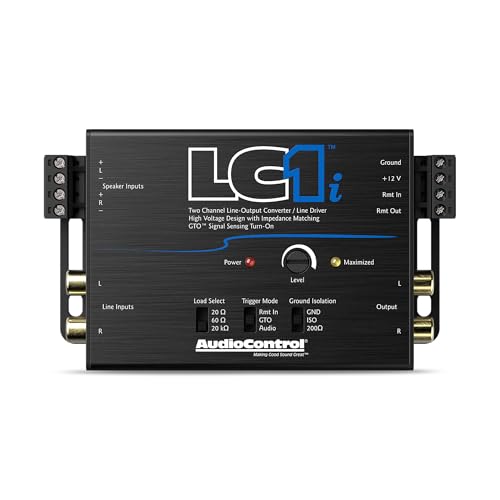
Your factory stereo can sound better, and the part that makes it possible is an active line out converter — a powered box that turns the speaker-level signal from your stock radio into the low-level RCA signal an aftermarket amplifier expects. Start with the AudioControl LC1i: it handles up to 400W (40V) per channel, so a strong factory signal stays clean, and its switches keep modern factory amplifiers passing audio. Every pick below is a genuinely powered unit, sorted by what it does best, with the honest limits of each spelled out.
This guide is built by comparing the manufacturers’ published specifications and the patterns across verified customer reviews, so you get each pick’s real strengths and trade-offs instead of marketing spin.
Some converters quietly add hiss, and some let a factory radio roll off the bass as you turn it up. The difference depends on three things: the switching, the load handling, and the output voltage. Those are exactly what you need to understand before spending money on an active line out converter.
Top Picks

How To Choose The Best Active Line Out Converter
The word “active” is doing real work here. A passive converter is just a transformer that steps speaker voltage down to RCA level, so it cannot fight the two problems factory radios create: a signal that gets weak at high volume, and a signal that loses bass as you turn the knob up. An active converter has its own power feed and circuitry, so it can boost what the radio sends and shape it back into something your amp can use cleanly.
Match the input handling to your factory system
Start with what your stock radio sends. The AudioControl LC1i and the NVX XLCA2 both accept up to 400 watts RMS of speaker-level input, which covers most amplified factory setups. Cars with a factory premium amplifier are trickier — it needs to see a speaker load before it will pass audio at all. That is what the load selection switches on the LC1i and the NVX XLOC44X are for; they let the factory amp detect a load and keep going instead of shutting down.
Channel count decides who gets a clean signal
Two channels runs a front-stage amp or a single sub amp. Four channels (as on the NVX XLOC44X) lets you run front and rear separately. Five channels, which is what the SoundQubed Q-LOC5 offers, gives you front, rear, and a dedicated sub feed in one box. If you are feeding a multi-amp system and want to keep steering-wheel controls and the factory sub, the six-channel AudioControl LC7i can sum factory channels into a dedicated subwoofer output.
Signal clean-up features you will actually use
Ground isolation is the first one to look for — it is a switch that breaks a ground loop so alternator whine stops riding along on your audio. The LC1i and the NVX XLOC44X both offer load matching, and the LC1i adds a selectable ground isolation switch. On the bass side, factory radios roll bass off as volume climbs; the Gravity GR-DBE, the NVX XLCA2, the AudioControl LC7i (AccuBASS) and the Kicker 47KEYLOC all address that in their own way. A dash-mounted remote for sub level is another practical extra — the NVX XLCA2 includes one, and the AudioControl units accept an optional knob.
Side-by-Side Comparison
| Model | Best For | Channels | Max Speaker Input | Max Supply Voltage | Amazon |
|---|---|---|---|---|---|
| AudioControl LC1i★ Best Overall | Retaining a late-model factory amp | 2 | 400W per channel | 40 V | Amazon |
| Gravity GR-DBEBass On A Budget | Budget bass restoration with a dash knob | 2 | 400W per channel | 13 V | Amazon |
| NVX XLCA2 | Two amps on one converter with a bass knob | 2 | 400W RMS | — | Amazon |
| SoundQubed Q-LOC5 | Front, rear, and sub from one box | 5 | — | 18.7 V | Amazon |
| NVX XLOC44X | High-voltage factory systems | 4 | 400W RMS | 40 V | Amazon |
| AudioControl LC7i | Multi-amp builds with factory crossovers | 6 | 400W per channel | 12 V | Amazon |
| Kicker 47KEYLOC | Auto-detecting the factory signal type | 2 | — | 40 V | Amazon |
Detailed Reviews
1. AudioControl LC1i Line Output Converter
Our pick — 4.5+★ from 600+ verified ratings; the strongest balance of quality and price.
The converter built for cars that fight back — factory amps, whine, and all.
If your car has a factory premium amplifier, this is the converter that understands why it matters. It accepts speaker-level signal up to 400W (40V) per channel and then feeds your aftermarket amp a clean pre-amp signal over RCA. The onboard load selection switch is the standout: you pick 20 ohms, 60 ohms, or 20k ohms so the factory amplifier detects a speaker load and keeps passing audio instead of muting the system. That single switch is why this box survives installs that leave passive converters dead in the water.
The signal handling goes further than most. A built-in line driver boosts weak factory radio output so your downstream amps get a strong feed, and a selectable ground isolation switch breaks the loop that causes alternator whine. If you have ever heard that rising pitch under the music, this is the fix. A ‘Remote Out’ also triggers your amplifier when the converter wakes up, whether you choose the GTO signal-sense turn-on or a manual 12V trigger.
The chassis is slim (4.8″ L x 3″ D x 1″ H including the speaker connectors) and screws down, so it tucks behind a kick panel without eating cabin space. The optional ACR-1 dash knob, sold separately, runs on a 20-foot cable with a metal housing and removable mounting tabs for a flush dash install. What seals it is consistency: reviewers most often praise build quality and function, and it carries a 4.5+ star rating across 600+ ratings. The honest catch is that ACR-1 knob is not in the box, and 8.8 ounces of metal wants a solid screw-down surface rather than zip ties.
Where it earns its keep
- Load selection at 20 / 60 / 20k ohms keeps late-model factory amps awake
- Handles up to 400W (40V) per channel so hot factory signals do not overwhelm it
- Selectable ground isolation kills alternator whine at the source
- Remote Out turns on downstream amps automatically
Bumps in the road
- Dash knob is an optional extra, not included
- Only two channels, so front/rear/sub separation needs a bigger unit
Buy this one: you drive a newer car with a factory amplifier and want the stock head unit kept.
Hold off: if you plan three or more amp channels or want the sub knob bundled in.
2. Gravity GR-DBE Line Output Converter
Bass roll-off fix and a dash knob in one modestly-priced two-channel box.
The Gravity GR-DBE aims at the single most common complaint about factory stereos: the bass disappears as you turn the volume up. Its BassLift digital bass enhancement is built to compensate for that factory roll-off and bring low-frequency punch back. There is a dash-mounted level control knob in the box so you can adjust from the driver’s seat without reaching behind the dash. Two active speaker-level inputs take the factory amplified signal and convert it to clean low-level RCA for your amps.
On paper the output side is strong. The preamp outputs are rated 9.5 Vrms with 13V peak, which gives external amplifiers a healthy signal and lets you run amp gain lower instead of cranked. Frequency response is listed at 10 Hz to 100 kHz, ±1 dB. Distortion is specified at 0.01% total harmonic distortion, signal-to-noise is over 110 dB, and input impedance is 20K-ohm. The compact housing fits flexible mounting spots for a tight install.
Here is the honest read: this is the most inconsistent pick on the list. Some units work well and sound better than the factory system ever did; others stop working after a few minutes or arrive with build complaints. The bass boost and adjustability also divide opinion, with some finding the enhancement effective and others finding it does not behave as expected. That does not make it a bad buy — it makes it a budget bet where the amplifier’s supply ceiling of 13 V is worth checking against your car. Compared with the NVX XLOC44X, which handles up to 40 V on its inputs, this one sits at 13 V, so it suits milder factory systems and not high-voltage premium setups.
The price-to-risk math: if your budget is tight and you want bass restoration plus a dash knob in one purchase, this delivers both features. If your factory system runs hot or you cannot tolerate a swap-out, step up to a unit with more headroom.
Worth a look: budget builds with a moderate factory radio where an in-box dash knob matters.
Think twice: high-voltage factory systems and buyers who want zero risk of a return.
3. NVX XLCA2 Line Output Converter

Two amps, one bass knob, and a trigger output — all in a two-channel chassis.
Here is a two-channel converter that behaves like it knows you are running more than one amp. Dual amplifier outputs mean you can feed two amps from the same box without a splitter. There is a 9.5-volt pre-out and a separate 12-volt trigger output, so the converter can wake the next device in the chain. The included dash-mounted remote handles bass level from the driver’s seat, and level-matching controls let you dial each output to the amp it feeds.
The input side takes up to 400 watts RMS of speaker-level signal, which keeps it useful across stock and upgraded head units. xBOOST handles bass enhancement and bass compensation together, so the low end that the factory radio drops at volume gets some of its weight back. Selectable automatic turn-on means the converter powers itself when the car is running, with no separate trigger wire needed.
Buyers most often cite build quality and reliability, and much of the praise centers on how well it drives a sub. There are edges to know. Sound quality draws a split reaction — some find it great, others report inconsistent bass. The bass knob and the bass restoration have their own mixed reports, with a few units developing a knob fault. The two-channel layout is also the limit here: if you want front, rear, and sub on separate feeds, the SoundQubed Q-LOC5 offers 5 channels and two extra RCA outputs, while this one covers two amps but only from one signal path.
Why it ranks here: the combination of dual amp outputs, a 12V trigger, and a bundled dash remote is unusual at this tier, and the reliability talk backs it up.
Pair it with: a two-amp build where you want the bass knob included rather than bought extra.
Look elsewhere: if you need separate front/rear/sub RCA feeds or are chasing a strictly clean bass signal.
4. SoundQubed Q-LOC5 Active 5-Channel High to Low Converter
Five channels of conversion with an LED on each one to prove the signal is clean.
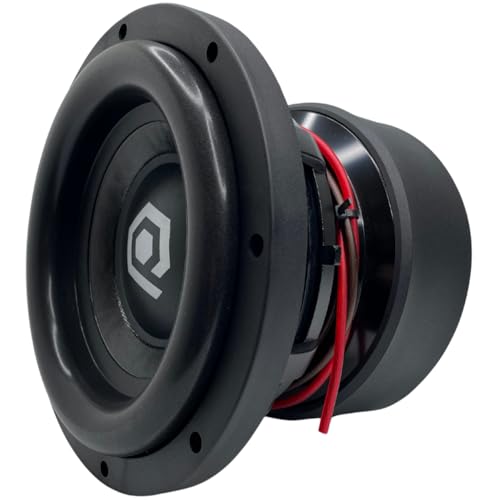
Channel count is the whole reason to look here. This box converts speaker-level signal from a factory or aftermarket head unit into RCA for your amps across 5 channels — front, rear, and a subwoofer feed you can control separately — or you can switch it to run in 2-channel mode. Five channels versus the two on the AudioControl LC1i or the Gravity GR-DBE is the difference between running a sub amp and a four-channel amp from one clean source, versus needing a splitter and hoping the levels stay matched.
The LED clipping indicator on every channel is the feature that earns the box its spot. You feed the converter a signal, watch the LEDs, and set source voltage so a clipped signal from the head unit never reaches your gear — no extra test equipment needed. The active design is what makes that possible; a passive box cannot adjust source voltage because it has no circuitry to set. The chassis measures 5″ L x 3.75″ W, and it mounts to a surface with screws.
It installs quickly and the price is fair for five channels, but build consistency is the trade-off. Some units work very well; others arrive with dead channels, and the signal can pick up noise through the amplifier on certain installs. Treat this as a pick that rewards a careful installation and a return window you actually use. It is also the smaller enclosure of the two SoundQubed-of-AudioControl comparisons — narrower than the AudioControl LC7i, which is the six-channel alternative if you need channel summing for factory crossovers.
Install advantages: separate front, rear, and sub outputs plus per-channel clipping LEDs make this the most self-diagnosing unit on the list.
Set expectations: mixed reliability reports mean you should test all five channels before you mount the box permanently.
Reach for this if: you are feeding a front/rear amp plus a sub amp and want to set levels by eye.
Go bigger if: you need channel summing for a factory amp with built-in crossovers — that is six-channel territory.
5. NVX XLOC44X Line Output Converter

Four in, four out, and a 40V ceiling that laughs at hot factory systems.
If your factory radio or amplifier sends a strong signal, this is the converter built not to flinch. It handles up to 40V on its speaker-level inputs — that is 400 watts RMS — and feeds up to 9.5 volts of output to your amplifiers over RCA. Four inputs and four outputs mean you can run front and rear channels separately with a matching number of RCA feeds. That is a lot more headroom than the Gravity GR-DBE, which is rated to 13V on its inputs; for a premium factory system, the 40V ceiling here is the difference between clipping and staying clean.
Load selection mirrors what you would expect on a premium box: 20, 60, or 20K ohms, so factory amplifiers that need to see a load keep passing audio. Auto turn-on works from a DC offset or by audio detection, so the converter starts up with the car without a separate trigger lead. Impedance matching helps keep the signal matched to the source, and there is support for a remote level control.
This pick has the thinnest review base, so treat its 4.0+ star rating and handful of reviews as a small sample, not a verdict. The spec is what sells it: four channels of conversion at a 40V input ceiling covers a higher-end factory system where most budget boxes would give up. If you only need two channels, the NVX XLCA2 gives you the same brand DNA with a bundled bass knob and dual amp outputs instead of the extra RCA channels.
Spec-first selling point: 40V input handling on a four-channel active converter is the reason to buy this over a two-channel box with a lower voltage ceiling.
Fair caution: the limited review history means you are leaning on the spec sheet more than the crowd here.
Made for: four-channel builds off a strong factory system that needs high input headroom.
Not the one: if you only run two channels or want a dash bass knob in the box.
6. AudioControl LC7i Line Output Converter
Six channels of summing and AccuBASS for factory systems that hide their crossovers.
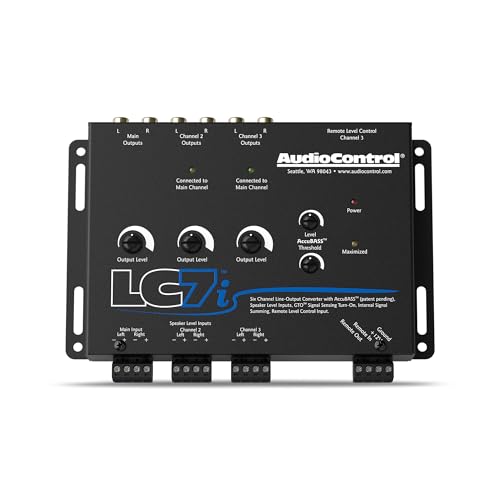
This is the audiophile’s converter, and the reason is channel summing. Factory systems with built-in crossovers split the signal in ways that make adding a sub difficult; the LC7i’s internal channel summing lets you interface with those amps and put the signal back together. Six channels of conversion at up to 400W per channel handle the front, rear, and sub duties in one box. AccuBASS processing is the headliner: it corrects and restores the bass roll-off that happens when you turn the factory radio up, so your sub gets a real signal instead of a fading one.
There is more flexibility here than on any other pick. AutoMode can turn two inputs into three outputs, creating a dedicated subwoofer output from a front/rear system so you can drive a sub amp and crossover. Fixed and variable outputs with discrete onboard level controls give you tuning room. A ‘Remote Out’ can trigger up to 2 devices down the signal chain. Factory volume and steering wheel controls are retained. The footprint is compact at roughly 7.5″ x 4.7″ x 1.22″, so it slides behind a panel in most cars, and the controls live on the board so you do not need a dash knob for the initial tune.
Where it stumbles is the same place premium electronics always do: reliability is a split story. Some units run flawlessly for years; some units arrive faulty, and distortion is the other thread that runs through the conversation. The six channels and summing are enough to justify the step up over the five-channel SoundQubed Q-LOC5 if your factory amp has crossovers to untangle.
Why the tuning crowd buys it
- Six channels with internal summing for crossovers in factory amps
- AccuBASS restores bass lost to factory volume roll-off
- AutoMode turns two inputs into three, with a dedicated sub out
- Remote Out triggers up to 2 devices down the chain
What you should know
- Reliability reports are mixed, so test before final mounting
- Tuning controls take real effort to dial in well
Best fit: a multi-amp build off a factory head unit with crossovers and a sub to add.
Simpler path: if you only need two channels and no summing, the LC1i above covers it for far less fuss.
7. Kicker 47KEYLOC Key Series Smart Powered Line-Out Converter
Feed it a test tone and it tells you what kind of signal you are dealing with.
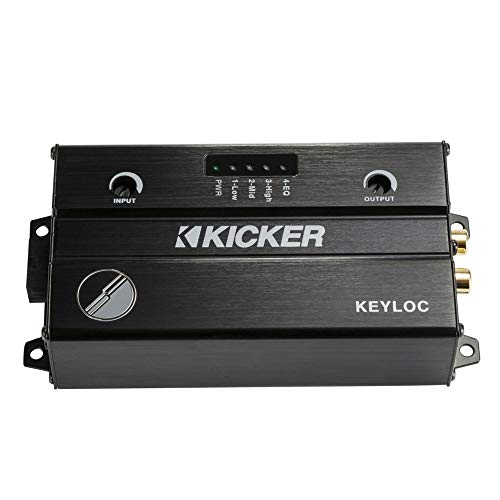
The Kicker 47KEYLOC is the only converter here that diagnoses your car for you. Attach the speaker wire, play a test tone, and read the LEDs — they tell you whether Hi, Mid, or Lo is coming out of that pair of speaker wires. No oscilloscope or RTA needed, which is the kind of feature that saves an afternoon in a car with an unknown factory system. It also lets you keep or defeat the factory time delay, or the all-pass filter built into many modern vehicles. Defeating that filter counteracts the factory effect, so you can tune for one-seat audio or hold the factory imaging.
Its signal handling is the most-praised part. Reviewers most often credit its low-frequency bass restoration and its fix for factory bass roll-off, with clean output close behind; sound quality is the single most-mentioned strength. Reviewers also rate its effectiveness and feature set highly. The converter fits two channels over RCA, mounts to a surface, and works with a range of vehicles without needing a brand-specific harness.
The catch is setup. That test-tone LED routine is straightforward for some and a genuine pain for others, and the difference often depends on how much patience you have at the wiring stage. Budget an hour you did not plan to spend. Two channels is also the max here; if you need to drive a front stage, a rear stage, and a sub, the six-channel AudioControl LC7i takes that job, while this one stays focused on cleaning up a two-channel feed.
The standout trick: the LED signal reader takes the guesswork out of a factory system you have never measured, and the time-delay and all-pass filter defeat is a step most converters ignore.
Time cost: the test-tone setup rewards patience, so plan it as a weekend job rather than a quick install.
The pick for: cars with an unknown factory signal and a tuner who wants to know what is really coming out of the wires.
Overkill if: you already know your factory signal and only need a straightforward two-channel conversion.
Know the Specs
Maximum supply voltage
This number tells you how hot a speaker-level signal the converter can take before it clips. Measured in volts, it maps roughly to watts per channel — 40V is where the 400W-rated units like the AudioControl LC1i, the NVX XLOC44X, and the Kicker 47KEYLOC sit. A unit rated at 13V (the Gravity GR-DBE) is built for a milder factory system. If you have a premium amplified factory setup, check this number first; too low a ceiling means the signal clips before your amp ever sees it.
Load selection
Modern factory amplifiers need to see a speaker load before they will pass audio. When you cut the factory speaker wires to insert a converter, the amp can think the speaker is gone and shut off. Load selection switches let you present 20 ohms, 60 ohms, or 20k ohms to the factory amp so it keeps working. The AudioControl LC1i and the NVX XLOC44X both offer those three settings. If your car has a factory premium system, this switch is often the reason one converter installs cleanly and another leaves you with silence.
Channel count and summing
Two channels covers a front stage or a single sub amp. Four channels (NVX XLOC44X) splits front and rear. Five channels (SoundQubed Q-LOC5) adds a dedicated sub feed. Six channels (AudioControl LC7i) adds channel summing, which is the ability to recombine a factory signal that was split by built-in crossovers. Summing matters most in cars with factory premium audio where the subwoofer signal has already been shaped by the factory amp.
Ground isolation and noise
Alternator whine — that rising whine that tracks engine speed — comes from a ground loop between the radio and your amplifier. A ground isolation switch breaks that loop so the noise cannot ride the signal path. The AudioControl LC1i includes one. On any pick, signal-to-noise ratio and total harmonic distortion figures tell you how quiet and clean the converter stays; lower distortion and higher signal-to-noise mean less hiss and more music.
Common Questions
Will an active line out converter work with my factory amplified stereo?
How is an active converter different from a passive one?
Do I need two channels or more?
Can a line out converter get rid of alternator whine?
What does bass restoration actually do?
Will the converter keep my steering wheel controls and factory volume?
How do I set the gain without an oscilloscope?
What is channel summing and do I need it?
Can I mount the converter behind a dash panel?
Do I lose my factory time delay or all-pass filter when I add a converter?
The Bottom Line
For most factory-stereo upgrades, the active line out converter to start with is the AudioControl LC1i. Load selection at 20 / 60 / 20k ohms keeps a late-model factory amplifier passing audio, while a 40V input ceiling and a ground isolation switch keep the signal clean. Its 4.5+ star average across 600+ ratings makes it the crowd favorite here. If you want to run a front/rear plus sub amp from one five-channel box, the SoundQubed Q-LOC5 is the clear step up. And if your system is a six-channel factory setup with crossovers that need untangling, the AudioControl LC7i is the one to reach for. For a two-channel install that adds a dash bass knob and a smart signal reader, the Kicker 47KEYLOC makes a strong case.
How we choose
We do not accept paid placement. Every pick is matched to a real buyer and a real use-case; we do not hands-on test units.
Sources
Specifications: manufacturer listings and product documentation. Review insights: verified customer reviews, as of November 2026. Pricing: not shown on this page (it changes often); check the current price via the retailer link.
As an Amazon Associate, Gamepad Test earns from qualifying purchases. This does not affect which products we feature.