
Specs are compiled from manufacturer listings and verified buyer reviews and can change over time — please confirm the key details on the product page before buying.
You want an aluminum chop saw blade that slices through extrusion and leaves an edge so clean you can skip the file. The single most useful thing to know up front: the tooth count and the tooth shape decide that result far more than brand name does. A high tooth count with a triple-chip grind (TCG — alternating flat and chamfered teeth that shear metal instead of gouging it) gives you the burr-free finish. A low tooth count or a wood blade gives you torn edges, melted shavings, and a dangerous kickback risk on aluminum.
This guide is built by comparing the manufacturers’ published specifications and the patterns across verified customer reviews, so you get each pick’s real strengths and trade-offs instead of marketing spin.
Below you will find seven aluminum-cutting blades that fit real saws, sorted by what each one does best for the money. Every pick here is a carbide-tipped blade built for non-ferrous metal, and each listing below tells you the arbor size, kerf, and tooth count so you can match it to your saw before you buy. If you want to make a clean, burr-free cut on aluminum extrusion the first time, this best aluminum chop saw blade roundup breaks down which tooth count and arbor fit your saw best.
Top Picks


How To Choose The Best Aluminum Chop Saw Blade
Aluminum is soft, gummy, and grabby. A blade built for wood or ferrous metal will clog, overheat, and kick back on it. The right blade is a carbide-tipped design made for non-ferrous metal, and the four specs below decide whether it works well on your saw.
Tooth count and triple-chip grind
More teeth means a smoother cut, because each tooth takes a smaller bite. Tooth count is simply the number of cutting tips around the rim, so a 100-tooth blade leaves a finer finish than an 80-tooth blade. You can see that gap in this guide: the CRALY 10-inch runs 100 teeth against the FOXBC 10-inch at 80 teeth. Triple-chip grind (a tooth shape that pairs each flat tooth with a chamfered one) lets the blade shear the aluminum instead of digging in. That is why burr-free cuts depend on both the count and the grind.
Arbor size and saw compatibility
The arbor is the center hole that slides onto your saw’s spindle. A 5/8-inch arbor fits most 10-inch miter and table saws. A 1-inch arbor is what most 12-inch and 14-inch chop saws use. Get the arbor wrong and the blade will not mount, no matter how good the teeth are. Measure your saw’s spindle before you order.
Kerf and plate thickness
Kerf is the width of the slot the blade cuts. A thin kerf removes less material and draws less power from the saw, which keeps the motor from bogging down in thick aluminum. Plate thickness is the steel body’s gauge, and a thicker plate resists flex on hard cuts. The two work together with the stabilizer vents and expansion slots that let the blade handle heat without warping.
RPM limits and hook angle
Every aluminum blade has a top speed rating in RPM (revolutions per minute — how fast the blade spins). The Diablo 12-inch is rated to 5000 max RPM, while the Evolution 14-inch is built for low-RPM saws with a 1600 RPM ceiling. A negative or low hook angle tilts the teeth back so they scrape rather than grab, which is the safe geometry for metal. Running a blade past its RPM rating or on the wrong saw type is how teeth break.
Side-by-Side Comparison
| Model | Best For | Diameter | Teeth | Arbor | Amazon |
|---|---|---|---|---|---|
| MASTEC 10-Inch 100T TCG★ Best Overall | Best Overall | 10″ | 100 | 5/8″ | Amazon |
| FOXBC 10-Inch 80T TCGQuietest Cut | Smooth, quiet cuts | 10″ | 80 | 5/8″ | Amazon |
| TWIN-TOWN 12-Inch 96T TCG | Big 12-inch saws | 12″ | 96 | 1″ | Amazon |
| CRALY 10-Inch 100T Black Ice | Thin aluminum sheet | 10″ | 100 | 5/8″ | Amazon |
| Diablo 12-Inch 96T TCG | Premium shop workhorse | 12″ | 96 | 1″ | Amazon |
| Oshlun SBNF-100100 10-Inch 100T | Fine finish on frames | 10″ | 100 | 5/8″ | Amazon |
| Evolution 14BLADEAL 14-Inch 80T | 14-inch chop saws | 14″ | 80 | 1″ | Amazon |
Detailed Reviews
1. MASTEC 10-Inch 100T TCG Saw Blade
Our pick — 4.5+★ from 700+ verified ratings; the strongest balance of quality and price.
A 100-tooth, 5/8-inch-arbor blade that drops into the three saws most home shops already own.
Start with the number that earns it the top spot: 100 carbide teeth on a 10-inch body. That count is what lets it finish aluminum with a clean edge instead of the ragged, snagging cut a lower-tooth blade leaves. It carries a 5/8-inch arbor, which is the center hole used by most 10-inch miter saws, circular saws, and table saws, so most buyers will not need an adapter bushing.
The declared use list is broad for a metal blade: aluminum, plexiglass, plastic, and non-ferrous metals. The triple-chip teeth handle the softer, gummier materials without loading up, which is why so many owners run it on PVC pipe and plastic lattice as well as aluminum extrusion. What wins people over most is the finish — the cut quality is the single most raved-about trait, with buyers describing aluminum slicing like butter and edges coming off clean.
The honest catch is durability. Most buyers report the blade holds its edge through a long run of cuts, but some have lost teeth or seen fast wear, so treat it as a sharp consumable rather than a forever blade. Feed it steadily and let the teeth do the work rather than forcing the cut.
What earns it first place
- 100 teeth leave a clean edge on aluminum extrusion and bar stock.
- 5/8-inch arbor drops into most 10-inch miter, circular, and table saws.
- TCG teeth also handle plastic, plexiglass, and PVC pipe cleanly.
- Thin 2.8 mm body cuts fast without bogging the saw motor.
Where it asks for care
- Some units have lost teeth or worn quickly with hard use.
- Heavier than the FOXBC 10-inch at 0.88 kg vs 0.78 kg.
Grab it if: you own a 10-inch miter, circular, or table saw and want one blade that does aluminum and plastic cleanly.
Think twice if: you run production-level cuts all day and need the most wear-resistant teeth you can get.
2. FOXBC 10-Inch 80-Tooth TCG Saw Blade
Fewer teeth, less vibration — this is the blade you want if aluminum cutting leaves your saw screaming.
Laser-cut stabilizer vents are the standout engineering here. Those vents trap noise and damp vibration during the cut, which matters because a shrieking, shaking saw is exactly what makes aluminum cutting feel dangerous. It runs 80 triple-chip teeth on a 10-inch body with a 5/8-inch arbor, so it fits the same saw family as the MASTEC above, and the kerf is a thin 0.094 inch.
The trade-off against the MASTEC is real and worth stating plainly: 80 teeth versus 100 teeth means it takes a slightly bigger bite per tooth. You give up a little of the ultimate burr-free polish in exchange for speed and steadier running. If you cut aluminum extrusions and copper pipe on a job site rather than finishing bright architectural rails, that is a fair swap.
Owners describe it as sharp and clean with no tear-out, chipping, or melting — the fears that come with cutting soft metal. The blade quality is the trait that gets the most credit, and durability gets no complaints at all. It is the lightest of the 10-inch blades here at 0.78 kg, which keeps the saw head easier to swing. For an 80-tooth blade, it holds up unusually well according to the people running it.
The stabilizer-vent edge: vibration control is the separating feature. A 0.094-inch kerf plus those vents mean less chatter, so your cut stays square and your ears get a break.
Where the polish dips: 80 teeth instead of 100 — fine for pipe and extrusion, one step off the finest finish on bright trim.
Reach for this: if you cut aluminum pipe and extrusion and hate a saw that howls and shakes.
Pass it by: if mirror-smooth edges on thin sheet aluminum are the whole point of the job.
3. TWIN-TOWN 12-Inch 96 Tooth TCG Saw Blade

A 12-inch, 96-tooth blade for the larger miter and table saws that 10-inch blades simply cannot fill.
If your saw swings a 12-inch blade, this is the pick built for it: a 12-inch body, 96 triple-chip teeth, and a 1-inch arbor that matches the larger spindle. The teeth are C4 grade ultra-fine grain carbide, which the maker says holds sharpness up to 2X longer than standard blades. That is a manufacturer figure, not something this guide tested, but the logic is sound — finer grain carbide resists the chipping that ends a metal blade’s life.
Two practical extras separate it from a basic blade. An electrophoretic coating (a factory-applied finish that resists rust and corrosion) keeps the steel body intact in damp shops and job trailers. Each blade also carries a unique ID code for quality tracking and comes backed by a limited lifetime warranty. Compare that to the Diablo 12-inch at 3 pounds versus this at 2.4 pounds, and the TWIN-TOWN is the lighter blade on a big saw head.
It cuts aluminum, plastic, and non-ferrous metals cleanly enough that buyers compare it to the finish of far pricier blades. The cutting performance is the trait praised most, with aluminum, plastic, and acrylic sheet all coming off smoothly. The caveat is edge life on hard use: some buyers find the teeth wear or break sooner than expected, so budget to replace it if you cut thick stock every day.
Best fit: anyone running a 12-inch miter or table saw who wants a coated, warrantied blade at a mid-range price.
Look elsewhere: if you need a blade for a 1-inch arbor chop saw that demands the heaviest teeth money can buy.
4. CRALY 10 Inch 100 Teeth Circular Saw Blade
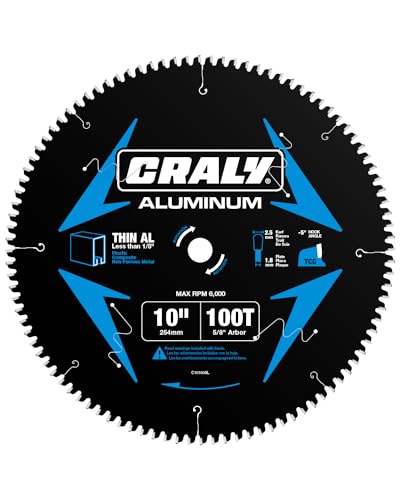
Built thin and coated slick so soft aluminum sheet stops sticking to the teeth.
Two numbers define this blade. The kerf is a thin 2.5 mm, which means it removes less metal per pass and asks less of your saw motor. And the teeth are 100 triple-chip carbide, so it finishes thin aluminum, plastic, and composite sheet with a clean edge. It uses a 5/8-inch arbor to fit most 10-inch circular saws.
The Black Ice coating is the part you feel in use. It is a factory non-stick shield that cuts friction, heat, and corrosion, so hot aluminum shavings are less likely to weld themselves onto the tooth tips. The steel body is laser-cut and hardened, with expansion slots and stabilizer vents to control the heat that warps lesser blades. On soft sheet, that combination is what keeps the cut smooth instead of smeared.
Sharpness is the trait owners single out most — this blade keeps biting through aluminum bar stock and carbon fiber sheet. The recurring honest note is noise: it is quieter than a screaming abrasive blade, but it will screech on some cuts. That is normal for a high-tooth carbide blade biting soft metal, not a defect, and ear protection solves it. Against the MASTEC’s 2.8 mm body, this one is the thinner of the two at 2.5 mm, which is why it feels quicker through light work.
Why thin kerf wins here: a 2.5 mm cut and a non-stick coating mean less heat, less drag, and a cleaner edge on thin aluminum — the material that gives most blades trouble.
The one honest gripe: it can screech under load, so plan on hearing protection for longer runs.
Made for: cutting thin aluminum sheet, composite, and plastic where a fat kerf would bind the blade.
Not the tool: if you need to mow through thick aluminum bar all day and want the heaviest tooth mass.
5. Diablo Saw Blade – 12″ Diameter, 96 TCG Teeth, 1″ Arbor

The shop-floor standard: a 12-inch, 96-tooth blade built to shrug off hard impacts on the job.
This is the premium pick, and the specs back it up. It runs 96 triple-chip teeth on a 12-inch body with a 1-inch arbor, and the cut geometry includes a -5 degree hook angle and a 0.091-inch kerf. The negative hook angle is the safety feature serious metal cutters look for — it tilts the teeth back so they scrape the aluminum rather than grab it, which cuts kickback risk. It holds a 5000 max RPM rating.
The durability story is in the brazing. Tri-Metal Shock-Resistant Brazing keeps the carbide tips attached through the extreme impacts that break cheaper teeth, and a Perma-SHIELD non-stick coating resists heat, gumming, and corrosion so the blade stays clean. That is what separates it from the mid-range blades here. Compared to the TWIN-TOWN 12-inch at 2.4 pounds, the Diablo is the heavier of the two at 3 pounds, and that extra mass is part of why it feels planted through thick aluminum.
Owners treat it as the reliable blade that does not need rework. The quality is the trait praised most, and buyers run it through aluminum extrusion, copper, brass, and even wood laminate. Cuts come off smooth and burr-free, with no signs of wear reported in normal use. The cost of this reliability is a premium-tier price and a weighty 3-pound head on the saw — a real trade-off if you portability-carry your saw between sites.
What the pro tier buys
- -5 degree hook angle reduces grab and kickback on aluminum.
- Tri-Metal brazing holds carbide tips through hard impacts.
- 5000 max RPM rating suits a 12-inch saw’s full speed.
- Perma-SHIELD coating resists heat, gumming, and corrosion.
The cost of all that
- The heaviest 12-inch blade here at 3 pounds.
- Premium-tier pricing that only pays off with regular hard use.
Worth it for: professional shops that cut thick aluminum and want a blade that will not let go mid-cut.
Overkill for: occasional weekend cuts where a mid-range blade already does the job.
6. Oshlun SBNF-100100 10-Inch 100 Tooth TCG Saw Blade

Precision-ground tips and a negative hook angle — this is a finish blade for clean architectural trim cuts.
Where the mid-range picks cut metal fast, this one is tuned for the edge you leave behind. It carries 100 triple-chip teeth on a 10-inch body with a 5/8-inch arbor, and the carbide tips are precision ground after being set. That process is what gives it a controlled, low-burr cut rather than one that needs a follow-up file. A negative hook angle backs that up by tilting the teeth to scrape soft metal, not grab it.
Two build details mark it as a step up in finish. The expansion slots are copper plugged, which lets the steel body expand with heat while staying stable and quiet. The body is a thicker 0.11 inch, heavier than the thin-kerf blades here, and that gauge resists flex on a demanding cut. Cuts on aluminum frames and PVC pipe come through clean according to the people running it.
The edges are its strength and its soft spot. Some owners note the teeth dull quickly under constant use, and burr removal is split between clean cuts and more material to file off. So this is not the blade for production cutting of thick stock. It is the one you reach for when a visible aluminum frame needs to look right. Against the CRALY’s 2.8 mm body, this one is the thicker and stiffer of the two at 0.11 inch.
The finish argument: precision-ground C-1 carbide tips and copper-plugged slots give you a stable, clean cut on visible aluminum frames and soffit.
Sized honestly: edge life is the watch item — on thick, constant stock, plan to sharpen or replace sooner.
Pick this one: for finish work on aluminum frames, soffit, and trim where the edge gets seen.
Set it aside: if your saw runs nonstop on thick bar stock and you want maximum lifespan per blade.
7. Evolution 14BLADEAL 14″ 80T Aluminum Blade TCT Saw Blade
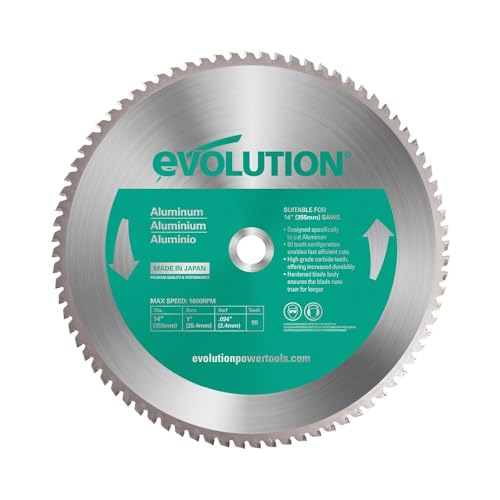
The big-chop-saw blade — 14 inches, an 80-tooth TCT rim, and a speed cap built for low-RPM saws.
This is a specialist blade and the specs say so loudly. It is a 14-inch, 80-tooth TCT (tungsten-carbide-tipped) blade on a 1-inch arbor with a 0.094-inch kerf. The critical limit is 1600 RPM — this blade is designed for Evolution saws or other low-RPM saws, and running it on a high-speed saw is the one thing to never do. Match it to the right machine and it is a fine blade on thick aluminum.
It fits a wide list of machines: Evolution S355CPSL, S380CPS, and EVOSAW380, plus the DeWalt DW872, Milwaukee 6190-20, MK Morse CSM14MB, Ridgid 614, and others. That compatibility list is the reason to buy it — you match the blade to your 14-inch chop saw rather than hunting for a fit. Note that this data lists no compatible-device entry beyond these saws, so double-check your model before ordering.
On aluminum it cuts cleanly, and buyers credit cutting performance first, with quality close behind. The honest trade-off is speed: 80 teeth on a 14-inch wheel is a coarse count for such a big blade, so the finish is good but not glass-smooth. It is happiest on extrusion and thicker stock, not bright architectural trim. It is also built only for low-RPM saws (slow-spinning machines), which rules it out for higher-speed chop saws.
Match it up: any owner of an Evolution or low-RPM 14-inch chop saw who wants a compatible 80-tooth aluminum blade.
Steer clear: if your saw spins above the 1600 RPM ceiling — this blade is not made for it.
Know the Specs
Teeth and triple-chip grind (TCG)
Tooth count is how many carbide tips run around the rim. More teeth means each bites less, which leaves a cleaner edge on soft aluminum. The triple-chip grind pairs a flat-topping tooth with a chamfered one so the blade shears metal rather than gouging it. On a chop saw, a 96- or 100-tooth blade tends to leave a finer finish than an 80-tooth blade, though the trade-off is that fewer, bigger teeth cut faster and run steadier.
Arbor and diameter
The arbor is the center hole the blade mounts onto. A 5/8-inch arbor fits most 10-inch saws; a 1-inch arbor fits most 12- and 14-inch chop saws. Diameter must match the saw’s guard and spindle. A 10-inch blade will not safely run on a saw built for 12 inches, and a 14-inch blade needs a saw sized for it. Always confirm both the diameter and the arbor before ordering.
Kerf and plate gauge
Kerf is the width of the cut the blade makes. A thinner kerf removes less material and draws less power, so the saw motor stays strong through thick aluminum. Plate thickness is the steel body’s gauge, and a thicker plate resists flex on hard cuts. Stabilizer vents and expansion slots let the body handle heat without warping, which is what keeps a metal blade running true.
RPM rating and hook angle
Every blade has a top speed in RPM. A 14-inch chop saw blade rated to 1600 RPM belongs on a low-speed machine; a 12-inch blade rated to 5000 RPM suits a faster saw. Hook angle is the tilt of the teeth: a negative or low angle scrapes soft metal instead of grabbing it, which reduces kickback and keeps the cut controlled.
Common Questions
Will a 10-inch aluminum blade fit my miter saw?
How many teeth do I need to cut aluminum cleanly?
Can I use a wood blade to cut aluminum on a chop saw?
What is the difference between TCG and a standard wood-tooth blade?
Why does the Evolution 14-inch blade have a 1600 RPM limit?
What kerf should I look for on a thin aluminum cutting blade?
How long does an aluminum cutting blade last?
Should I run an aluminum blade slower than a wood blade?
Do these blades work in a cordless circular saw?
Is a 1-inch arbor blade the same as a 5/8-inch one?
The Bottom Line
For most home shops running a 10-inch saw, the MASTEC 10-Inch 100T is the blade to buy. Its 100 triple-chip teeth sit on a 5/8-inch arbor (the center hole that mounts on your saw), so it fits the saw you already own, and the finish earns top marks. If a shrieking, shaking saw is your headache, the FOXBC 10-Inch 80T trades a little polish for steadier, quieter running. And if you own a 14-inch low-RPM chop saw, the Evolution 14BLADEAL is the one that fits the machine you have. Match the blade to your arbor and let the teeth do the cutting.
How we choose
We do not accept paid placement. Every pick is matched to a real buyer and a real use-case; we do not hands-on test units.
Sources
Specifications: manufacturer listings and product documentation. Review insights: verified customer reviews, as of November 2026. Pricing: not shown on this page (it changes often); check the current price via the retailer link.
As an Amazon Associate, Gamepad Test earns from qualifying purchases. This does not affect which products we feature.