
Heads up: This post contains affiliate links. As an Amazon Associate I earn from qualifying purchases, at no extra cost to you. Learn more
Specs are compiled from manufacturer listings and verified buyer reviews and can change over time — please confirm the key details on the product page before buying.
You want the arcade bowling game that fits your room and your family, not the one that looks best in a product photo. The real split is simple: a desktop set you can clear off the kitchen table, or a full lane that takes a whole game room and a real ball. This guide covers five arcade bowling games — two compact, three full-size — and matches each one to the room, the players, and the amount of patience you have for assembly night.
This guide is built by comparing the manufacturers’ published specifications and the patterns across verified customer reviews, so you get each pick’s real strengths and trade-offs instead of marketing spin.
Compact households want a mini set for quick rounds; full-lane owners want a thick playing surface and a working ball return. Here is the shortlist for either path.
Top Picks
How To Choose The Best Arcade Bowling Game
The first decision is not which brand to buy — it is which size you can live with. A desktop bowling set sits on a counter and gets put away after dinner. A full roll-and-score lane becomes furniture in a game room for years. Get that call wrong and you end up with a game nobody wants to set up, or one that eats a room you wanted for something else.
Table footprint before anything else
Full-size lanes each ship with a recommended room size from the maker, and those recommendations assume you want free movement all the way around the table. That matters because you walk to the return box after every roll. Measure your room against that recommendation before you order anything. Desktop sets flip the math: they live on a table or floor and disappear into a closet afterward, so your only limit is how much counter space you are willing to hand over.
Playing surface thickness and ball roll
The playing surface is the board the ball rolls down, and its thickness is the spec that decides whether your shots stay straight. A thicker one-piece board flexes less over time, so a rolled ball keeps its line instead of drifting into the side. Thin boards on a big lane are where you start hearing about dings and uneven roll. On desktop sets the surface is molded plastic, so the question becomes build stiffness rather than board thickness.
Scoring: batteries, plug-in, or nothing
An electronic scorer is a display that counts your points as the ball passes through a scoring ring, so nobody has to keep score by hand. Some full-size games run that display on batteries, others on a plug-in adapter — a real difference if the table ends up far from a wall socket. The most basic desktop sets drop electronics entirely and have you tally the score yourself, which is one less battery to replace and one less thing to break.
Pin resetting and ball return
On a desktop bowling set, the pins sit at the end of a short lane and reset either automatically or by hand. Automatic resetting means you keep rolling; manual resetting means someone walks over and stands the pins back up each frame. On a full lane, the automatic ball return sends your ball back to a goal box after every throw so you never chase it down the alley. That return system is the feature that makes a long game night feel like an actual arcade.
Side-by-Side Comparison
| Model | Best For | Format | Playing Surface | Scoring | Amazon |
|---|---|---|---|---|---|
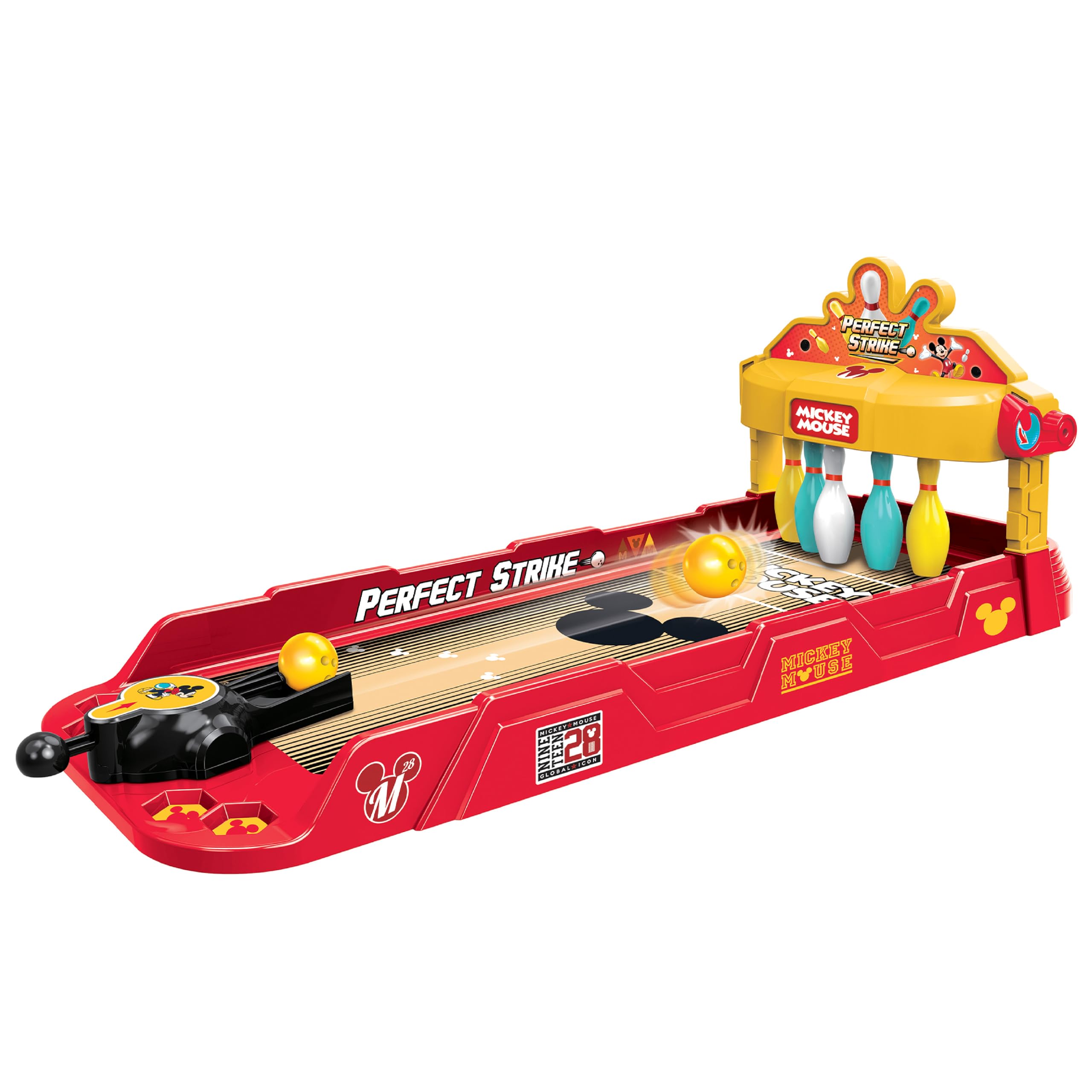
| Mickey Mouse Table Top Play Set★ Best Overall | Kids and themed desk play | Desktop set, 1 player | Plastic lane, 24″L x 10″W x 3″H | Manual, spring launcher | Amazon |
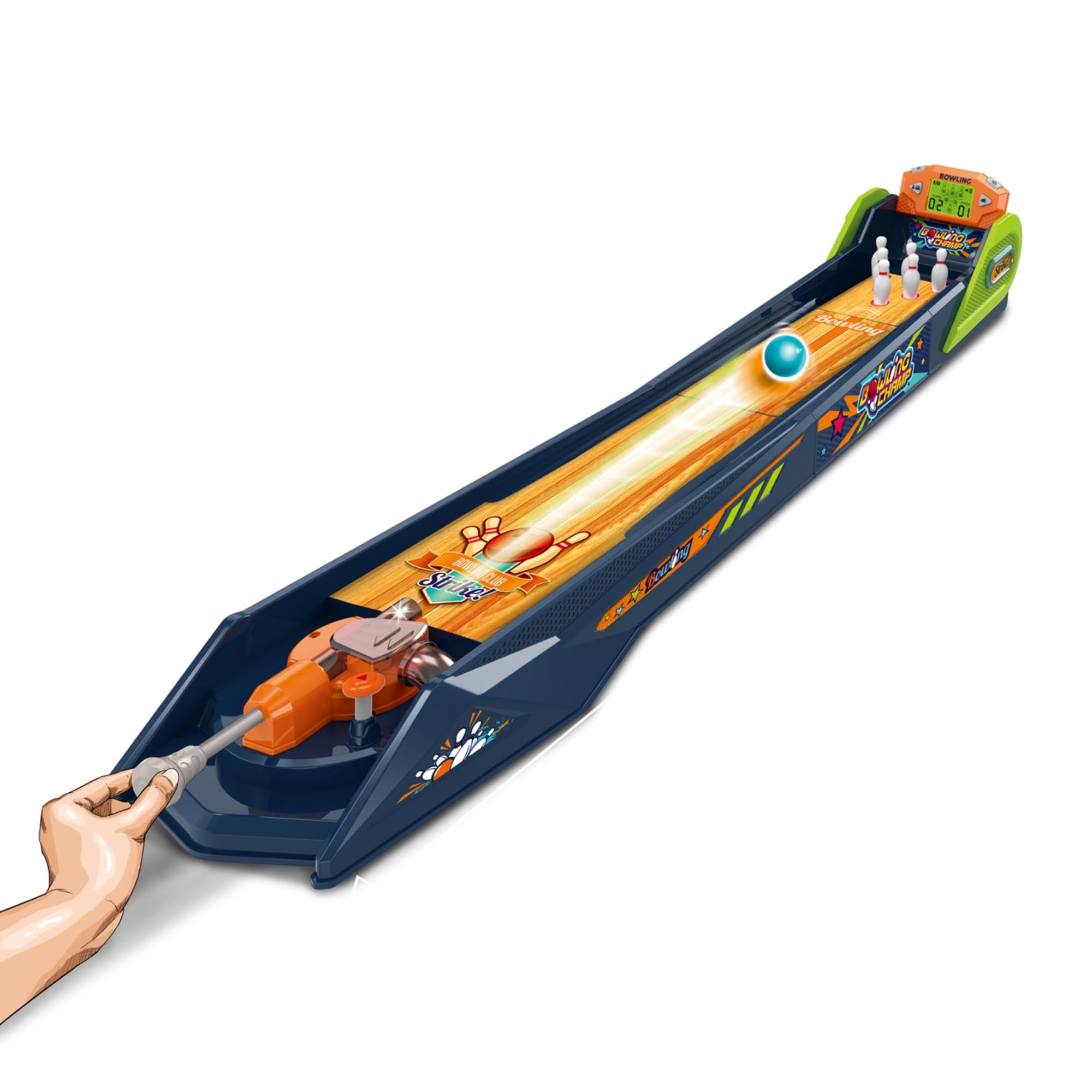
| OLEOCA Electronic Tabletop Arcade GameBest Tabletop Scoreboard | Two-player tabletop rounds | Desktop set, 1-2 players | Plastic lane, 33″ alley | LCD auto scorer with lights and sound | Amazon |
| MD Sports Roll & Score Arcade Game | Entry full-size family lane | Full lane, 1-2 players | 5mm one-piece laminated engineered wood | Battery LED scorer with arcade sound | Amazon |
| Hall of Games Roll & Score Collection | Bigger lane in a game room | Full lane, 1-2 players | 12mm one-piece engineered wood | Plug-in electronic scorer with LED lights | Amazon |
| Barrington Roll and Score Classic Arcade | Longest lane, statement piece | Full lane, 1-2 players | 12mm one-piece engineered wood | Plug-in LED scorer with arcade sound | Amazon |
Detailed Reviews
1. Mickey Mouse Table Top Play Set
Our pick — 4.0+★ from 20+ verified ratings; the strongest balance of quality and price.
A three-inch-tall Mickey bowling alley that packs onto a desk and resets itself.
This is the pick for a parent with a small apartment, a kid who loves Mickey, and no interest in giving up a wall. The whole set stands 24″ long, 10″ wide and 3″ high, so it clears the counter, plays on the floor, and stores on a shelf afterward. It is the shortest game here by a wide margin — the Hall of Games lane runs 60.75″ tall and 107″ long, and this one measures 3″ and 24″ on those same axes.
What makes it work is the spring-powered shooter. You pull back, aim and launch a mini ball at the pins — the same tactile flick-and-release you get from a pinball plunger. There are 6 pins and 3 balls in the box, which is enough for a frame. The pins reset on their own and the balls return smoothly, so a kid can run a full game alone without an adult standing over the lane to stand pins back up.
The trade-off you should hear about: no batteries and no scoreboard. You count the score yourself, so the arcade feel comes from the Mickey graphics and the lane art rather than a lit-up display. If you want a screen tracking points, the OLEOCA tabletop set below adds an LCD auto scorer for the same compact idea.
What works in its favor
- Listed for ages 6 and up and built from plastic, so it takes knocks from kids
- Auto-resetting pins and smooth ball return mean continuous play
- Assembles without batteries and takes up a 24″ x 10″ countertop
What to go in knowing
- One player at a time, so nobody plays head-to-head
- No electronic scoring — you tally points by hand
Reach for this if: you want a themed, battery-free bowling lane for a kid on a table or floor.
Look elsewhere if: two-player scoring matters — the OLEOCA set has the mode and the screen.
2. OLEOCA Bowling Game — Electronic Tabletop Arcade Game
All the arcade theatre — screen, lights, sound — in a two-pound box you can lift with one hand.
The number that decides this one is 33 inches. That is the alley length, which is long enough that a ball has somewhere to travel and short enough to sit on a coffee table. The frame measures 35″ long by 5.7″ wide, and the whole thing weighs 2 pounds, so one person moves it from table to closet without a second trip.
Where it separates from the Mickey set is the electronics. A built-in screen tracks your score as pins fall, and the lane responds with lights and sounds on each roll — this is the arcade layer that makes a desktop game feel like a machine. There are two modes, so you can practice solo or go head-to-head against someone in the same room. The launcher is spring-powered: pull back, aim, release.
The honest catch is the lane length. A 33-inch alley is short, and the included spec sheet lists the assembled dimensions as 15 x 6 x 3 inches in one field — worth eyeballing the listing photos so you know exactly what arrives. It also asks for 3 years and up, which is a wider age range than the Mickey set’s 6+ but means you supervise younger kids around the small parts.
The appeal in one line: you get scoring, lights and sound in a mini set — the two-player mode is what pushes it ahead of any battery-free desktop lane.
The honest limit: it is a plastic novelty game, so treat the pins gently and expect a short lane rather than a true full-scale roll.
This one wins when: you want a screen keeping score and two people playing on a kitchen table.
Step away when: you need something a toddler can play unsupervised.
3. MD Sports Roll & Score Arcade Game

The full-size lane that gets you in the door without asking for a spare bedroom.
MD Sports builds the smallest of the three big lanes here, and that is its whole reason to exist. The playing surface runs 7’3″ long — 87 inches — and the table stands about 4 feet tall. If you have a spare wall and not a whole room, this is the one engineered for that gap.
The surface is a 5mm one-piece board of laminated engineered wood. A one-piece board means no seams down the middle of your lane, so the ball rolls without catching a joint. The 63mm plastic balls are sized to sit comfortably in a hand. When a ball drops through one of the ABS scoring rings, the battery scorer with LED lights and arcade sounds logs it, and there is single or two-player mode. Two balls come in the box, and the automatic return sends them back to the goal box after each roll.
Where this lane earns its keep is family use — it is the game that kids and grandkids actually gather around, and that is what the fun praise centers on. Set expectations on assembly, though: the reviews split hard there, and the rolling surface has taken dings for some owners over time. Read the instructions twice and give yourself an evening rather than an hour.
Short version: a full lane with a one-piece 5mm surface and an automatic return for families with a spare wall.
Plan for: a build session, plus 3 AAA batteries that are not in the box.
The right fit for: a family who wants a real 87-inch lane without dedicating a full room.
The mismatch to avoid: if you want zero assembly, this is not the lane for that.
4. Hall of Games Roll & Score Arcade Game Collection

A 12mm surface, a plug-in scorer and four balls — the lane built for a dedicated room.
The number here is 12mm, and it is the reason this lane feels different under the ball. That is the thickness of the one-piece engineered wood playing surface, and it is more than double the 5mm board on the MD Sports above — 12mm versus 5mm. A stiffer board keeps its shape so a rolled ball holds its line. It matters more on a 9-foot lane than a 7-foot one, and this lane runs 9 feet long, 24.5″ wide and about 5 feet tall.
Shooting is single or two-player, with the option to switch the arcade sounds off entirely if the room is small and the volume gets old. The electronic scorer tracks points as balls drop through the ABS scoring rings, and a transparent acrylic cover keeps balls in play instead of bouncing out onto the floor. Four balls are included, which means you never stop to fetch one mid-frame. The scorer runs on a plug-in adapter, so you are not buying batteries.
The trade-offs are the ones every big lane shares. It weighs 133.8 pounds and the maker recommends 12’5″ x 5’5″ of free floor around it. Assembly is the recurring sticking point — some tables go together cleanly, others take real time, and the instruction sheet earns a split verdict. If you have ever bolted together flat-pack furniture, you already know the drill.
Why it earns a premium slot
- 12mm one-piece surface versus the 5mm board on the MD Sports lane
- Plug-in scoring means no battery runs mid-party
- Four balls and an acrylic ball cover keep a fast round moving
The cost of going bigger
- 133.8 pounds and a 12’5″ x 5’5″ recommended room
- Assembly draws a split verdict — budget a real evening
Best matched to: a finished game room with wall power and floor to spare.
Not for: an apartment or a bonus room that has to double as a bedroom.
5. Barrington Roll and Score Classic Arcade Game Collection

Ten feet of lane, 185.9 pounds, and a distressed oak finish that turns heads before a ball rolls.
Start with the size, because it dictates everything else. The Barrington runs 10 feet long, 24.75″ wide and about 4.75 feet tall — 119.5″ of length against the Hall of Games’ 107″. It weighs 185.9 pounds, so moving it is a two-person job and a permanent placement decision. The maker recommends 13.5′ x 6′ of room. At 119.5″ long, this is furniture first and game second, so measure the doorway before you measure anything else.
What you get for that footprint is the most polished arcade look in the group. The 12mm one-piece engineered wood surface matches the Hall of Games board, the scorer is a plug-in LED unit with arcade sounds, and the balls land in sturdy ABS scoring rings before returning to a metal cage with an antique finish. Four balls come with it. The distressed Oak PVC laminate and rust-resistant metal legs give it a look that reads as a permanent piece, not a foldaway toy.
Two things to weigh honestly. First, the machine is loud — that is the one thing people consistently push back on, so a basement location serves it better than a shared living space. Second, the build is the big task in this purchase: the instructions are the weak link, and some tables come from the start wobbling until the legs are dialled in. Take the afternoon, use a level, and it settles.
What it is: the longest, heaviest lane in this group, with a 12mm surface and a metal-cage ball return.
What to brace for: the sound carries, and the leg alignment deserves extra patience during assembly.
Pick it for: a basement or game room where the lane is meant to stay put.
Skip it for: a room next to a bedroom, given the volume level.
Know the Specs
Playing surface thickness
This is how thick the board your ball rolls down is, measured in millimetres. A thicker one-piece board flexes less and keeps the ball tracking straight, which is why the 12mm surfaces on the Hall of Games and Barrington lanes feel different from the 5mm board on the MD Sports. On desktop sets the surface is molded plastic instead, so the question becomes build stiffness rather than board thickness.
Electronic scorer power source
A scorer is the display counting your points as balls pass through the scoring rings. How it gets power changes your life with it. Battery scorers like the MD Sports unit need 3 AAA batteries that are not included, so keep spares on hand. Plug-in scorers on the Hall of Games and Barrington lanes draw from a wall adapter, so you want a socket near the table or an extension cord planned in.
Ball return and cage
The automatic ball return sends your ball back to a goal box after every throw so you never walk down the alley. Without it, every frame means walking the alley to fetch your ball. The Barrington adds a metal cage with an antique finish to keep balls in play; the Hall of Games uses a transparent acrylic cover for the same job. On desktop sets, look for a smooth ball return so kids can play a frame without help.
Recommended room size
Each full-size maker publishes a room size that assumes you can walk all the way around the table. The MD Sports asks for about 11′ x 5′, the Hall of Games 12’5″ x 5’5″, and the Barrington 13.5′ x 6′. Those are the numbers to tape out on the floor before ordering. If you cannot walk both sides, you will be climbing over the lane to retrieve balls.
Common Questions
How much floor space does a full-size arcade bowling game really need?
Do I need batteries for the electronic scorer?
Will a mini tabletop bowling set work on carpet?
What is the difference between the MD Sports and Hall of Games lanes?
How long does assembly take on a full-size roll and score game?
Can two people play a tabletop bowling game together?
How heavy is a full-size arcade bowling game?
Is the playing surface on the Hall of Games and Barrington the same?
How do you keep pins standing on a tabletop bowling game?
Which arcade bowling game is quietest for a shared living space?
The Bottom Line
For most households, the arcade bowling game that makes sense is the Mickey Mouse Table Top Play Set because it resets its own pins, needs no batteries, and clears off a counter in seconds. If you want an LCD scorer and two-player mode on the table, grab the OLEOCA Electronic Tabletop Arcade Game — that 33-inch alley is the tabletop pick for competition. And for a game room where a lane becomes furniture, the Hall of Games Roll & Score Collection is the one to reach for, with its 12mm one-piece surface and a plug-in scorer that never runs out of batteries mid-party.
How we choose
We do not accept paid placement. Every pick is matched to a real buyer and a real use-case; we do not hands-on test units.
Sources
Specifications: manufacturer listings and product documentation. Review insights: verified customer reviews, as of November 2026. Pricing: not shown on this page (it changes often); check the current price via the retailer link.
As an Amazon Associate, Gamepad Test earns from qualifying purchases. This does not affect which products we feature.