
Heads up: This post contains affiliate links. As an Amazon Associate I earn from qualifying purchases, at no extra cost to you. Learn more
Specs are compiled from manufacturer listings and verified buyer reviews and can change over time — please confirm the key details on the product page before buying.
Perception games live or die on one thing: whether the matching actually feels fair when the clock is running. A good one lets you spot the match in a blink and grin. A bad one buries the match under fussy art or vague rules. The nine games below all put observation, speed, or spatial reasoning at the centre of play — and each one asks something slightly different of your eyes and your reflexes.
This guide is built by comparing the manufacturers’ published specifications and the patterns across verified customer reviews, so you get each pick’s real strengths and trade-offs instead of marketing spin.
You will see which games suit a rowdy party, which ones calm a solo puzzle habit, and which ones work with a four-year-old at the table. Every pick below earns its place through a concrete mechanic, a real player count, or a playtime that fits a specific kind of evening — exactly what you need to judge the games for perception you are actually going to play.
Top Picks


How To Choose The Best Games for Perception
Start with the room, not the rulebook. A perception game is only as good as the number of people you can actually get around the table, so match the stated player count to your usual crowd before anything else. Playtimes in this guide run from 10 minutes to 20 minutes, so match the listed time to the evening you have planned.
Player count and age range decide who can join
A game listed for 2-8 players handles a full party. A solo puzzle game handles one person who wants quiet focus. Age ranges are the other gate — a game marked ages 3+ is built for small hands and short attention, while one marked 17+ assumes adult conversation. Check both numbers before you buy, because a brilliant game nobody at your table can play is money wasted.
Reflex games versus thinking games
Perception splits into two families. Reflex games ask you to spot a match and grab or slap before anyone else, which rewards fast eyes and faster hands. Thinking games ask you to study a layout and work out the one correct arrangement, which rewards patience. Decide which kind of evening you are planning, because these two types feel completely different to play.
Component size and durability
Small pieces suit travel and small hands, but they also get lost and they can disappoint buyers expecting a big board. Wooden and card components survive family use better than thin cardboard. Read what the game actually includes — cards, totems, bells, boards — and picture whether it will survive a table of excited kids.
Side-by-Side Comparison
| Model | Best For | Players | Playtime | Age Range | Amazon |
|---|---|---|---|---|---|
| Wooden Matching Game Puzzle★ Best Overall | Family competition with a bell | Not listed | Not listed | Kids and adults | Amazon |
| Asmodee Spot It! CampingFastest To Learn | Fast party rounds anywhere | 2-8 | 10 minutes | Ages 6+ | Amazon |
| Magnet Game Magnetic ChessBest Magnet Set | Magnetic strategy for kids | Not listed | Not listed | Kids 6-8-12 | Amazon |
| Confident Games in A Nutshell | Big-group word guessing | 2-20 | 20 minutes | Ages 10+ | Amazon |
| Clarendon Games The Mole | Social deduction evenings | 3-8 | 10 minutes | Ages 17+ | Amazon |
| Richard Scarry’s Busytown Seek & Find | Preschool family play | 2-4 | 20 minutes | Ages 3+ | Amazon |
| Foxmind Jungle Speed | Loud reflex chaos | 2-10 | 15 minutes | Ages 7+ | Amazon |
| Smart Games Penguins Pool Party | Solo spatial puzzling | 1 | Not listed | Ages 6-99 | Amazon |
| LUDILO Slapzi | Speed matching with image cards | 2-8 | 10 minutes | Ages 6+ | Amazon |
Detailed Reviews
1. Wooden Matching Game Bell
Our pick — 4.5+★ from 900+ verified ratings; the strongest balance of quality and price.
A bell turns a quiet pattern puzzle into a race, and that is the whole trick here.
The core loop is simple to explain and hard to win: a card shows a pattern, you build that pattern from your wooden cubes, and whoever matches it first rings the bell and takes the card. That single bell turns an otherwise calm puzzle into a sprint, and the game sits at 0.62 kg — practically identical to the Magnet Game’s 0.59 kg but carrying real wooden heft.
What wins people over is the racing itself. The pattern-matching race is clearly the heartbeat of the experience, and it works because the difficulty adapts to the player — grandparents and grandchildren can sit at the same table and both get a real contest. The set arrives with puzzle building cubes, pattern blocks and a rulebook, and the material is wood rather than thin cardboard, which is why it survives the kind of enthusiastic grabbing this game encourages.
The honest catch sits on the table itself. The cubes are smaller than many buyers picture, and that is the one repeated note in an otherwise warm reception. If you are buying for a three-year-old with a grabbing habit, this is a game for supervised play, not independent play. For everyone else — families, teens, adults who like a fast head-to-head — it is the most complete package on this list.
What earns it first place
- The bell-driven race keeps a mixed-age table genuinely competitive.
- Wooden pieces give it the durability family games need.
- Works solo, in pairs, or with a crowd, so it earns shelf space.
- Pattern building trains shape sorting and recognition without feeling like a lesson.
Where it asks for care
- Cubes run smaller than the photos suggest, so check the scale if you expect chunky blocks.
- Loose pieces need a tray or bag — this is not a game you toss in a backpack.
Go for it if: you want one game that handles a birthday party, a rainy Sunday, and a solo puzzle session without boring anyone.
Think twice if: your youngest player is still mouthing small objects.
2. Spot It! Camping Card Game
Two cards, one shared symbol, and a reflex window measured in tenths of a second.
You flip two cards, hunt for the symbol both of them share, and call it out before anyone else. Five different rule sets ride on that same deck, which is why one small tin covers so much ground. And this tin is genuinely small — 3.3 x 5.9 x 1.1 inches against the Magnet Game’s 11 x 11 x 0.1 inch board, a dramatic difference in footprint that makes the Spot It! deck the obvious one to toss in a bag.
Round length is the other number that matters: a 10-minute playtime here against 20 minutes for the Confident Games word-guesser. The short cycle means the Spot It! deck gets dealt again and again, and it suits short attention spans and restless kids alike. The camping theme keeps the symbols themed to nature rather than generic shapes, which helps younger players latch onto the images.
Two to eight players covers almost any gathering, and ages 6+ puts it within reach of a school-age child. The trade-off is depth — five games from one deck is variety, not strategy, and a table of adults who want to think hard will land elsewhere. For a party, a camping trip, or the twenty minutes before dinner, that trade is worth taking.
Why the tin earns a spot: the teach takes seconds, the rounds are 10 minutes, and the portability is real — an ideal pocket-sized perception test.
The bill of goods: it is a sprint, not a marathon. Nobody will build a whole evening around five variations of symbol spotting.
Pick this for: the host who needs a game that goes from box to laughing in under a minute.
Look elsewhere for: a game with strategic depth that rewards planning.
3. Magnetic Chess Board Game
Forty magnets, a folding board, and a rule set that rewards reading the table two moves ahead.
This is chess with a magnetic twist — 40 magnetic pieces with strong magnetism, a chess board, a storage bag and a gift box in the set. The magnet rules change how the pieces behave, which means each move carries more variables than the classic game you learned as a kid. That is the pitch, and for a child aged six to twelve learning to slow down and look ahead, it is a real workout in spatial perception.
Families with a mix of ages tend to get the most out of it. The simple rules let a younger child start fast, and the strategic layer gives a parent something to chew on. The board measures 11 x 11 x 0.1 inches — flat and easy to leave on a coffee table between sessions — and the whole set weighs 0.59 kg, so it stays put rather than sliding around.
One thing to know before you buy: the magnetic pull is a point some love and others find heavy-handed, and the board’s durability has drawn both praise and a shrug. Neither is a deal-breaker, but it tells you this is a game for engaged, hands-on play rather than rough-and-tumble use. It also carries a choking-hazard warning for a small ball component, so keep it out of reach of little ones under three.
What lands well
- Magnetic pieces stay where you put them, which beats a flimsy cardboard set.
- Storage bag means the 40 pieces do not scatter between sessions.
- Age-appropriate climb from quick to strategic keeps it in rotation for years.
The honest notes
- Strong magnets divide opinion — some find the pull too heavy when placing pieces.
- Board sturdiness draws a split reaction, so store it flat and don’t stack weight on it.
Best for: families with one child in the six-to-twelve window who is ready for a step up from a basic board game.
Not the one for: groups wanting a fast, loud party game to fill a whole evening.
4. Slide & Reveal Word Guessing Game
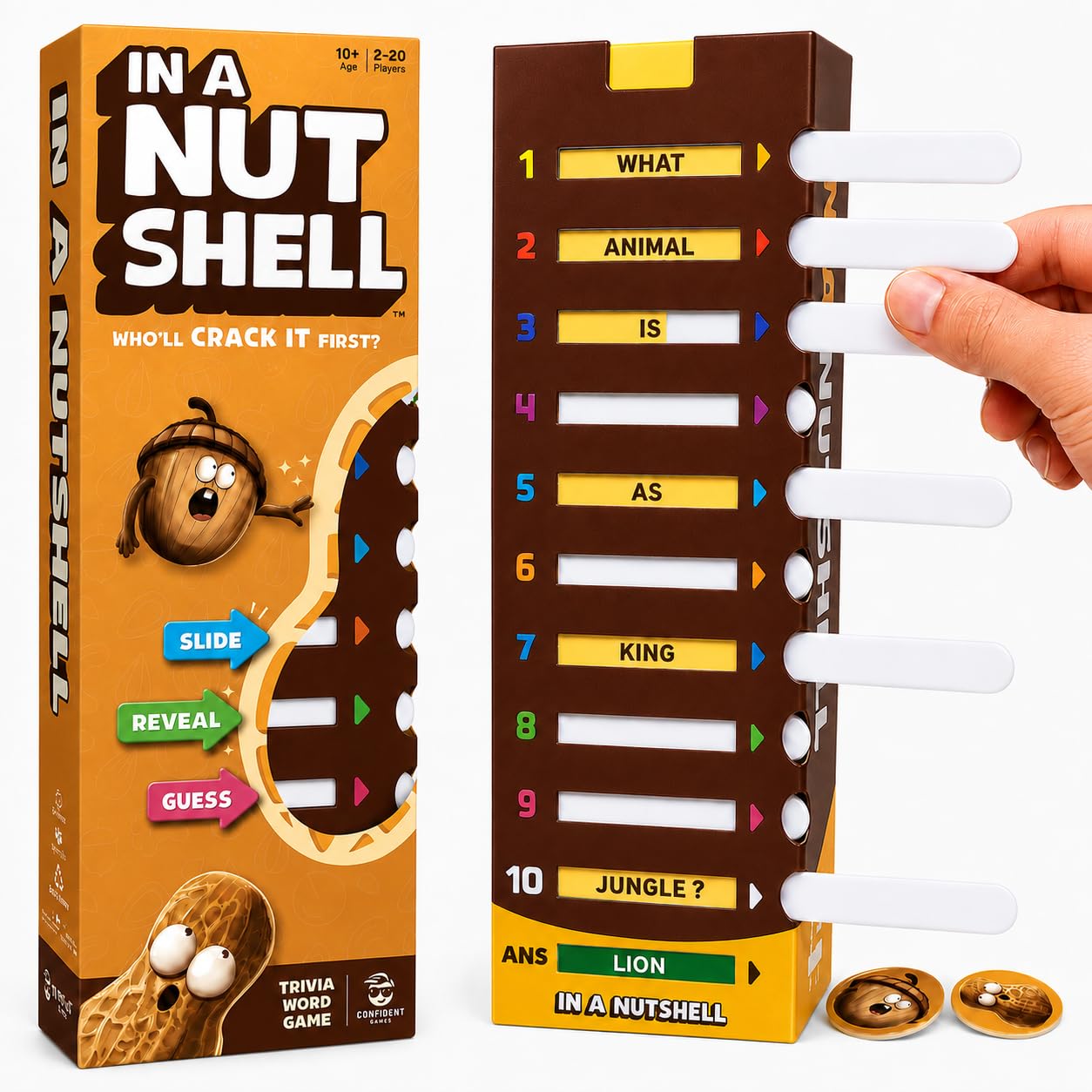
Twenty players, 464 questions, and a sliding box that reveals one word at a time.
Here is the mechanic: a question hides behind sliding windows, and your team scores more by guessing the answer with fewer words revealed. “Which animal is known as king of the jungle?” becomes a wager — open nothing and risk it all, or peel back a word at a time and sacrifice points for certainty. That push-your-luck structure is what makes it feel like a perception game rather than a plain quiz.
It plays 2 to 20 people over roughly 20 minutes, which makes it the roomiest capacity on this list by a wide margin. Two game modes let the whole group get involved, and the set arrives with 464 questions, a scorecard, team tokens and the sliding game box itself. It weighs 2 pounds and sits at 10.94 x 3.66 x 2.01 inches, so it stands upright on a shelf between games.
The word-guessing format is where its limits show. Trivia-dodgers and people who dislike being put on the spot will find the pressure grating rather than fun, and the 10+ age floor means it is not a preschool game. But in a family room or a party with a mix of ages above ten, it is one of the few games here that can genuinely seat twenty.
The read: a team word game where the sliding reveal turns every question into a calculated gamble — smart, social, and built for a crowd.
The catch: if your group is small, the format loses its spark; the risk-and-reward guessing scales with player count.
Reach for this when: you are hosting a mixed-age crowd and need one game everyone can join in one sitting.
Skip the risk if: you are playing with just two or three and prefer cooperative play.
5. Clarendon Games The Mole Party Game – Card Games

Everyone gets the same location card — except one player who has to bluff their way through it.
Each person receives a case file naming a location, while one member of the group is the Mole and has no idea where the rest are. Question cards drive the interrogation, and your job is to spot the vague answer, the over-shrug, the player who was too quick to agree. Observation and social reading carry the whole game, and the laugh comes from watching a friend sweat through a simple question about the weather.
It moves fast — 10 to 20 minutes for 3 to 8 players — and comes in a compact box with a simple manual, which makes it a pub-table or after-dinner pick rather than a centrepiece. Age 17+ is accurate advertising: the content and the conversation are aimed at adults. Several people note the balance is nearer the top of that player range, so it plays best with at least five at the table.
The instructions get a fair share of grumbles, and a first round spent checking the rulebook is normal. Once the group gets the shape of the round, the mood picks up quickly and it becomes that rare game where the bluffing is the fun. Just do not bring it to a party expecting to explain it in thirty seconds flat.
Where the fun comes from
- The Mole role gives one player real tension from the first question.
- Rounds run 10 to 20 minutes, so a group can replay it several times.
- Adult voice makes it a genuine pub or dinner-party game.
What to weigh first
- The manual leaves something to be desired — plan a slow first round while you learn together.
- With fewer than five, the interrogation loses its edge.
Made for: grown-up gatherings where the crowd actually talks and the point is to catch a liar.
Leave it on the shelf if: your table is three people or younger than teens.
6. Richard Scarry’s Busytown Seek & Find Game
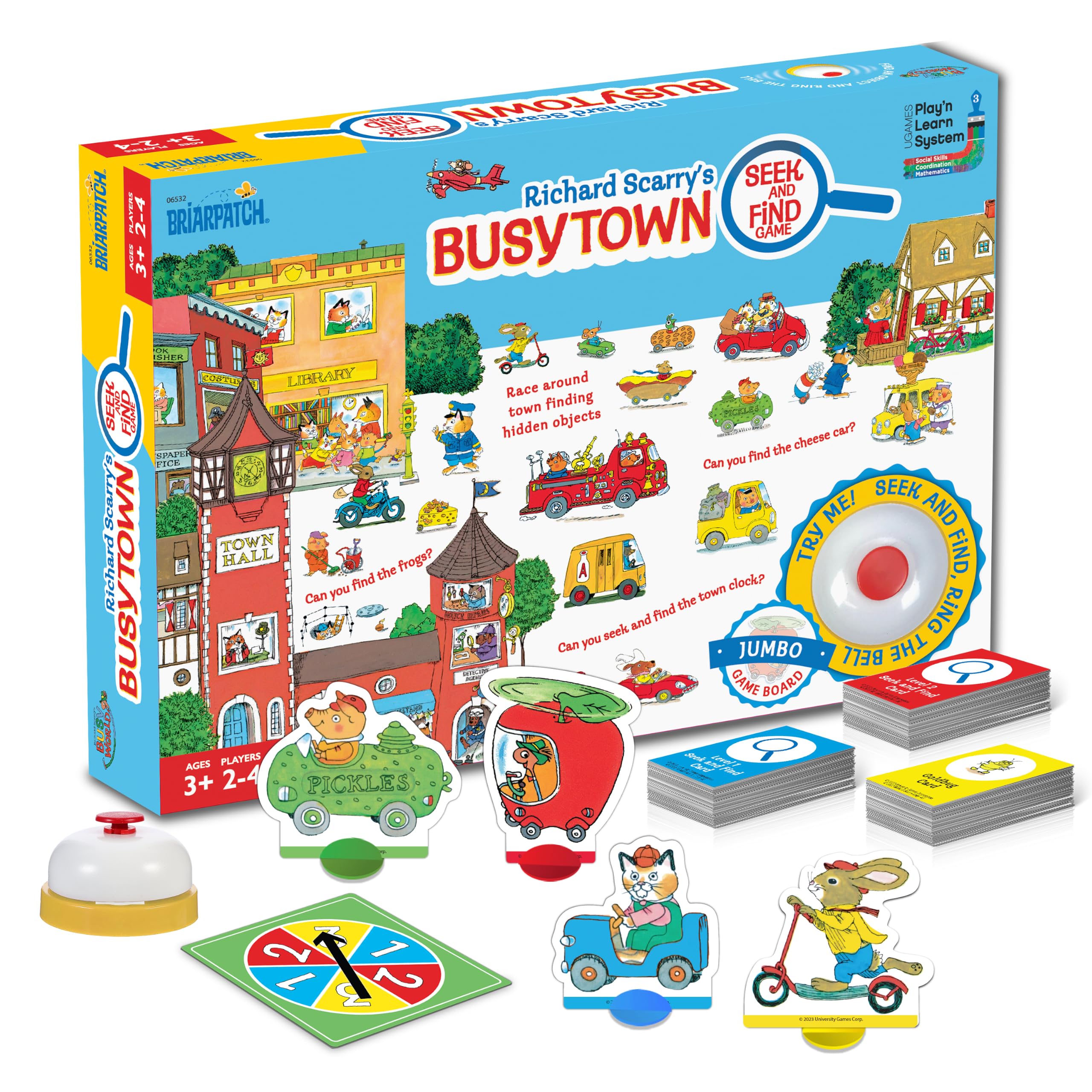
A jumbo board, 112 cards, and a bell for the preschool set — with no losing to worry about.
Cooperative is the key word here. Players work together to find items on the board, and the bell rings in celebration rather than competition. The set packs a jumbo game board, 112 playing cards split across two seek-and-find levels, 12 Goldbug cards, a spinner, four character pawns, and a bell — which is a lot of components for ages 3 and up to handle.
Those two card levels matter for longevity. Fifty postcards at Level 1 and fifty at Level 2 mean a four-year-old can start on the easy tier and work up without the game running dry. The jumbo board at 15.5 x 10.5 inches means the pictures are big enough for small hands to point at, and the whole session runs about 20 minutes for 2 to 4 players — the right length for a preschool attention span. If you have a grandchild who lights up at “I found it!”, this is built for them.
The piece-quality story is mixed. Most owners are happy with the sturdy board and cards, but a handful have been disappointed with the durability of one or another component. That is a small minority against overall satisfaction, and the bigger caution is supervision — the set carries a choking-hazard warning for small parts, so it stays under watch near younger siblings.
What makes it work: cooperative searching means no crying at the end — everyone wins or hunts together, which is exactly right for a three-year-old.
One caution: the small-parts warning means it needs a grown-up in the room with toddlers around.
This is the one if: you need a first proper game for a preschooler who can follow a simple rule and loves spotting things.
Look past it if: your children are past seven and want a game with a winner.
7. Foxmind Games: Jungle Speed – Eco Edition

Identical-looking cards, a wooden totem in the middle, and a very real chance of a scraped knuckle.
Everyone holds a deck and flips cards in turn. When two cards show the same symbol, the faster of those two players grabs the totem — and a wrong grab costs you. Certain cards look almost identical, which is the perceptive sucker punch: your eyes tell you it matches, your brain catches the difference a half-second too late, and you have already lunged. The wooden totem, 70 cards, a storage bag and the rulebook all come in the box.
Two to ten players over about 15 minutes means it fills a room better than it fills a quiet evening. The added-difficulty cards force everyone to grab at once or change the method of play, so the rules shift as the round goes on — a nice way to keep later rounds from settling into routine. This is a game you hear before you see: the totem slaps the table, the group erupts, and the next deal starts on the laugh.
The cost of all that speed is physical. Fingers clash on the totem, and the totem itself is the thing everyone reaches for. Play it with people who find a little chaos funny rather than stressful, and expect fingers to meet. It is a party-sized reflex test with plenty of chaotic energy, not a game for a quiet table of two.
The case for grabbing one
- The totem is the centre of the action — tactile and loud in the best way.
- 70 cards and 2-10 players make it the widest crowd option after the word-guesser.
- Card-tricking layers keep each round different.
The reality check
- Fast hands mean collisions — this is a physical game, so play it with care around the totem.
- It is not a two-player quiet-evening game; it needs a group to hit its stride.
The right crowd: a loud group of seven or more who find a little chaos hilarious.
Wrong night for it: a calm evening in with just one other person.
8. Smart Games Penguins Pool Party
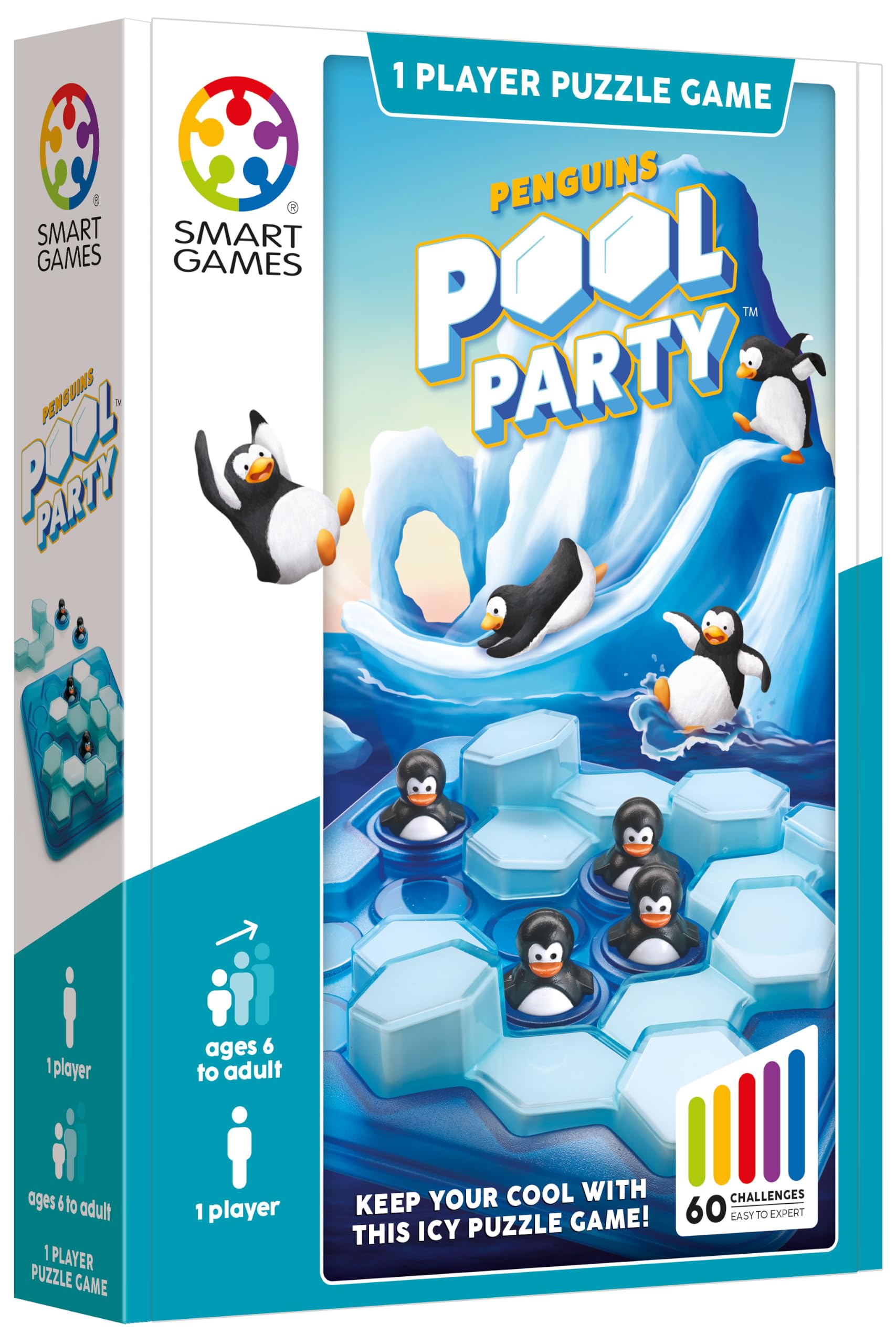
Four penguins, four ice blocks, and exactly one correct arrangement for each of 60 puzzles.
This is the quiet one. You place four penguin figures in the water according to a challenge card, then fit four 3D ice-block puzzle pieces around them without covering the penguins. There is one solution per challenge, and the booklet hands you the answer if you get stuck. Spatial reasoning and visual perception do all the work, and the challenge cards climb from easy to expert so a child grows into it rather than out of it.
Six is the stated starting age and the difficulty ramp backs that up: the first cards go quickly, the last ones can genuinely stall an adult. The whole set is built for travel — the game board has a lid for storage, the penguins and ice blocks fit inside, and the case is compact enough for a bag. It weighs 360 g and runs from ages 6 to 99, which means it earns a place in a backpack, a waiting room, and a quiet corner of the house.
The honest limitation is that it is a solo game, full stop. This is not an activity you can hand to a group — one player at a time, one puzzle at a time. That makes it perfect for an only child, a long flight, or someone who likes to solve rather than socialise, and completely wrong for game night. The puzzle difficulty gets a mixed response, with some finding the later challenges genuinely stiff — usually a sign the ramp is working.
Where it shines: the one-solution-per-challenge design means success feels earned, and the portable case makes it a genuine take-anywhere puzzle.
What to expect: it is one-player-only, so this is a quiet-time investment, not a family-night game.
Suits: the solo problem-solver who wants a page-turner in puzzle form.
Not for: a table full of people wanting to play together on a Friday night.
9. LUDILO Slapzi, Educational Card Game for Kids and Families
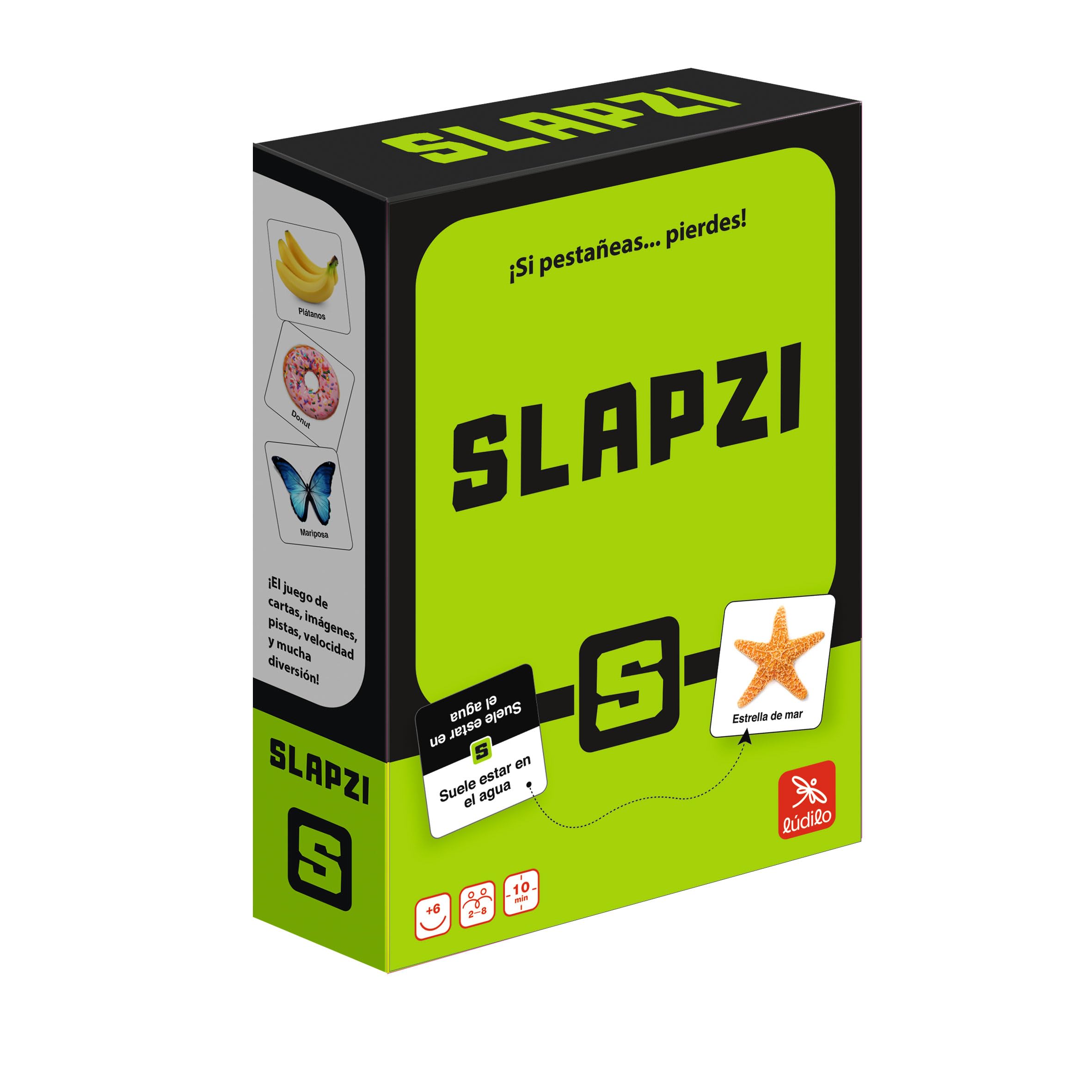
Slap the track card with the matching image first — 120 double-sided cards and eight ways to play.
Slapzi is a reaction game built on pairing. A track card gets flipped, and everyone races to slap down an image card that fits. The set carries 120 double-sided image cards and 65 track cards, spread across eight game modes so the rules can shift before the group tires of one version. It runs 2 to 8 players, ages 6 and up, at roughly 10 minutes a round.
The educational angle is visual perception and processing speed — spotting a match under time pressure and committing your hand before the competition. Flexible thinking gets a workout too, because the track cards ask you to read the prompt while your eyes scan the table. In a family setting that makes it a genuinely useful warm-up game, and eight modes give it far more replay life than a one-rule card game.
Ten minutes of slapping can get loud and animated, and younger players may need a round or two to learn the prompt-reading. It is also a 0.5 kg box, so it lives on a shelf rather than in a pocket. For a school-age family that wants a fast, screen-free card battle, that is a fair trade.
What it gives you
- Eight modes from one box keeps the rules fresh.
- 120 double-sided image cards mean huge variety within a round.
- 2-8 players and 10-minute rounds suit a busy family evening.
What to keep in mind
- A 0.5 kg box that lives on a shelf, not in a bag.
- Younger players need a round to get the prompt-reading rhythm.
Ideal for: families who want a fast, screen-free card game that grows with the kids.
Not for: a solo evening or a table that dislikes competition.
Know the Specs
Player count and playtime
Player count tells you how many can sit at the table, and playtime tells you how many rounds fit into an evening. The games here list playtimes from 10 minutes to 20 minutes. Match both to the group you actually host.
Visual perception vs. spatial reasoning
Visual perception means spotting differences, tracking symbols, or catching a match, the skill behind games like Spot It! and Slapzi. Spatial reasoning means arranging pieces in a layout until only one configuration fits, the skill behind the Penguin Pool Party puzzles. Both are perception; the first is fast, the second is slow.
Common Questions
How many players do I need for a perception game?
Is a solo puzzle game good for adults too?
What is the difference between a reflex game and a thinking game?
Will a perception game help my child learn?
Are the pieces in these games big enough for young children?
Can I travel with a perception game?
How long does a typical round last?
Which of these is best for a mixed group of kids and adults?
What should I check before buying a magnetic chess set?
Do these games need batteries or an app?
The Bottom Line
When the goal is a single game that covers the most evenings, the Wooden Matching Game Puzzle with Bell takes it: wooden pieces, a bell-driven race, and a mixed-age table that stays competitive. If you want the lock-and-go party tin, the Asmodee Spot It! Camping teaches in seconds and packs into a pocket. And for the solo problem-solver who wants a puzzle with one correct answer and a lid to carry it in, the Smart Games Penguins Pool Party is the quiet-time pick. For a crowd that loves a bluff, the Clarendon Games The Mole earns its place at an adult table — and if your group shrinks, the bigger player counts above are the safer bet.
How we choose
We do not accept paid placement. Every pick is matched to a real buyer and a real use-case; we do not hands-on test units.
Sources
Specifications: manufacturer listings and product documentation. Review insights: verified customer reviews, as of November 2026. Pricing: not shown on this page (it changes often); check the current price via the retailer link.
As an Amazon Associate, Gamepad Test earns from qualifying purchases. This does not affect which products we feature.