
Specs are compiled from manufacturer listings and verified buyer reviews and can change over time — please confirm the key details on the product page before buying.
You cannot judge a tabletop game from its box photo. What matters is how it feels on turn four, when the rules have clicked and the table gets quiet. The right pick depends on your group’s player count, playtime, and appetite for rules. Four adults who want tough decisions need a very different box than a family with a seven-year-old and forty minutes before bedtime. This article sorts nine strong games by player count, playtime, how fast the rules stick, and whether the game holds up after the twentieth play. That way you can match player count and playtime to your table instead of guessing from the cover art.
This guide is built by comparing the manufacturers’ published specifications and the patterns across verified customer reviews, so you get each pick’s real strengths and trade-offs instead of marketing spin.
Every entry below lists exactly how many players it handles, how long a session actually runs, and where the rules tend to trip newcomers up. If you want the short answer before the long one, the video games board games shortlist below starts with the box that has the strongest owner track record right now.
Top Picks

How To Choose A Video Games Board Games Pick
Start with the number of humans you can reliably get around a table on a Tuesday. That single fact eliminates more boxes than playtime or theme. A game built for 2-5 players can feel thin with two and crowded with five, so check the range against your real group before you fall for the artwork.
Match playtime to the night, not the box
The printed playtime is an average, and it assumes everyone already knows the rules. A box that says 30 minutes usually means 30 minutes on play four, not play one. If your group meets for an hour after dinner, a game that lists 30-45 minutes leaves room for teaching. A game that lists 60-90 minutes needs a longer evening or a faster group.
Read the player count for the low end
Most boxes advertise the maximum player count in big type. What matters more is whether the game stays interesting at the minimum. Two-player games should be tight and tense rather than a watered-down version of the four-player experience. If you mostly play as a couple, that low-end number is the one to check first.
Decide if you want to win together or against each other
Cooperative games put everyone on the same side against the game itself, which suits families with mixed skill levels and groups who dislike losing to a friend. Competitive games give each player their own score to protect. The trade-off with co-op is a tendency for one experienced player to steer everyone else’s turns, so co-op works best when the group talks as equals.
Weigh how much rules-teaching your table tolerates
A game with a deep decision space can still be simple to explain, and those are the ones that hit the table most often. Look for a game whose rules fit on a single reference card and whose first turn makes sense without flipping through a booklet. If the box describes its rules as streamlined or accessible, that usually means the designer cut the fiddly steps rather than the strategy.
Side-by-Side Comparison
| Model | Best For | Player Count | Playtime | Core Mechanic | Amazon |
|---|---|---|---|---|---|
| Asmodee Harmonies★ Best Overall | Families who want beauty and brains | 1-4 | 30 min | 3D landscape tile placement | Amazon |
| AzulAward Winner | Two-player duels and family night | 2-4 | 30-45 min | Tile drafting and pattern building | Amazon |
| BLANK SLATEBest Party Pick | Parties and loud family dinners | 3-8 | 20-35 min | Word association and prediction | Amazon |
| Castle Panic 2nd Edition | Mixed-age groups playing as a team | 1-6 | 60 min | Cooperative tower defense | Amazon |
| Ticket to Ride | A first modern strategy game | 2-5 | 30-60 min | Route and network building | Amazon |
| Talisman 5th Edition | Fantasy fans who like dice and drama | 2-6 | — | Roleplaying adventure race | Amazon |
| Carcassonne | Endless replay without new purchases | 2-5 | 35 min | Landscape tile-laying | Amazon |
| Pandemic | Groups that love planning together | 2-4 | 45-60 min | Cooperative role-based strategy | Amazon |
| Wingspan | Players who want depth and gorgeous art | 1-5 | 60-90 min | Engine building with bird cards | Amazon |
Detailed Reviews
1. Asmodee Harmonies Board Game
Our pick — 4.5+★ from 900+ verified ratings; the strongest balance of quality and price.
The landscape builder that makes a thirty-minute session feel like a small holiday.
Harmonies asks you to build a little dreamlike world out of landscape tiles and then populate it with animals for points. The pieces you physically handle are the reason it lands: the box carries 120 wooden tokens, and the set includes 79 animal cubes alongside 32 animal cards plus 10 Nature’s Spirit cards. That is a lot of tactile weight to move around a table, which is exactly why the act of placing and stacking feels satisfying rather than abstract.
You get a real decision without giving up the evening, because the playtime is listed at 30 minutes. That number makes this the easiest recommendation on the page for a family. The table footprint stays small, and the player count runs 1-4, so the same box covers a quiet solo session and a full family table. For reference, the Harmonies range of 1-4 players sits directly against BLANK SLATE’s stretch to 3-8 players. Those are different jobs entirely, so think about that before you assume one box covers both.
What wins people over is the tile-stacking puzzle itself, and the second thing everyone notices is how quickly the rules click, even for younger players. Parents consistently report that kids grasp it without a long teaching session, which is rare for a game with genuine tactical depth. The strategy layer rewards planning a few moves ahead without punishing a first-timer, so a mixed-experience table stays competitive.
Plan on a normal dining table rather than a cramped coffee table, because the listing gives the board piece at a slim 2.52 inches long by 8.43 inches wide. Also treat the small tokens as a swallow risk around toddlers. Beyond that, this is a polished box with beautiful illustrated cards that earns its spot at the top.
What Earns It First Place
- 120 wooden tokens and 42 illustrated cards give it real table presence
- Rules are easy enough for kids, deep enough for adults to plan around
- Plays solo or with 1-4 players in about 30 minutes
- Combines luck and strategy so nobody is mathematically out of it early
Where It Asks More Of You
- The board wants a proper table and a little setup room
- Small animal cubes need watching around very young children
- Strategic players may want more conflict than the theme offers
Go for it if: you want one box that handles a solo evening and a family night without changing games.
Think twice if: your table is small or your group wants direct player-versus-player conflict.
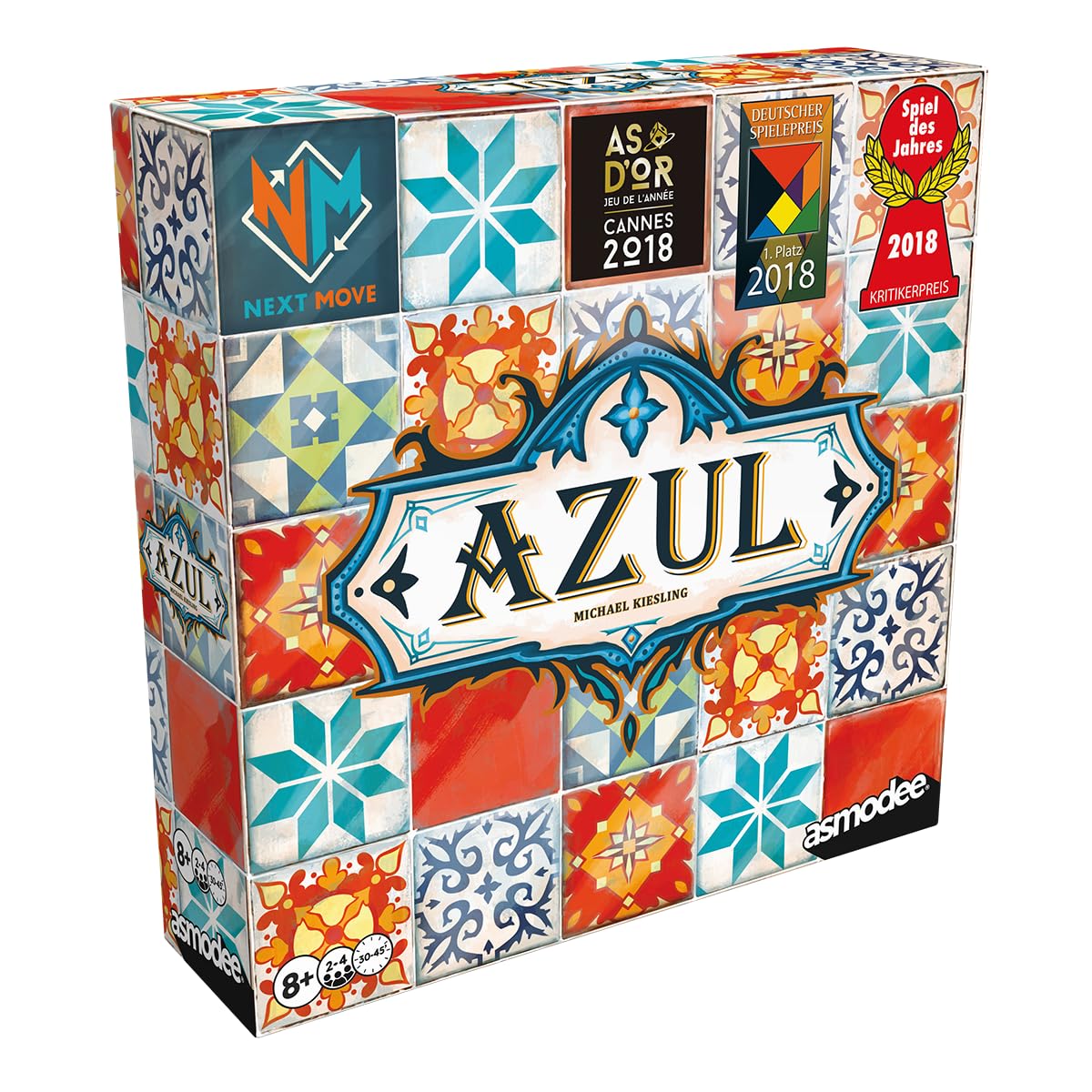
2. Azul Mosaic Tile-Placement Strategy Board Game
Draft a tile, deny a tile — the two-player duel that turned a mosaic into a knife fight.
Azul hands you 100 resin tiles and a simple loop: pull tiles from shared factory displays, fill your pattern rows, and build a mosaic wall that scores. The pieces are the first thing anyone picks up, because resin tiles feel like actual Portuguese ceramic rather than cardboard. The set also includes 9 factory displays, 4 player boards, 4 scoring markers, and a linen bag, so the tactile quality runs through the whole box.
It sits in the tight two-player space better than almost anything else here, though the box covers 2-4 players and ages 8 and up. A session runs 30-45 minutes, which puts it just above Harmonies’ 30-minute mark — a small difference that matters when you are squeezing in one game before the kids go down. The draft-and-deny mechanic is where the teeth are: taking a pile of tiles your opponent needed is half the game.
The combination of a clean tile-drafting rule set and real strategic consequence is what makes Azul a permanent shelf fixture for so many households. It won the 2018 Spiel des Jahres, and the play patterns back that up. Newer players learn in a few minutes; experienced players still find new tile combinations each round, so replay value stays high without needing expansions.
Where it asks patience is the player-count feel. The four-player version is looser and less tense than the duel, so if you are buying mainly for a group of four, expect a friendlier game than the two-player version. It also rewards a slightly ruthless streak, which is worth knowing if you have a child who takes tile-stealing personally.
Best-played-at-two: the duel format is where Azul’s draft-and-deny tension peaks, so buy it thinking head-to-head first.
Small caveat: four-player sessions feel noticeably gentler, and a tile-hungry opponent can knock a younger player’s plans flat.
Reach for this if: you mostly play as two and want a genuinely tense thirty minutes.
Look elsewhere if: your table of four wants a cooperative feel where nobody’s plan gets wrecked.
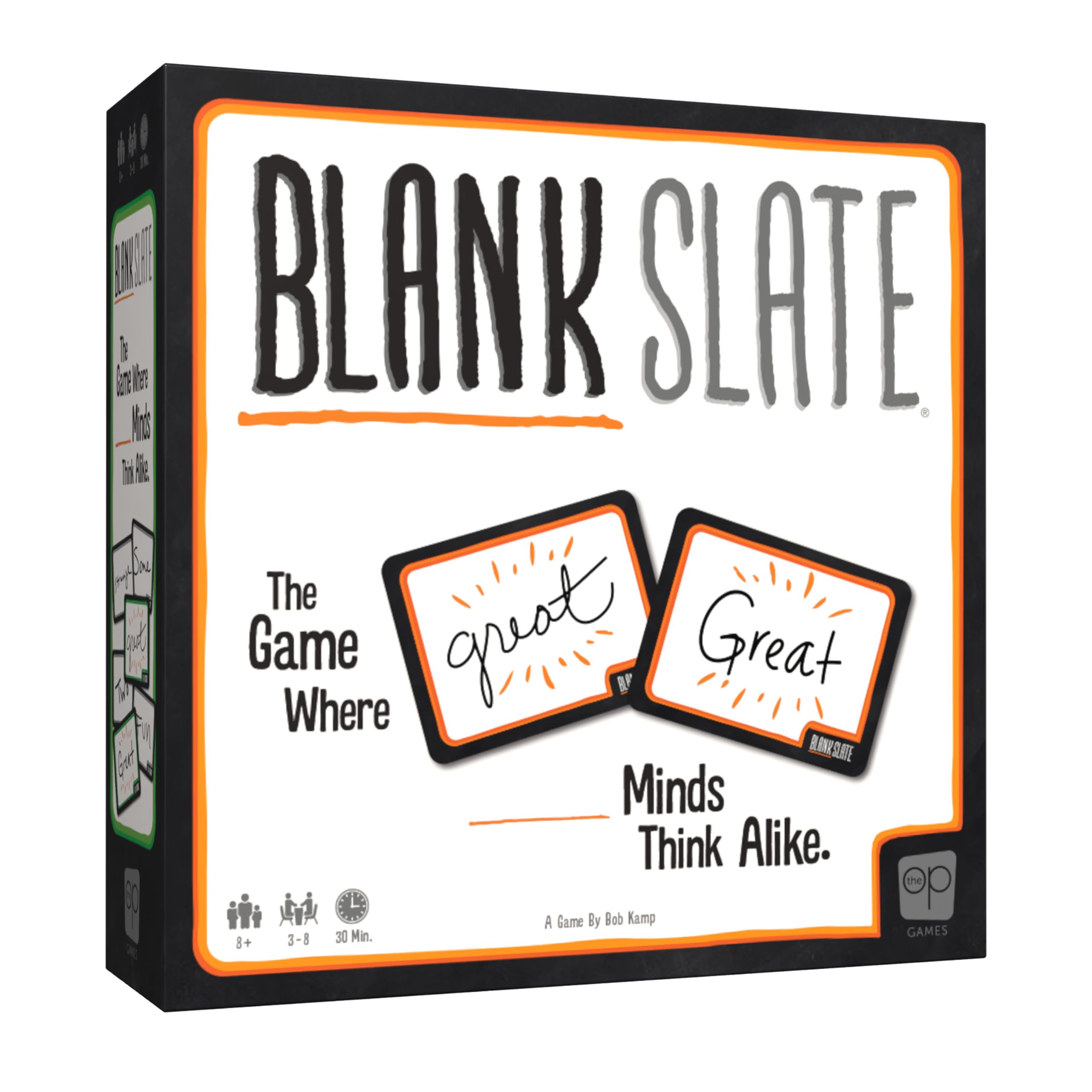
3. BLANK SLATE Board Game
Eight slates, one word cue, and a room full of people discovering they think alike.
Blank Slate is a prediction game: you read a word cue, write the word you think completes the phrase, and try to match another player’s answer without any hint. The kit is built for a crowd — 8 dry-erase slates, 250 double-sided word cue cards, and a scoreboard. Player count stretches from 3 to 8, which is the widest on this list by a clear margin, and a round runs 20-35 minutes.
Compare that to Harmonies, which tops out at 4 players: Blank Slate covers 3-8, roughly double the headcount, and that difference decides whole categories of gatherings. If your birthday parties regularly hit six or seven people, most strategy boxes on this page simply cannot seat them, while this one was designed around exactly that table.
What gets people laughing is the mind-reading failure — you are certain everyone will write the same word cue answer, and they do not. The rules land in about a minute, so anyone who can write can play, including grandparents and older kids sitting at the same table. Because slates wipe clean and the card deck runs 250 double-sided cues, it holds up across repeated holidays without repeating answers.
The trade-off is that this is not a strategy game, and a group that wants mechanical depth will find it thin after a long night. It also leans on the crowd, so a table of three is noticeably quieter than a table of seven. One nice detail is portability, since the whole set packs down without a board to protect.
The crowd answer: with 3-8 players and a one-minute teach, this is the box that rescues a party where nobody wants a rulebook.
Fair warning: it wants a full table and rewards people willing to be a bit silly, so a serious competitive group may burn out on it in one sitting.
Built for this table: six or more people, mixed ages, and a night that should stay light.
Not built for: a two-player strategy evening, where the guessing falls flat.
4. Fireside Games Castle Panic 2nd Edition
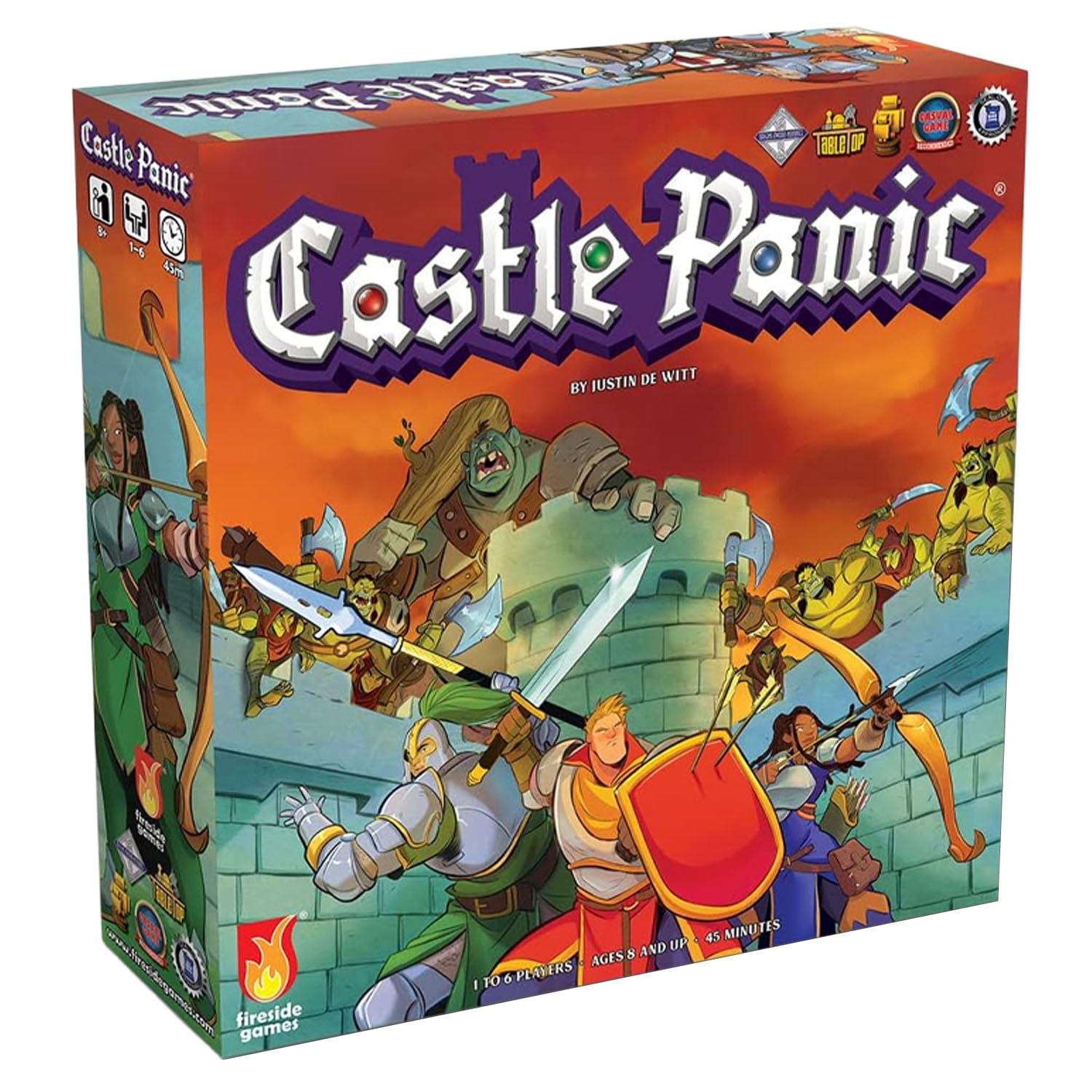
Monsters at the walls, towers to keep standing, and a plan everyone has to agree on.
Castle Panic puts the whole table on one side, defending Castle Bravehold from monsters closing in from every direction. You trade cards, coordinate, and try to keep at least one tower standing. The box runs 1-6 players across four modes — co-op, solo, a competitive Master Slayer mode, and an Overlord mode where one player runs the monsters. That flexibility is unusual at this size, and it means the box survives a group whose mood shifts from team play to rivalry.
The playtime is listed at 60 minutes, which is the campfire-length session of this list — roughly double a 30-minute Harmonies game, and the reason it suits a full evening rather than a quick round. For a group that wants the drama of a siege rather than a quick tile puzzle, that longer clock is the point, not a drawback.
What makes it click is the cooperation itself — the table trades cards and defends the towers together instead of guarding their own scores, and mixed-experience groups end up helping each other rather than competing. The rules are simple enough for children to follow while adults still find the tension real. The 3D towers and bright monster tokens give the game a physical centerpiece that reads clearly from across the table, and the included board is designed for a proper tabletop spread.
The honest limit is the challenge level. This is a game you can win, and for adults who want a punishing puzzle, it may feel forgiving after several plays. There is a Master Slayer mode and an Overlord option to add bite, but the base co-op leans friendly — great for kids, less of a strain for veterans.
Strength: four modes in one box mean a family can play cooperatively one night and competitively the next without buying anything else.
The catch: the base co-op experience runs on the gentler side, so hard-nosed adult groups should head straight for the Master Slayer or Overlord settings.
Best for: families with a spread of ages who want one team goal and a satisfying hour.
Skip if: your group wants to beat each other, not the board.
5. Asmodee Ticket to Ride Board Game
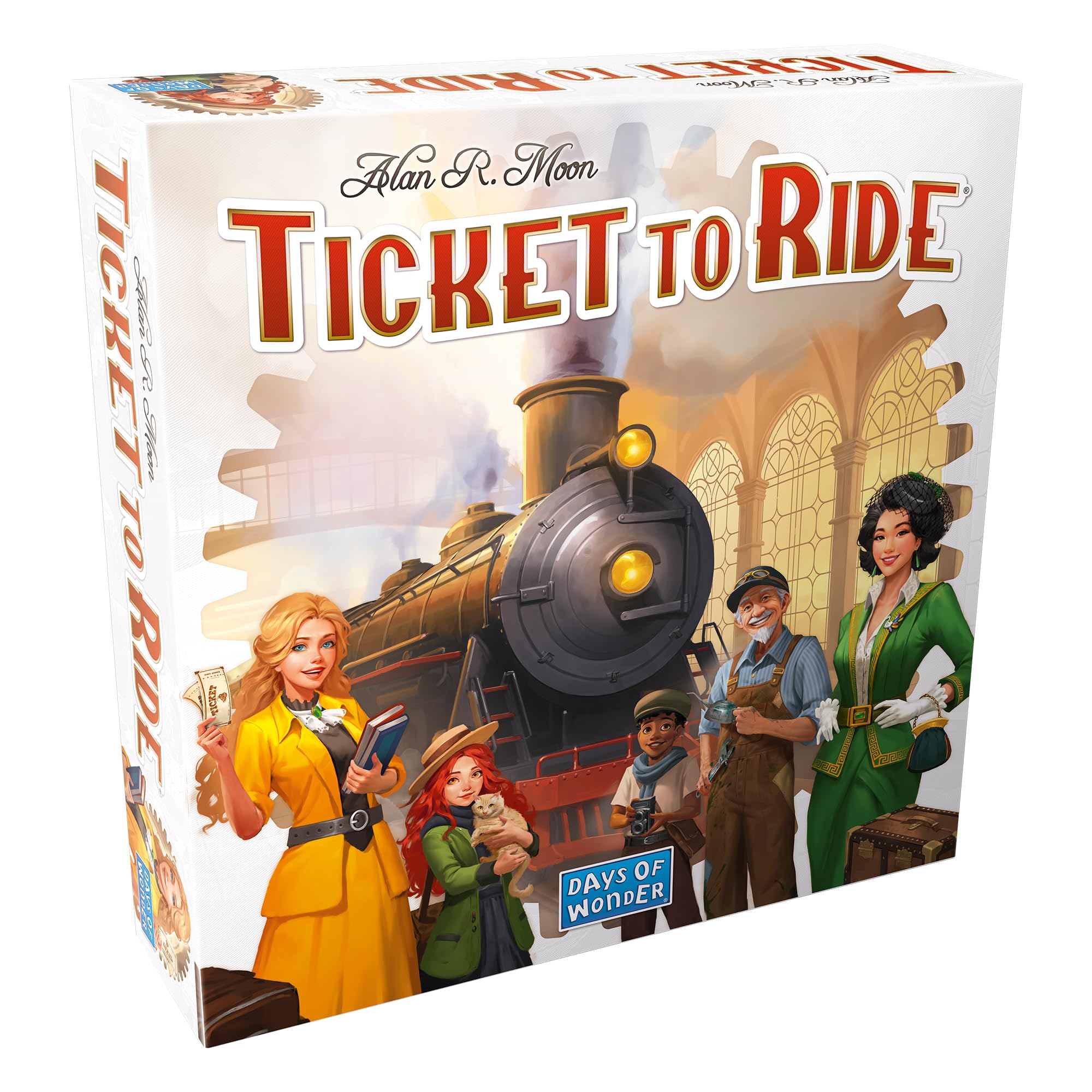
The train game that teaches a whole family how route planning feels in one sitting.
Ticket to Ride is the gateway game — collect colored train cards, claim routes across a map of North America, and connect your cities before someone else blocks the line you needed. The box carries 225 plastic trains in 5 colors, 110 train cards, 33 tickets, and 5 wooden scoring markers, so the table looks like a proper board game the moment it is set up. The giant map and the miniature trains do a lot of the convincing for new players.
It runs 2-5 players and lists a 30-60 minute playtime, which makes it the flexible middle ground of this list. That is between Harmonies’ compact 30-minute session and Castle Panic’s full 60, so it works for a weeknight round and stretches comfortably into a longer weekend game. The rules are simple enough for ages 8 and up to follow, and the ticket cards give every player a secret goal that keeps the table guessing.
The design’s real feat is that it makes planning feel notable without a heavy rulebook. You are weighing card sets, defending routes, and racing for the longest path bonus all at once. Multiple ways to win means a player who falls behind on one route can pivot to tickets or the longest-path card instead of sitting out the rest of the evening.
The catch is a familiar one for gateway games: experienced players will eventually solve the map and want more tension. There is also a luck element in the card draw that can leave you waiting for the right color, so a competitive group may find the randomness galling. For a first strategy game, though, that randomness is what keeps newcomers in the fight.
Why it earns a slot: 2-5 players, 30-60 minutes, and rules that make sense on the first read — the perfect bridge from party games to real strategy.
Where it wears: map knowledge and card-draw luck eventually cap the tension for seasoned players.
Pick this if: you are introducing a family or friend group to strategy games for the first time.
Hold off if: everyone at your table already knows the map and wants a harder puzzle.
6. Avalon Hill Talisman 5th Edition

One hundred adventure cards, twelve characters, and a dragon guarding the crown.
Talisman is the fantasy adventure race: choose a character, cross a magical land in three regions, grab a Talisman, reach the Crown of Command, and deal with its guardian dragon. The fifth edition refreshes the package with 12 detailed character figures and matching cards that reveal each character’s unique ability, plus 100 illustrated adventure cards that change the board as they are layered on.
It seats 2-6 players and asks for ages 12 and up, so it is the box for a table that wants roleplay and luck in equal measure rather than tight optimization. The board changes as you play, which keeps the map from becoming a solved problem the way a fixed-board game can. It also means no two journeys look alike, and that is the replay value the designers are selling.
The updated rulebook is the friendlier part of this edition: the changes are designed to make the game more accessible to newcomers and non-gamers while keeping the strategic core for fans. The redesigned figures and artwork give the table a strong visual anchor, and the game plays long enough to feel like an event rather than a filler round.
What the box does not promise is a short night. This is the kind of game that runs long enough that a group should plan for the whole evening, and the luck of a dice-driven adventure means a player can have a run of bad rolls. Character pieces earn mixed feelings in the reviews, with some loving the figures and others less convinced, so go in for the adventure rather than the miniatures.
The selling point: 12 characters and 100 adventure cards give every session a different map, and the streamlined fifth-edition rules lower the entry barrier for non-gamers.
The reality check: dice-driven adventure means swings of luck, and the figures are the most debated part of the box.
Made for: fantasy fans who want a long, story-flavored evening with a bit of chance in the mix.
Not for: players who need tight, luck-free strategy from turn one.
7. Carcassonne Tile Placement Strategy Board Game
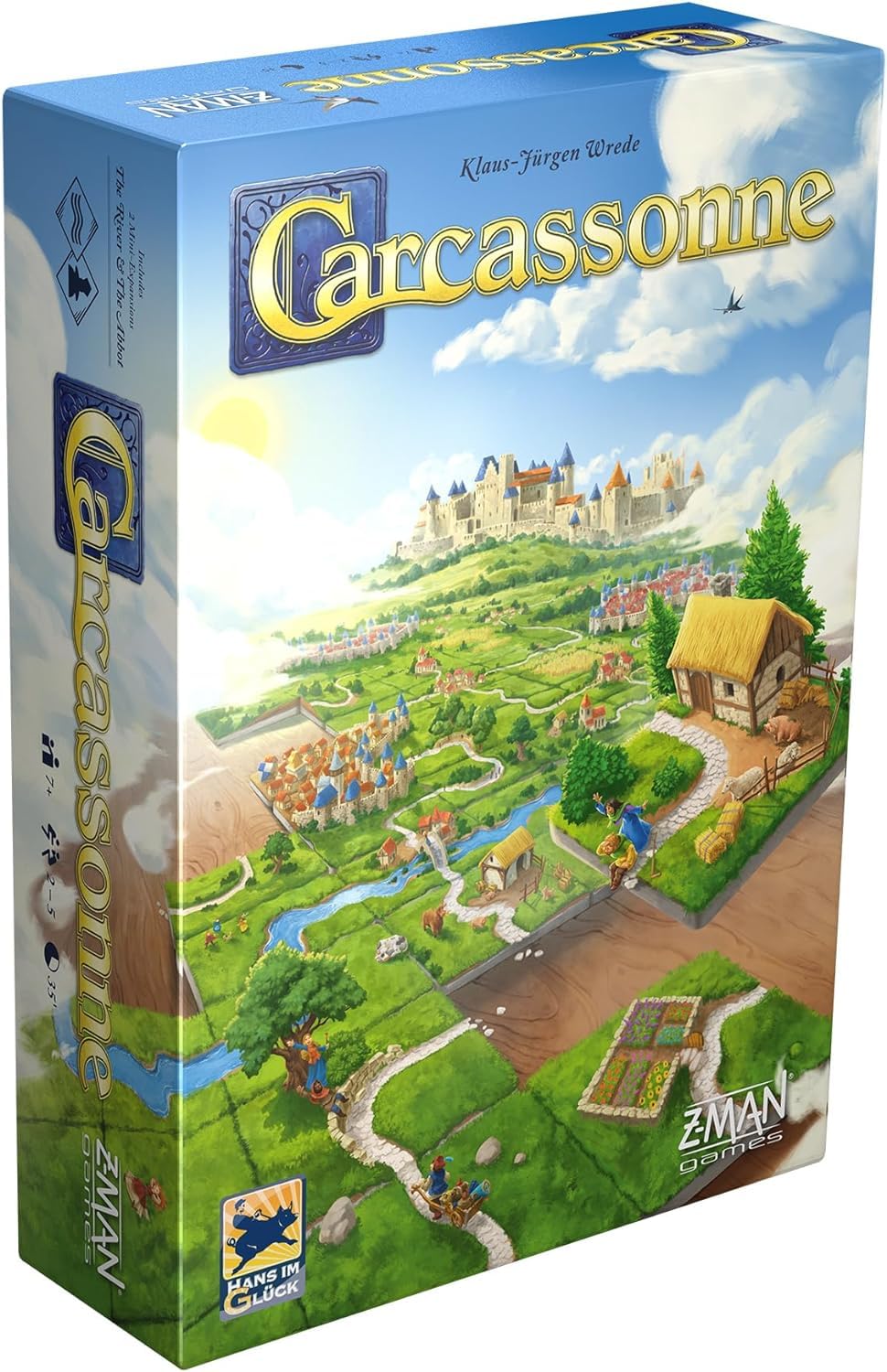
Draw a tile, place a meeple, and watch a medieval countryside build itself from nothing.
Carcassonne is the classic tile-layer: every turn you draw a landscape tile, place it beside what is already on the table, and deploy a meeple as a knight, farmer, or monk to claim the feature you are building. Cities, roads, fields, and monasteries emerge from the shared draw pile, so the board is different every game. It seats 2-5 players and lists an average 35-minute playtime.
The box includes the Abbot and The River mini-expansions from the start, which matters because it gives a new owner extra variety without another purchase. Randomized tile draws mean a fresh puzzle each session, and that is the engine behind its longevity — the same box keeps producing new landscapes rather than replaying the same map.
Its strength is the balance between intuitive rules and real decisions. A 7-year-old can place a tile and score a road; an adult can spend the same turn building a city trap. The game plays cleanly at two and stays lively at five, which is a wider working range than most strategy boxes manage. Cooperative or competitive play both fit, depending on how the group talks.
One honest note: because the tile draw is random, a run of awkward tiles can handcuff an experienced player who has a plan. There is also a physical footprint that grows as the map spreads, so a small table fills up by the end of a session.
Why It Stays On The Shelf
- Randomized draws create a different landscape every session
- Abbot and The River expansions are already in the box
- Rules make sense to a 7-year-old, decisions satisfy an adult
- Works cleanly at two players and comfortably at five
What To Plan For
- Random tiles can stall a well-laid plan
- The map spreads wide and needs table room late in the game
- Longtime players will want expansion content for extra variety
Right fit: a household that wants one box to last years of game nights without shopping again.
Wrong fit: a group that needs controlled, luck-free planning every turn.
8. Pandemic Cooperative Strategy Board Game

Everyone wins together or loses together — no scoreboard to hide behind.
Pandemic is the co-op benchmark: the whole table works against the game itself, combining specialist roles like the Medic, Scientist, and Researcher to contain outbreaks and complete four cures before the clock runs out. It seats 2-4 players, ages 8 and up, and lists a 45-60 minute playtime, so it fits a solid evening rather than a lightning round.
Pandemic is the more demanding cooperative game than Castle Panic, which covers 1-6 players in a 60-minute session. Pandemic is built for a group that wants to talk through every move rather than roll dice and hope. The role system is what separates it: each player’s ability shapes the team plan, so a table of four genuinely has four jobs to do.
What keeps it on the table is the planning itself. You are managing cards, balancing immediate threats against long-term cures, and making decisions that can flip the whole night’s fortunes. That tension gives it a level of replayability that surprises first-time players, since the order of the deck changes the strategy every time.
The honest trade-off is the learning curve. The rules are thicker than most games here, and the first session can feel like homework while everyone works out the roles and the outbreak mechanics. Once it clicks, it clicks hard — but if your group wants a game you can teach in one minute, this is not it. Pandemic also works as the entry point to the wider series, including Pandemic Legacy Season 1, so the base box is a sensible first step if you want a co-op campaign later.
The case for it: roles, cures, and outbreak management create a co-op night where every decision matters and no one can coast.
The honest cost: setup and rules take a real first-session investment, and the game asks for a group willing to coordinate rather than play in silence.
Choose this when: your group likes to plan out loud and wants to beat the game, not each other.
Avoid if: your table wants instant rules and no meeting-before-the-game feel.
9. Stonemaier Games: Wingspan by Elizabeth Hargrave

A birdfeeder dice tower and 170 birds — the box that turns a tabletop into a wildlife preserve.
Wingspan is an engine-building game about attracting birds to your preserve. You gain food tokens through a custom birdfeeder dice tower, lay egg miniatures in a range of colors, and play bird cards into habitats where their abilities chain into bigger turns. The component list is the most elaborate here: 170 unique bird cards, 103 food tokens, 75 egg miniatures, 5 custom wooden dice, and a 2-piece organizing tray.
It seats 1-5 players and lists a 60-90 minute playtime, which is the longest on this page and the reason it lands in the premium tier. It even includes an Automa deck for solo play, so a single player can compete against a simulated opponent. A 6-minute setup time is part of the design, which matters when a long game already eats your evening.
The artwork is what most people notice first — 170 unique bird cards with illustrations that tie each bird’s real nest type, egg count, and food needs into the mechanics. There is an educational thread too, since the game teaches real bird facts as you play. The 26 bonus cards and 8 goal tiles add goal variety so the same preserve does not repeat the same scoring path.
The recurring complaint is complexity. This is a medium-weight game, and the rules take real attention on the first play. The swift-start pack in the box eases that by walking a first-timer through the opening actions, but a group that wants a one-minute teach should look at Ticket to Ride instead. That longer runway is the cost of all that depth.
Standout feature: the birdfeeder dice tower and 170 unique bird cards make the setup itself a spectacle, and the 1-5 player range covers solo play through family night.
The price of depth: this is the heaviest rule set in the group, and a 60-90 minute session needs a committed evening.
Worth it for: players ready to invest a long evening in a deep, beautifully produced engine builder.
Not the first buy if: you need a game you can teach a reluctant group in five minutes.
Know the Specs
Player Count And Real Table Fit
The number on the box is the range the designer supports, not the range where the game shines. A box that says 2-5 players can play well at two and feel loose at five, so check where your regular group sits. If you mostly play as a pair, a game that lists its two-player experience as its strongest is the better buy than one that lists a wide range to cover all bases.
Playtime And Session Length
Printed playtime assumes everyone already knows the rules. A 30-minute game can take 45 on a first play while the table learns. That gap matters more than the printed number when you are squeezing a game into a weeknight, so plan the first session as a teaching session and the second as the real game.
Cooperative Versus Competitive
A co-op game puts the whole table on one side against the board, which suits mixed skill levels because a strong player can help a newcomer without hiding their hand. The risk is one player steering every decision, so co-op works best when the table talks as a group. Competitive games keep each player’s choices private and create the tension many groups want.
Component Count As A Quality Signal
Token counts, card counts, and included trays tell you how much physical game you are getting. Resin tiles and wooden tokens hold up better to repeated handling than thin cardboard, and a custom organizing tray cuts setup time every single session. For a game you plan to play for years, that build quality matters as much as the rules.
Common Questions
How many players do I need for a board game night?
Is a cooperative board game better for families with young kids?
How long does a typical board game session actually take?
What is the difference between tile placement and tile drafting?
Do I need expansions to enjoy these games?
How durable are the pieces in a board game box?
What age range works for a family board game?
Can I play these games solo?
Is a party game or a strategy game better for a mixed group?
How do I stop one player from taking over a co-op game?
The Bottom Line
For most tables, the standout video games board games choice is the Asmodee Harmonies. It covers a solo session and a family night in one box, teaches fast enough for kids, and offers real planning underneath, all in about 30 minutes. If your crowd is bigger than four, grab Blank Slate — it seats 3-8 and nobody needs more than a minute of rules. And if your group wants to plan together rather than compete, Pandemic is the co-op challenge worth the longer setup.
Two honest nudges before you close the tab. If this is a gift for someone new to modern games, Ticket to Ride is the gentlest on-ramp, and if they already own a shelf of strategy boxes, Wingspan is the one that feels like an event. Everything on this list is worth owning — the only wrong pick is the one that does not fit the people around your table.
How we choose
We do not accept paid placement. Every pick is matched to a real buyer and a real use-case; we do not hands-on test units.
Sources
Specifications: manufacturer listings and product documentation. Review insights: verified customer reviews, as of November 2026. Pricing: not shown on this page (it changes often); check the current price via the retailer link.
As an Amazon Associate, Gamepad Test earns from qualifying purchases. This does not affect which products we feature.