
Heads up: This post contains affiliate links. As an Amazon Associate I earn from qualifying purchases, at no extra cost to you. Learn more
Specs are compiled from manufacturer listings and verified buyer reviews and can change over time — please confirm the key details on the product page before buying.
If you are moving from a 360 pad to an Xbox One-era controller, the GameSir G7 SE gives you the biggest jump in feel for the least money in the mid-range. The official Xbox Wireless Controller is the safest plug-and-play bet if you want zero setup. The real question is no longer “which feels nicer” — it is whether the sticks will still track straight after six months of ranked grinding.
This guide is built by comparing the manufacturers’ published specifications and the patterns across verified customer reviews, so you get each pick’s real strengths and trade-offs instead of marketing spin.
The 360 era taught a generation of players to accept slow stick wear and loose triggers, so this breakdown focuses on what actually changed — trigger locks, back paddles, and drift-free magnetic sticks. Here is the straight-talking Xbox One Controller vs 360 upgrade breakdown worth your time.
Top Picks
How To Choose The Best Xbox One Controller vs 360
Going from a 360 pad to a modern Xbox controller is mostly about fixing two things the old design could not: sticks that drift and triggers with no travel adjustment. Get those right and everything else — battery life, grip texture, weight — becomes a preference call rather than a deal-breaker.
The Stick Question: Hall Effect vs Traditional Potentiometers
Traditional sticks use potentiometers (small contact pads that wear down as the stick rubs against them), which is exactly why a heavily used 360 pad starts pulling to one side. Hall Effect sticks replace that physical contact with magnetic sensing, so there is no rubbing surface to wear out. Look for the phrase “Hall Effect” in the listing — it is the single most valuable spec on this entire page for long-term play.
Trigger Stops and Back Buttons for Competitive Play
Trigger locks let you shorten how far the trigger has to travel before it registers — useful in shooters where you want the shot to fire fast, and easy to switch back to full travel for racing games. Back buttons (sometimes called paddles or mappable buttons) let you keep your thumbs on the sticks while jumping or crouching. Both are genuine 360-era gaps, not marketing filler.
Wired vs Wireless: Latency, Cables, and Battery Life
A wired controller removes charging from your routine entirely, but it puts stress on the cable and the USB-C port every time you move. Wireless gives you freedom but adds a battery to manage. Check the listed battery hours against how long your typical session runs, and check whether the USB connection is detachable so a worn cable can be swapped without replacing the whole pad.
Side-by-Side Comparison
| Model | Best For | Sticks | Connection | Battery / Weight | Amazon |
|---|---|---|---|---|---|
| XBOX Wireless Controller | Ice Breaker Special Edition★ Best Overall | Style-led all-rounder | Standard textured | Xbox Wireless, Bluetooth, USB-C | Up to 40 hours / 14.08 oz | Amazon |
| GameSir G7 SEBest Value | Drift-free on a budget | Hall Effect | USB wired (detachable) | — / 420 g | Amazon |
| PowerA Advantage Fortnite GlowBest Looks | Glow-in-the-dark FPS play | Hall Effect | USB-C wired | — / 10.24 oz | Amazon |
| FLYDIGI VADER 5S | Tinkerers who swap genres | Hall Effect, adjustable tension | Wired | — / 450 g | Amazon |
| Xbox Wireless Controller – White | Family-room default | Standard textured | Bluetooth wireless | — / 1.2 lb | Amazon |
| Turtle Beach Victrix Pro BFG Reloaded | Modular layout switching | Hall Effect, swappable | Wired and wireless | Up to 20 hours / 9.28 oz | Amazon |
| Nacon Revolution X Unlimited | Deep software tuning | Hall Effect magnetic | 2.4GHz RF, Bluetooth, wired | Up to 10 hours / 230 g | Amazon |
Detailed Reviews
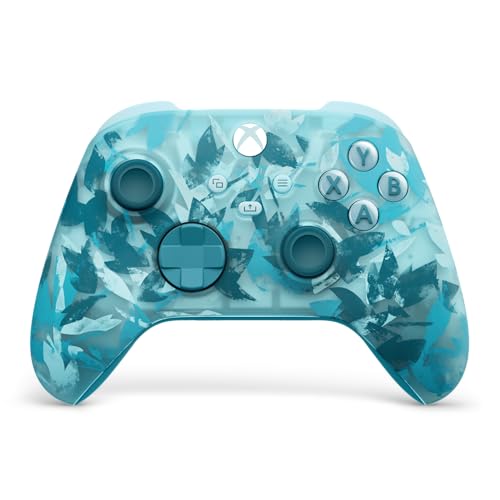
1. XBOX Wireless Gaming Controller Ice Breaker Special Edition
Our pick — 4.5+★ from 750+ verified ratings; the strongest balance of quality and price.
The iced-blue showpiece that still does the boring stuff right — 40 hours per charge.
A 40-hour battery rating is the headline, and it is not a small one next to a 360 pad that chewed through AA cells on a weekly schedule. In practice that means you can leave the charging cable in the drawer for days of evening sessions. The controller carries the sizeable 14.08-ounce weight that bigger hands tend to prefer, so it feels planted rather than twitchy in your palms.
The textured triggers and bumpers are the part 360 veterans notice first. That textured surface gives your fingertips something to hold when a racing game asks you to feather the throttle. Rubberized grips on the back case keep the whole thing from sliding around during long sessions. Button count lands at 19, which covers the D-pad, face buttons, bumpers, triggers, and the dedicated Share button for screenshots and clips.
The Ice Breaker finish draws far more compliments than complaints, and reliability reports skew heavily positive. The honest catch is that the value and durability side of the ledger is split. A vocal minority report the pad giving up sooner than they expected, and that is worth knowing if you are hard on hardware. Connection options are the widest here: Xbox Wireless, Bluetooth, and USB-C for direct plug-in play, plus a 3.5mm jack for any compatible headset.
Where it earns its keep
- Up to 40 hours of battery per charge keeps the cable out of your lap
- Textured triggers and bumpers give your fingers grip during precision input
- Switches between console, PC, mobile and cloud without a dongle
- Share button captures clips without leaving the game
Where it asks patience
- At 14.08 ounces it is the heaviest-feeling pad in this lineup
- Long-term durability reports are split — some units wear faster than expected
- Rubberized grips pick up hand oils and need an occasional wipe
Reach for this if: you want one controller that pairs to console, PC and cloud with zero fuss, and you prefer a substantial pad in your hands.
Look elsewhere if: you need guaranteed drift-proof sticks and the split durability reports are enough to make you hesitate.
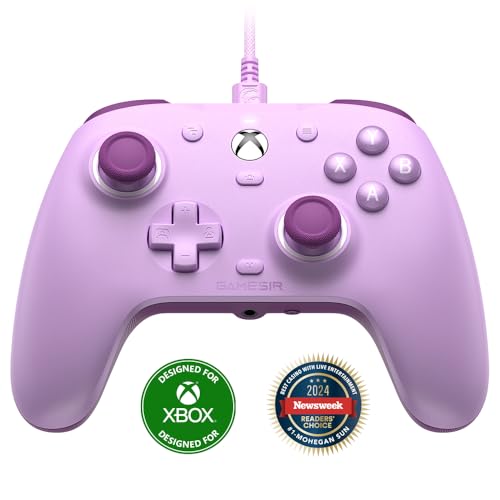
2. GameSir G7 SE Wired Controller
The drift-free workhorse that undercuts the big names on pure stick technology.
This is the controller that makes the 360 comparison sting the most. Hall Effect joysticks and Hall Effect triggers use magnetic sensing instead of wearing contact pads, which is exactly the failure point that turns an old 360 stick into a pulling mess. The spec sheet asks for far less money than the premium pads here and still delivers the anti-drift hardware. Owners describe it as a reliable daily driver rather than a showpiece.
Physical footprint is 3.39 x 4.69 x 6.34 inches, making it a compact companion for a desk or a small cabinet shelf. The full 420 g weight sits under the FLYDIGI VADER 5S at 450 g, so it feels marginally lighter on long PC sessions. Two custom back keys let you remap mid-game, and the pulse-type vibration trigger motors plus asymmetric grip motors give you separate feedback from each hand. An ultra-fine laser-engraved texture on the grip resists slipping without feeling abrasive.
The genuine sticking point is the wiring. The connectivity verdict lands firmly negative, with the recurring theme being the controller dropping out at the USB-C plug-in spot. A detachable cable means you can replace that cable rather than the whole pad, which is a real saving. But if you want a truly wireless living-room pad, this is not the one. Buy it if you play at a desk and want Hall Effect sticks without paying wireless-pad money.
The drift argument: for anyone whose 360 pad wanders on its own, magnetic Hall Effect sticks are the single most meaningful upgrade on this page — no rubbing parts, no gradual wear-in of the dead zone.
The cable caveat: the detachable USB design is genuinely useful when a cable frays, but the non-wireless build is the trade-off you are accepting for the drift-free sticks.
Best for: the desk-bound player who wants Hall Effect sticks without paying premium-tier money and will happily play wired.
Not for: couch players who need wireless freedom — the connection reliability at the USB-C plug is the recurring weak point.
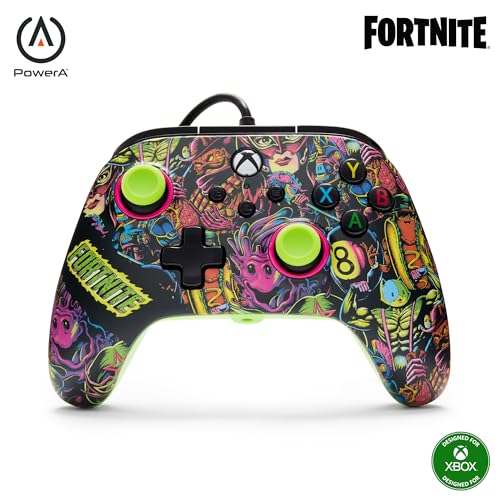
3. PowerA Advantage Wired Controller – Fortnite Glow
A glow-in-the-dark arcade piece with real trigger-lock hardware inside.
At 10.24 ounces this is the lightweight of the premium-leaning group, and that is 38% less weight than the Ice Breaker pad’s 14.08 ounces. A lighter shell is genuinely easier on your wrists across a four-hour session. The spec that earns the price though is the 3-way trigger locks, letting you set a short pull for shooters or full travel when a racing game needs throttle feel. Flip it mid-game and you feel the difference instantly.
Hall Effect modules (magnetic sensors that read stick position without physical contact) in the thumbsticks mean the drift problem the 360 era bequeathed is addressed at the source. The dual rumble motors and rich impulse triggers add feedback that a plain 360 pad simply cannot produce. Two mappable buttons program on the fly, so you can bind jump or crouch without diving into system menus. There is also the glow angle: a glow-in-the-dark effect plus a fluorescent reaction under UV light, and a code for the Moon Bounce Emote.
Owners single out the button layout for praise, and quality and value both land as positives. The realistic caveat is durability over months, not days. Buttons sticking after a stretch of use is the recurring note, and one unit stopping within a week is the kind of outlier every controller line sees. Officially licensed by Xbox and carrying a 2-Year Limited Warranty, this sits best with the player who wants their setup to look like an arcade cabinet.
The trigger advantage: three lock positions is a feature the 360 design never had, and it is the fastest way to shorten shot travel in an FPS without opening a settings menu.
What to accept: a glow finish and a limited-run theme make this a look-at-me pad; if you want a quiet black controller, this is not the brief.
Pick this for: a Fortnite player who wants trigger locks, back buttons and a setup that lights up under UV.
Think twice if: you need a plain-looking controller or you already know you are rough on buttons.
4. FLYDIGI VADER 5S Wired Controller
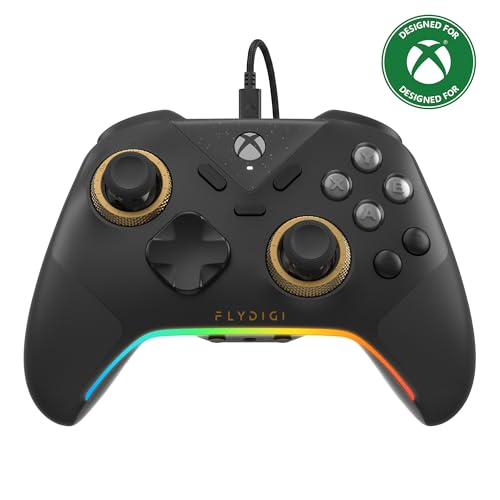
Tune the sticks from 40gf to 100gf and swap trigger feel without touching software.
The number that matters here is 40gf to 100gf — the physical joystick tension range you can adjust on the fly. Lighter tension for fast FPS flick shots, tighter tension for racing and sports precision. No ordinary Xbox controller lets you change that without opening software or replacing parts, and it is a genuinely different proposition from the fixed-tension 360 pad. Hall Effect sticks handle the drift question at the same time, with zero deadzone claimed.
Trigger response switches too: micro-click triggers for rapid firing, or Hall Effect linear triggers for smooth throttle and braking. The 4-motor vibration setup puts motors in both triggers and both grips, so recoil and road feel arrive from the right places. Six remappable buttons, 17 buttons total, and on-controller profile switching mean you can adjust volume, remap, or change vibration mid-match. Weight comes in at 450 g, which is 7% heavier than the GameSir G7 SE at 420 g.
The honest friction is the wiring again, and it bites harder here. Connectivity lands as a clear negative — random disconnects during play, plus the simple fact that it is not wireless at all. Reliability reports split roughly down the middle, with some pads working perfectly and others failing to power on. Ergonomics and button mapping, by contrast, are the things players single out, with the extra buttons near A and B getting specific praise. It suits the player who treats a controller as a tuning platform.
Why tinkerers love it: adjustable tension and a trigger-mode switch in one pad means separate setups for shooters and racers are no longer necessary.
The honest friction: a wired-only pad with reported disconnects asks you to accept a tether and a bit of risk for the tuning depth.
Your match if: you jump between FPS, racing and sports and want to dial in stick and trigger feel per genre.
Your mismatch if: you want wireless play or you are not willing to gamble on a split reliability record.
5. Xbox Wireless Controller – White

The white default that has become the safe, do-everything family-room pad.
Twenty buttons, Bluetooth wireless, and up to twice the wireless range of previous Xbox One controllers — tested on an Xbox One S console, per the maker. That range claim is the practical fix for the 360-era habit of sitting close to the TV. Textured grip keeps the shell steady in sweaty hands, and it pairs with Windows PCs and tablets over Bluetooth without a dongle.
The colour is what buyers mention most. It shows up exactly as pictured, and the colour draws steady praise — the red version gets specific shout-outs alongside the white. Kids take to it, which is a real consideration for a shared console. At 1.2 pounds it is a chunky pad, so it feels substantial rather than delicate in smaller hands, for better and worse.
The recurring gripe is longevity. Joystick wear and a right bumper giving out after a couple of months appear often enough to be a pattern, and the headphone jack is a noted weak spot on some units. Wireless dropouts also come up. None of that makes it a bad pad from the start — it works exactly as needed for plenty of households — but it is a pad you buy for straightforward reliability, not for a decade of hard competitive use. For a family console that gets weekend use, it does the job.
The household case: Bluetooth pairing to PC and tablet without a dongle, textured grip, and a range improvement over older Xbox One pads make this the low-friction choice for a shared living room.
Buy with eyes open: stick and bumper wear over months is a real risk, so this is not the pad for someone grinding ranked every night.
Go here for: a straightforward wireless pad for a family console, and a colour that actually matches the living room.
Hold off if: you expect years of hard daily play from one pad — the joystick and bumper wear reports are worth heeding.
6. Xbox Wireless Controller – Black
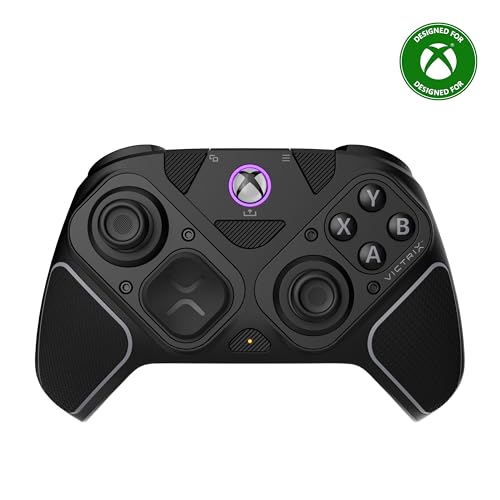
Swap the stick and fightpad modules and turn one controller into three.
Three customizable modules with built-in Hall Effect technology is the reason this exists. The ergonomically enhanced 6-button fightpad module with Kailh microswitches turns the pad into a fighting-game tool, and 11 interchangeable components let you rearrange the layout to taste. Five-stop Hall Effect clutch triggers with a hair-trigger mode give you a travel range the 360 pad never offered. At 9.28 ounces it is the lightest premium pad here.
Connectivity is the flexible part: wired and wireless with up to a 20-hour rechargeable battery is a real middle ground between the 40-hour pads and the wired-only crew. Four mappable quick-action buttons and the 3.5mm audio jack with a lifetime Dolby Atmos subscription cover competitive and home-theatre needs. A carrying case and module tool ship in the box, and the Victrix Control Hub app handles profile work on Xbox and PC.
Owners praise the build quality and the depth of customisability, with the grip drawing specific affection. The rough edges are the triggers and the back buttons — some find the rear buttons intrude on normal play, and trigger reliability is a split call. Value also splits, since this is premium-tier money and not everyone feels it earns that. It suits a player who wants to fight one night and shoot the next with genuinely different hardware.
One pad, three shapes: the interchangeable modules and 11 components are the reason to buy — nothing else here lets you physically reconfigure the layout.
The reach problem: rear buttons getting in the way of regular play is the honest ergonomic trade-off of a 4-button competitive layout.
Buy it if: you play both fighting games and shooters and want one controller that physically changes shape between them.
Leave it if: you want a fixed, simple layout without extra paddles near your grip.
7. Nacon Revolution X Unlimited

An LCD screen on the controller itself, plus 1ms wired latency and over 60 hardware combinations.
Latency is the spec that jumps out: ultra-low at 1ms wired and 2ms wireless. For a player who blames every missed shot on input delay, that is the number to look at, and it is a world away from what a stock 360 pad could offer. Hall Effect magnetic technology covers both joysticks and triggers, aimed squarely at preventing drift. Four vibration motors split between the handles and triggers add another layer of feedback.
The physical customization is unusually deep. A 4-way or 6-way D-pad, 3 sets of weights, 3 sets of joystick heads (concave, convex, high-dome), 2 sets of joystick rings, a storage case, and more than 60 combinations between them. An LCD screen on the pad handles mapping, audio mixing, and profile work without a PC. Six mappable shortcut buttons can carry keyboard commands in PC mode, and a 10-hour battery plus charging station keeps it topped up between sessions.
Weigh the caveats honestly. Connectivity is the repeated frustration — wireless drops and disconnections, even though some users report perfect connections. Stick drift still shows up despite the magnetic design, and the lower back paddle buttons are awkward to reach for some hands. The shape suits larger hands particularly well. At 230 g it is by far the lightest controller in this group, which changes the feel entirely depending on what you are used to.
The latency pitch: 1ms wired is the headline for competitive play, and the LCD screen means you tune without leaving the sofa.
The gamble: deep software features do not cancel out the mixed wireless reliability, and drift still appears on some units despite the Hall Effect design.
For the tweaker: you want to fine-tune weights, stick heads and button mapping on the controller itself, and you accept premium money for it.
For most players: the mixed connectivity and button-placement notes make the mid-range Hall Effect pads an easier recommendation.
Know the Specs
Hall Effect Sticks and Stick Drift
Traditional thumbsticks use potentiometers — contact surfaces that rub as the stick moves, which is why a heavily used pad slowly starts to drift. Hall Effect sticks sense movement magnetically with no contact, so there is nothing to wear down. Drift is the slow wander of the in-game camera or crosshair when your thumb is not touching the stick, and it is the number-one reason people replace a controller. Look for “Hall Effect” explicitly in the listing — several picks here have it and several do not.
Trigger Locks and Travel Distance
A trigger lock (or trigger stop) lets you shorten how far the trigger pulls before the input registers. Short travel means the shot fires faster in shooters; full travel gives you the analog range racing games rely on for throttle control. Multi-position locks let you change that between games without swapping controllers. A pad with trigger stops covers both jobs; a pad without them is one fixed feel.
Wired vs Wireless Connection
Wired pads trade freedom for consistency — no battery to charge, no dropouts, but cable and port wear over time. A detachable USB cable is a small but meaningful detail, because a frayed cable can be swapped without replacing the whole controller. Wireless pads add battery hours into your routine, and the listed ratings range widely here. Choose based on where you actually play: a desk setup suits wired, a living room usually wants wireless.
Weight and Long-Session Comfort
Weight is a feel decision, not a quality decision. Heavier pads feel planted and steady, which some players prefer for precision aiming. Lighter pads reduce wrist fatigue over long sessions and suit smaller hands. The weights vary widely here, so try to match the pad to how long your typical session runs rather than to a spec sheet number.
Common Questions
Will an Xbox One controller work with games built for the 360?
Are Hall Effect sticks really immune to drift?
Do I need trigger locks if I mostly play shooters?
How many hours of battery should I expect from a wireless controller?
Is a heavier controller better for competitive play?
Can I use these controllers on PC as well as console?
What is the difference between back buttons and paddles?
Should I replace a controller with drift or try to repair it?
How long should a modern Xbox controller last?
Can I use a 3.5mm headset with these controllers?
The Bottom Line
For most players upgrading from a 360 pad, the xbox one controller vs 360 winner is the Xbox Wireless Controller Ice Breaker Special Edition. The 40-hour battery, textured triggers, and console-PC-cloud switching cover everything a 360 pad could not, and it is why it takes the top spot. If drift is the thing that broke your last pad, reach for the GameSir G7 SE — Hall Effect sticks and triggers at mid-range money are the smartest anti-drift spend here. And for the player who wants to dial in stick tension and trigger travel per game, the FLYDIGI VADER 5S is the tinkerer’s pick.
How we choose
We do not accept paid placement. Every pick is matched to a real buyer and a real use-case; we do not hands-on test units.
Sources
Specifications: manufacturer listings and product documentation. Review insights: verified customer reviews, as of November 2026. Pricing: not shown on this page (it changes often); check the current price via the retailer link.
As an Amazon Associate, Gamepad Test earns from qualifying purchases. This does not affect which products we feature.