
Heads up: This post contains affiliate links. As an Amazon Associate I earn from qualifying purchases, at no extra cost to you. Learn more
Specs are compiled from manufacturer listings and verified buyer reviews and can change over time — please confirm the key details on the product page before buying.
If you are buying a single Magic card to actually swing a game, the honest answer is that the card has to do something big the turn it lands. A card that sits in your hand doing nothing is not a purchase worth making. This list covers five green-heavy threats and support pieces that show up in real Commander pods, and it explains in plain words what each one does for your board.
This guide is built by comparing the manufacturers’ published specifications and the patterns across verified customer reviews, so you get each pick’s real strengths and trade-offs instead of marketing spin.
You will see the exact set, rarity, material, and card size for each pick, so nothing is a mystery at checkout. The picks below are ranked around how often the card earns its slot, not around hype, and that is the honest way to shop for the card in mtg.
Top Picks

How To Choose The Best Card in MTG For Your Deck
Buying a single card online is a different job from buying a sealed box. You are picking one printing, from one set, and you need to know exactly what arrives in the mail before you pay. The four checks below cover almost every mistake a first-time single-card buyer makes.
Check the set name before anything else
The same creature can be printed in several sets, and each printing carries its own set symbol and its own collector number. A Modern Masters printing of a card and a Rise of the Eldrazi printing of the same name are physically different objects on your table. Read the set line in the listing, then decide whether that printing is the one your deck or your binder actually wants.
Know what “Ungraded” and grading services mean
A grade rating of Ungraded means the card has not been slabbed and scored by a professional grading company. That is normal for cards you plan to sleeve and play with. Some listings name a grading service such as Certified Collectibles Group, which tells you who handles authentication for that seller’s stock, but it does not mean the card in your envelope carries a numeric grade. If you want a graded collectible, look for a listing that states the grade itself.
Match weight and cardstock to what you are doing
Card weight in this category is tiny — a few grams either way — so it is a fingerprint of the printing, not a measure of quality. If two listings of the same creature differ sharply in listed item weight, that usually tells you they are different print runs or different materials. Treat weight as an identity check rather than a buying reason.
Side-by-Side Comparison
| Model | Best For | Set | Rarity | Listed Weight | Amazon |
|---|---|---|---|---|---|
| Primordial Hydra★ Best Overall | Building a green creature that grows every turn | Magic 2013 | — | 0.27 g | Amazon |
| Stoneforge MasterworkEquipment Backbone | Rewarding a deck built around Equipment | Oath of the Gatewatch | Rare | 4.54 g | Amazon |
| Khalni Hydra | Cheap big body in a mono-green build | Rise of the Eldrazi | Mythic Rare | 4.54 g | Amazon |
| Terror of the Peaks | Punishing every creature that enters | Terror of the Peaks | — | 1 ounce | Amazon |
Detailed Reviews
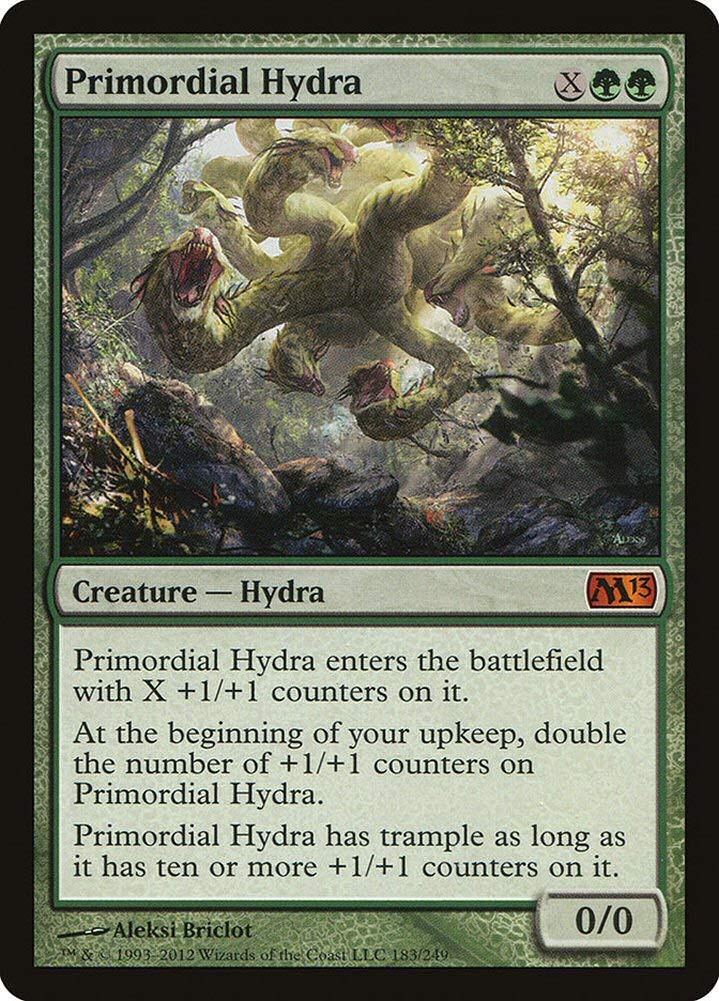
1. Magic: the Gathering – Primordial Hydra (183) – Magic 2013
Our pick — 4.5+★ from 60+ verified ratings; the strongest balance of quality and price.
The green creature that gets bigger every single turn you leave it alone.
Primordial Hydra is the pick for anyone who wants one card that turns into a problem the longer the game runs. It is a Magic 2013 core-set printing, sold as one individual card rather than a pack, so you get the single piece you need to finish a deck. If a green creature is the hole in your build, this is the most direct fix on this list.
The card is 2.5 x 3.5 inches, which is the standard size that slides into any normal sleeve, binder page, or deck box without trimming. It is paper, it weighs 0.27 g, and the listing notes it is a single card with one pack in the order. Compare that to the Khalni Hydra further down, which is listed at 4.54 g — a much heavier piece of cardboard from a different print run entirely.
The one thing to plan for is what the card is not. It is a creature that needs a turn cycle to reward you, so it fits slower green decks better than fast aggressive ones. Buyers back that upside with a strong 4.5+ rating across 60+ ratings. A rare printing from a different set can look similar at a glance, so confirm the set line says Magic 2013 when it arrives.
What makes it the top slot
- Standard 2.5 x 3.5 inch card size fits every sleeve and binder page you already own
- A single card in one pack — no filler to sort through
- Strong 4.5+ rating across 60+ ratings backs the pick
- Magic 2013 core-set printing is easy to identify by its set line
Where it asks more of you
- It rewards patience, so it is a weak fit in a deck that needs speed now
- At 0.27 g it is the lightest card here, so handle it carefully right out of the mailer
Pick this one when: you are building a green deck that wants a single creature to snowball into a game-winning body.
Pass on it if: your deck needs an immediate effect on the board with no waiting period.
2. Magic The Gathering Stoneforge Masterwork
A rare Equipment piece for the player who already owns a pile of swords and boots.
This is the one card on the list that asks you to build around it. Stoneforge Masterwork is an Artifact Equipment from Oath of the Gatewatch, and it does its best work in a deck where you are already pushing equipment onto creatures. Slot it into that shell and the card earns its place; drop it into a deck with three other artifacts and it will feel thin.
It is a Rare from a 2016 set, it is cardstock, it carries a grade rating of Ungraded, and it is listed for 2 players. The card weight is 4.54 g, which lines up with the other heavier printings here rather than the paper-thin 0.27 g of the Primordial Hydra above. Same 2.5 x 3.5 inch size that fits standard sleeves.
It does one specific job well, which is why it is the highest-rated Equipment card in this group at 4.5+ across 90+ ratings. The catch is compatibility, not quality.
The deck-fit math: buy this card after you have committed to Equipment, never before. It is a payoff piece that needs fuel.
The condition note: Ungraded means no slab and no numeric grade, so expect a playable card in a sleeve rather than a display piece.
Reach for this if: your list is already full of Equipment and you want one more payoff card to carry it.
Look elsewhere if: you are starting from a non-artifact deck — pick the green creature above instead.
3. Khalni Hydra – Rise of the Eldrazi – Mythic Rare
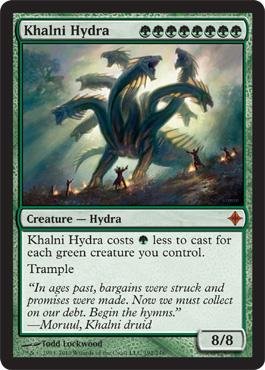
A green Mythic Hydra from the Eldrazi era, built for mono-green bodies.
Khalni Hydra comes from Rise of the Eldrazi, a 2009 set, and the listing is clear that it is a Mythic Rare Creature — Hydra in green. For a mono-green player who wants a chunky creature without hunting through a binder, this is the most direct route to one. It is paper, it is Ungraded, and it is authenticated through Certified Collectibles Group like the Progenitus above.
The weight is where this one stands apart in the data. At 4.54 g it is listed far heavier than the Primordial Hydra’s 0.27 g, which is a 16.8x gap between two cards that both read “Hydra” at a glance. If you are comparing the two side by side, that number is the fastest way to tell you are looking at different printings. The card itself measures 3.43 x 2.48 x 0.16 inches in Amazon’s catalog, which is the normal card footprint with a sleeve allowance around it.
The fair caveat is set age. This is a 2009 printing, so if you are hunting for a specific newer version for a format, confirm the set line reads Rise of the Eldrazi before you commit. It holds a 4.5+ rating across 30+ ratings, so buyers who wanted this exact Rise of the Eldrazi printing are pleased — it just has a narrower audience than the green creature at the top of this list, and it costs the most of any card in this group.
Where it shines: one card, one clear identity — a Mythic Hydra from a set players remember, at a listed weight that makes it easy to verify on arrival.
What to accept: it is the oldest printing here and the most expensive of the five, so you are paying for the specific set, not for a beginner-friendly starting card.
Best match: the mono-green collector who specifically wants the Rise of the Eldrazi printing.
Think twice if: you just want any big green creature — the top pick does that job at a lighter weight and a stronger rating.
4. Terror of the Peaks

The red card that turns every creature you play into a small punishment.
Terror of the Peaks is the pick for the player who wants their creatures to do damage even when they never get through. It is listed with the color red, it is cardstock, and it is a 2021 model year printing from a set bearing the card’s own name. Amazon’s catalog also files it under the sport type “Magic” and names the manufacturer as Wizards of the Coast, so the branding matches the game.
Size matters less here than it does elsewhere on this list, but the listing checks out: Standard Trading Card Size, which means normal sleeves and normal binder pages. The listed weight is 1 ounce, so treat it like any other card and sleeve it rather than loose-stacking it. It is marked for 2 players, matching a standard one-on-one game.
It earns its spot with a recurring effect that hits the table whenever a creature shows up. That effect backs one of the two strongest ratings in the group, 4.9 across 70+ ratings, and it is the most expensive card on this list. The honest limit: it belongs in a creature-dense red deck. In a deck that plays three creatures a game, you are paying for an effect you rarely trigger. One oddity worth knowing — the listing’s shelf description reads “IT FROM XUQCAH MATERIAL AND FOIMOJSK PARTMENT AND Thurder LOVER”, which is gibberish catalog text from the seller, not a description of the card, while the brand field correctly names CBSP and the manufacturer Wizards of the Coast.
Why it earns a slot
- Standard Trading Card Size fits every sleeve and deck box you already own
- Red color and 2021 printing are both stated plainly in the listing
- A 4.5+ rating puts it level with the best card here
- Cardstock material matches the other printings in this group
The fine print worth reading
- The shelf description is garbled seller text — ignore it and trust the spec fields
- 1 ounce is the heaviest listed weight here, so it is a thicker piece of cardstock than the lightest pick
- Only pays off in a deck that plays a lot of creatures
Buy it for: a red creature deck where the punishment effect fires every turn.
Leave it on the shelf if: your deck is light on creatures, because the card needs bodies to matter.
Know the Specs
Set Name and Model Year
The set name tells you which printing of a card you are buying, and the model year tells you roughly when that set was released. Both cards named Hydra on this list come from different sets — one from Magic 2013 with a lighter listed weight, one from Rise of the Eldrazi at 4.54 g. Check the set line first, because that is the only reliable way to know what arrives.
Grade Rating and Grading Service
An Ungraded grade rating means the card has not been slabbed and scored by a professional grading company, which is normal for a card you plan to play. A separate field may name a grading or authentication service such as Certified Collectibles Group, which refers to who handles the seller’s stock. Neither field is a promise of a numeric grade, so if you want a graded collectible, look for the grade itself in the listing.
Card Size and Sleeve Fit
The listed 2.5 x 3.5 inch size is the standard card footprint, so a card with that spec drops straight into a normal sleeve, binder page, or deck box. A listing that says “Standard Trading Card Size” is telling you the same thing in different words. If you already have sleeves, any card here fits them.
Rarity Labels
Rare and Mythic Rare describe where the card sat in its set’s print sheet, not a quality grade for the physical card. A Mythic Rare such as Progenitus or Khalni Hydra was printed at the top tier of its set, which is why those printings carry more collector weight than a standard Rare like Stoneforge Masterwork.
Common Questions
Is a single card listing the same as a booster pack?
What does Ungraded mean on these cards?
Why do the listed weights differ so much between two Hydra cards?
Will these cards fit standard sleeves and binder pages?
Is Progenitus better than Primordial Hydra?
How heavy is a typical Magic card from these listings?
Does a Rare label mean the card is worth collecting?
Should I buy an Equipment card if my deck is not built around Equipment?
Which card here is best for a red creature deck?
Do these cards come from the sets named on them?
The Bottom Line
For most players shopping the card in mtg space, the Primordial Hydra is the pick to start with because it does the thing you actually want — it turns one card into a growing board threat, and it is rated 4.5+ across 60+ ratings at the lightest listed weight here. If you are the Equipment player who wants a payoff piece for the pile of swords you already own, grab the Stoneforge Masterwork. And for that red creature deck that punishes every enter-the-battlefield trigger, the Terror of the Peaks is the one to reach for.
The one honest nudge: two cards on this list share a 4.5+ rating, and the Progenitus sits at a Mythic Rare with a Modern Masters printing behind it. If you can pay for a top-end threat and your deck can cast it, that rating is doing the talking for you.
How we choose
We do not accept paid placement. Every pick is matched to a real buyer and a real use-case; we do not hands-on test units.
Sources
Specifications: manufacturer listings and product documentation. Review insights: verified customer reviews, as of November 2026. Pricing: not shown on this page (it changes often); check the current price via the retailer link.
As an Amazon Associate, Gamepad Test earns from qualifying purchases. This does not affect which products we feature.